Scrofula is a term whose significance has varied much at different periods and in the usage of different writers. In its widest sense at the present day scrofula may be held to connote a disturbed condition of nutrition characterised by the occurrence of inflammatory or hyperplastic processes of a specific nature (see GERM THEORY) in the various tissues of the body. The tissues most frequently affected are the lymphatic glands, joints, bones, skin, and mucous membranes. The affection occurs most characteristically in the young subject. The older physicians (Hippocrates, Celsus) restricted scrofula practically to an inflammatory swelling of the lymphatic glands, more especially about the neck. Though frequent attempts were made to widen its significance so as to include supposed kindred processes in other structures, the old view remained dominant both in lay and medical parlance till recently. But the discovery in many so-called scrofulous manifestations of the presence of the Bacillus tuberculosis—the essential cause of tuberculosis (see TUBERCLE, CONSUMPTION)—has gradually modified the older conception and led to a recognition of the identity or at least the close relation existing between scrofula and tuberculosis. Hence many pathologists nowadays regard the tubercle bacillus as the one essential cause of so-called scrofula, and hold the latter (when used in the more limited sense of Hippocrates) as synonymous with a localised tuberculosis. Strong evidence may be advanced in favour of this view. Other pathologists regard the scrofulous tissue as a pretubercular manifestation, and suppose that the depraved structures afford a suitable soil or nidus on which the tubercle bacillus, whenever it obtains access, flourishes and multiplies, giving rise to tuberculosis proper. This subject will be therefore more fully treated under Tubercle (q.v.). Scrofula is synonymous with struma.
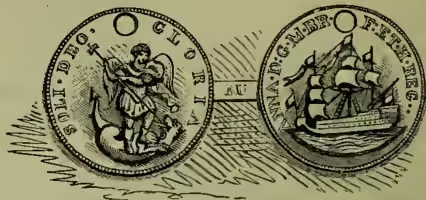
This disease for centuries was thought capable of being cured by the touch of a king, and it was claimed that this power was of English growth, commencing with Edward the Confessor, and descending only to such foreign sovereigns as could show an alliance with the royal family of England. But the kings of France claimed the gift, and it was certainly practised by Philip I., although he was allowed to have lost the power through his immorality. Laurentius, physician to Henry IV., claims that the power commenced with Clovis I., and says that Louis I. added to the touch the sign of the cross. He tells us also that Francis I. even in captivity preserved the power. In France it did not fall completely into disuse till 1776. William of Malmesbury is the first to mention the gift of healing in England and to attribute it to that most miserable of saints, Edward the Confessor. From his time down to Henry II. there is no account of the practice, but it reappears under Henry II., John, Edward II., Edward III., Richard II., Henry IV., V., VI., VII., and VIII., its truth guaranteed by grave and credible writers like Archbishop Bradwardine, Sir John Fortescue, and Polydore Virgil. Henry VII. was the first to institute a particular service of ceremony on the occasion of the touching; that used in Queen Anne's time will be found in the contemporary Prayer-books. In Henry's reign also the presentation of a piece of gold was first generally introduced, usually the angel-noble; but after the reign of Elizabeth the size of the coin was reduced for the sake of economy. James I. and Charles I. both touched, and we are told that the latter sometimes gave as his touch-piece silver instead of gold. But the practice reached its greatest height under Charles II., who even touched 260 persons at Breda before crossing to England, and we learn from the Charisma Basilicon, the third part of the Adeno-choiradelogia (1684) of the royal surgeon John Browne (1642–1700), that no fewer than 92,107 persons were touched between 1660 and 1682. Yet we learn from the Bills of Mortality that more persons died of scrofula during this period than any other, the evil having greatly increased during the king's absence. Browne's work is the best contemporary account of the rite that we possess. It is interesting that Sir Thomas Browne does not allude to the royal gift of healing, although there are allusions in his domestic letters to the practice of touching and to his granting the ordinary certificate as a physician. James II. also touched for the evil, but William III. put an end to the practice. Anne renewed it, and we read how on March 30, 1714, she touched 200 persons, among them Samuel Johnson, whom, however, she did not heal. With the accession of the House of Brunswick the practice entirely ceased, but it seems that the Pretenders for some time attempted to maintain it, and we are told that the prince Charles Edward touched a child at Holyrood in 1746, which was healed within 21 days after. In 1748 the nonjuring historian Thomas Carte lost his subsidy from the Common Council of London for a note in the first volume (December 1747) of his History of England to the effect that a man had been cured of the king's evil by the touch of the Pretender at Avignon in November 1716. We find frequent allusions to the practice in Pepys and Evelyn, and indeed it was for centuries an article of popular belief, so that we need not wonder at the credulous warmth of Heylin, Sergeant-surgeon Wiseman, and Jeremy Collier. See T. J. Pettigrew, On Superstitions connected with Medicine and Surgery (1844).
SCROFULOUS or Tuberculous Diseases occur similarly in cattle, sheep, pigs, and less frequently in horses and dogs. See at CONSUMPTION the section on consumption in the lower animals.