Goat (Capra), a genus of ruminant ungulates, nearly allied to sheep. The horns, which consist of a solid core of bone and a horny sheath around this, differ from those of sheep in their position on the top of the head, in their backward curvature, and in being laterally compressed. They are roughened by transverse ridges, and are either keeled in front as in the common goat, or broad anteriorly and triangular in section as in the ibex. Though present in both sexes, they are larger (up to 3 feet) in the males, who use them as weapons in contests with rivals or foes. Goats are further distinguishable from sheep by the arched forehead, the straight nose, the beard on the chin, the short erect tail with little hair, the general absence of tear-pits and interdigital glands, the nature of the hair, which can hardly be called wool, and the disagreeable odour, which is especially strong during the breeding season. The curious, confident, capricious temperament of the goat is also different from that characteristic of sheep; but in regard to this and most of the other characters it must be allowed that they are not constant, and that the two types are very nearly allied.
Goats are confined to the mountainous parts of the Old World, where they are found throughout the south European alpine region, from Spain to the Caucasus, and thence onwards through Armenia and Persia to the Himalayas and China. With the exception of a Neilgherry goat and an Abyssinian ibex, they are confined to the palearctic geographical region. Their remains are found in the Indian Pliocene, if not also Miocene deposits, and include a hornless form, Bucapra daviesii.
Goats are characteristically mountain-loving animals, climbing and leaping with marvellous dexterity. There does not seem sufficient warrant for believing the statement that the males of some species (e.g. C. egagrus or C. ibex) are able to save themselves in falling from a height by bending the head inwards and alighting on the massive horns. They feed on herbage of many kinds, and are unfortunately fond of young shoots of trees. The herds are usually small; the old males are cross and combative; the old females are said to act in turn as sentries; the kids are very agile and graceful. The males differ from the females in having stronger horns, thicker manes, and in slight colour distinctions. The breeding season is in autumn; the gestation lasts five months; the birth is single or double; and the kids follow the mother a few days after birth.
Goats have highly-developed senses of sight and smell, and are in many ways highly successful animals, swift in flight, bold in necessary attack, and well-adapted to their natural surroundings and mode of life. For general cleverness of climbing goats are deservedly famous, and in captivity they often exhibit daring and cunning. Romanes cites a case of one ringing a door bell when hungry for dinner, and two instances of the reasonable behaviour of two goats which met face to face on a narrow, rocky ridge, where the only action consistent with the life of both was that one should walk over the other, as accordingly happened. Their roguishness often suggests a faint sense of humour.
The common domestic goat is a variety of the Wild Goat (C. hircus) which inhabits the Taurus and other mountains of south-west Asia. Compared with its ancestor, the domesticated form is somewhat degenerate, being much reduced both in general size and as regards its horns. The domestication must have taken place at a very remote period, and spread from the East, probably through Egypt, westwards. A great number of breeds now exist, the pedigree of which has been of course complicated by varietal hybridisation, and it is at least possible that other species, such as the Grecian ibex, may in some cases have co-operated in the process. A most important variety, formed into a breed by artificial selection, is the Angora Goat (C. hircus, var. angorensis), where almost the whole body is enveloped in that long, silky, white hair which is so familiarly valuable and comfortable. The Angora goat has been introduced into Cape Colony, Australia, and the United States. The Cashmere Goat (C. hircus, var. laniger), from Tibet and Bokhara, is almost equally valuable, furnishing the white to brown hair used in making Cashmere wares. It has been successfully acclimatised in France. A third variety, utilised in the same way, is the Mamber Goat (C. hircus, var. mambrica), from Asia Minor and Tartary, distinguished by its long pendent ears. The Syrian goat, which also has long ears, is trained in the East to all manner of tricks—especially to balance itself on a slender pile of small wooden blocks, built up to a height of several feet.
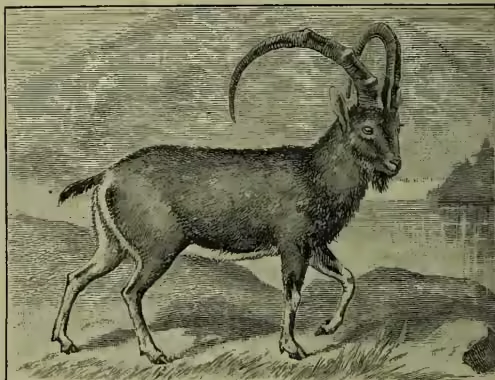
The Bezoar Goat, Grecian Ibex, or Paseng (C. egagrus), which ranges from the Greek Archipelago to Persia, was once in great repute on account of the supposed medicinal virtue of round concretions (or Bezoar balls, see BEZOAR) formed, as in many other ruminants, in the stomach. This is the wild goat that Homer refers to in connection with the Cyclops and Crete. The horns of the males bear strong tubercles in front; the beard is much developed; the general colour is reddish-brown, with dark stripes here and there.
The Markhor (C. falconeri or mcgaceros), from Tibet, Cashmere, and Afghanistan, is a strong, powerful goat, with corkscrew horns, much larger in the males, which are also distinguished by a thick mane on the neck and breast. Hunters credit it with killing and even eating serpents. Attempts at taming it in Europe have not been rewarded with much success.
The Alpine Ibex, or Steinbock (C. ibex), is typical of numerous goats which some separate off as a distinct genus. The chief difference is that the horns are broad in front, triangular in section, without a keel, but with a series of anterior transverse ridges. Different kinds frequent the lofty mountains of Europe and West Asia—C. hispanica or Izard in the Sierra Nevada, C. pyrenæica in the Pyrenees, C. caucasica in the Caucasus; but the distinctions are trivial, if not merely varietal. The Alpine ibex is a magnificent goat, without beard, but with very strong, slightly divergent, much-ridged horns. It used to be abundant, but through over-hunting, both for sport's sake and on account of supposed medicinal virtues, has become nearly extinct. Victor Emmanuel saved it in fact just in time by strict preserving, and small herds, amounting in all to about 300, still live on the heights between Piedmont and Savoy, especially in the Val-de-Cogne. Attempts at reintroduction have not been successful; in captivity the animals tend to become vicious, and the same is markedly true of hybrids between it and the common goat. In its native haunts it is said 'to surpass even the chamois in the certainty with which it estimates distances for extraordinary leaps.'
Goats can be kept with advantage in situations too rocky, or where the herbage is too scanty, for oxen or sheep. They were formerly kept in greater numbers in Britain than they now are. The goat is capable of the most perfect domestication, and becomes extremely attached and familiar. It is apt, indeed, to prove a troublesome pet, and makes use of its horns, although not angrily, much more freely than is at all agreeable. Goat and sheep may be successfully crossed, and the hybrids are to a certain extent fertile among themselves.
The uses of the goat are numerous. The flesh is good; that of the kid, or young goat, is in most countries esteemed a delicacy. Requiring but little attention, and able to subsist on rough diet, the goat is in many countries 'the cow of the poor.' The milk is very rich and nutritious, more easy of digestion than that of the cow, and often useful to consumptive patients. Some goats yield as much as four quarts of milk daily, although the average quantity is more nearly two. Both cheese and butter are made of goats' milk; they have a peculiar but not disagreeable flavour. Goats' milk is still very much used in Syria and other parts of the East, as it was in the days of the patriarchs. The skin of the goat was early used for clothing, and is now dressed as leather for many uses, particularly for making gloves and the finer kinds of shoes (see GLOVES). The hair, which may be advantageously clipped annually, is used for making ropes which are indestructible in water, and for making wigs for judges, barristers, and other functionaries. For the latter purpose the hair of white goats is used. Especially valuable of course are the Angora and Cashmere varieties. The horns are used for making knife-handles, &c., and the fat is said to be superior to that of the ox for candles.
Goats are sometimes employed in drawing children's coaches, to which as many as four are sometimes harnessed together, and they are sufficiently tractable and obedient to the rein.
But the economic importance of the goat is not altogether on the side of utility. It ruins young plantations and makes reforesting in some cases impossible. According to Carl Vogt, the legend that the devil created the goat is justified by the animal's pernicious influence: 'It is the most destructive creature in the world in forests, and the old seats of civilisation—viz. the countries round the Mediterranean—owe the destruction of their forests, the nakedness of their mountains, and the inevitable consequence of that condition, the dryness of their climate, to the devastations of these animals.' In the same connection it may be noted that the goat, as destructive of the vine, was sacrificed in ancient times to Bacchus. Spain has about 4,000,000 domestic goats; Germany, Greece, and Italy each some 2,000,000. See ANGORA GOAT, ANTELOPE, ARTIODACTYLA, CASHMERE GOAT, SHEEP. The Rocky Mountain Goat (q.v.) is an antelope rather than a goat. The izard is the ibex of the Pyrenees. See Pegler's Book of the Goat (new ed. 1886).