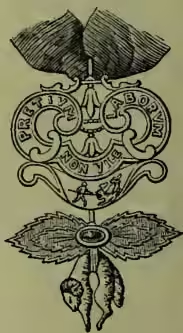
Golden Fleece (Fr. toison d'or), in Greek tradition, the fleece of the ram Chrysomallus, the recovery of which was the object of the famous expedition of the Argonauts (q.v.). The Golden Fleece has given its name to a celebrated order of knighthood in Austria and Spain, founded by Philip III., Duke of Burgundy and the Netherlands, at Bruges on the 10th January 1429, on the occasion of his marriage with Isabella, daughter of King John I. of Portugal. This order was instituted for the protection of the church, and the fleece was probably assumed for its emblem as much from being the material of the staple manufacture of the Low Countries as from its connection with heroic times. The number of the knights was thirty-one, and they themselves filled up vacancies by vote. This continued till 1559, when Philip II. of Spain held the last (the 23d) chapter of the order in the cathedral of Ghent; and subsequently Philip obtained from Gregory XIII. permission to nominate the knights himself. After the death of the last Hapsburg king of Spain in 1700, the Emperor Charles VI. laid claim to the sole headship of the order in virtue of his possession of the Netherlands, and, taking with him the archives of the order, celebrated its inauguration with great magnificence at Vienna in 1713. Philip V. of Spain contested the claim of Charles; and the dispute, several times renewed, was at last tacitly adjusted by the introduction of the order in both countries. The insignia are a golden fleece (a sheepskin with the head and feet attached) hanging from a gold and blue enamelled flintstone emitting flames, and borne in its turn by a ray of fire. On the enamelled obverse is inscribed Pretium laborum non vile. The decoration was originally suspended from a chain of alternate flints and rays, for which Charles V. allowed a red ribbon to be substituted, and the chain is now worn only by the Grand-master. The Spanish decoration differs slightly from the Austrian.
The costume consists of a long robe of deep red velvet, lined with white taffetas, and a long mantle of purple velvet lined with white satin, and richly trimmed with embroidery containing firestones and steels emitting flames and sparks. On the hem, which is of white satin, is embroidered in gold, Je l'ay empris. There is also a cap of purple velvet embroidered in gold, with a hood, and the shoes and stockings are red. See Reiffenberg, Histoire de l'Ordre de Toison d'Or (1830); and Zoller, Der Orden vom Goldenen Vlies (1879).