Goosander (Mergus merganser), a web-footed bird in the duck family (Anatidae), in the same genus as the Mergansers, of which it is the largest British representative. The adult male, which measures 26 inches in length, has the head and upper part of the neck of a rich shining green, the feathers of the crown and back of the head elongated, the back black and gray, the wings black and white, the breast and belly of a delicate reddish-buff colour. The bill, legs, and feet are orange-red. The female, which is rather smaller, has the head reddish-brown, with a less decided tuft than the male, and much grayer plumage. The edges of the bill are saw-like above and below, being covered with numerous sharp tooth-like projections directed backwards. The goosander is a native of the Arctic regions, extending into the temperate parts of Europe, Asia, and America.
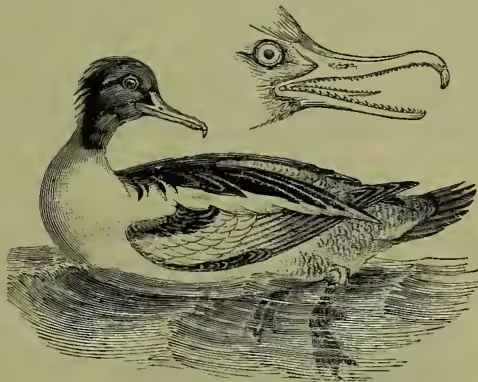
In the southern parts of Britain it is seen only in winter, and then only in severe weather, the females and young migrating southwards more frequently than the old males, and not unfrequently appearing in small flocks in the south of Scotland and north of England. In some of the estuaries and fresh-water lakes in the northern parts of Scotland it spends the whole year. It usually nests under a ledge of rock, in the hollow trunk of a tree, or under the shelter of the twisted roots, and lays, about the end of April, eight to thirteen creamy-white eggs. It feeds almost entirely on living fish, which its serrated bill and its power of diving admirably adapt it for catching. The flesh of the goosander is extremely rank and coarse.