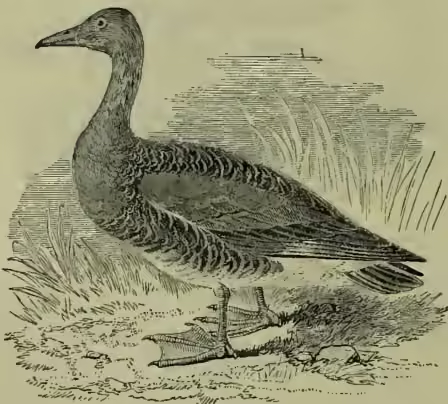
Goose (Anser), a genus of web-footed birds belonging to the duck family (Anatidae). The bill is rather high at the base and not longer than the head; the upper part of the beak is slightly hooked, and the lamellæ, characteristic of all the duck tribe, are short, tooth-like, and altogether adapted to cropping the grass and other herbage on which the geese chiefly feed. The feet are short and completely webbed; the hind-toe is present; and the legs are placed comparatively far forward, so that the movements on land are less awkward than those of most ducks. Geese swim little, and never dive. When migrating, or on other long flights, they usually fly in a double line, converging to form a more or less perfect wedge, led by a single gander. The genus is represented by over a dozen species occurring throughout the palaearctic and nearctic regions. Only one species is certainly known to nest in Britain—the Gray Laggooose (A. cinereus)—from which our common domestic goose is believed to be descended. This species used to breed abundantly in the fen districts of England, but has become very rare since the drainage of these parts. It still breeds, though not commonly, in the northern counties of Scotland and in the Hebrides, and large flocks are seen in winter in some of the central counties of Ireland. The nest is placed among heather or on a ledge of rock, and is made of reeds, moss, or grasses. The eggs, usually five to six in number, are surrounded by down plucked by the female from her own breast. The length of the adult male is about 35 inches; of the female, 30 inches; the plumage is grayish-brown on the upper parts, bluish-gray on the wing-coverts, dull white with black markings on the under parts; the feet, legs, and bill are flesh-coloured, and the nail at the tip of the bill is white. This last characteristic is shared by a smaller species, the White-fronted or Laughing Goose (A. albifrons), and by it these two may be readily distinguished from the other two common species which have the nail black. The white-fronted goose arrives in Britain every winter in large flocks as soon as severe weather sets in on the Continent. The male measures 27 inches; the prevailing colour is brown. The Bean Goose (A. segetum) and the Pink-footed Goose (A. brachyrhynchus) are closely-allied species, common in many parts of the country from autumn till late in spring. The bean goose is said to exhibit a fondness for newly-sown beans, among which it causes considerable havoc. Its plumage is darker than that of the preceding species; its length is 34 inches. It is readily domesticated. The smaller pink-footed goose has the legs and feet of a pink colour; the bill pink above, black at the base and edges; the nail, as in the bean goose, black.
A great rarity in Britain is the white North American Snow Goose (Chen hyperboreus), which is found all over North America, but breeds in the far north. The Canada Goose (Bernicla canadensis), found all over North America (where it is the commonest wild goose), is partially domesticated in Europe, where it breeds freely. Among the sea-geese the genus Bernicla, represented by our Barnacle Goose (q.v.) and Brent Goose (q.v.), must especially be noted. In other genera there are many interesting forms which can only be mentioned. The Egyptian or Nile Goose (Alopochen aegyptiaca), which is often seen figured on Egyptian monuments, was the 'fox-goose' or 'chenalopex' of the Greeks, so called perhaps on account of the burrows in which it breeds or the fox-like colour of part of its plumage. It is frequently kept in confinement, and finds its nearest relative in the Orinoco Goose (Alopochen jubata) of north-east South America. Notable also is the African Spur-winged Goose (Plectroterus), in which the corner of the wing bears a strong spur. Very unique, with sharply-clawed and only slightly webbed toes is the Semi-palmate Goose (Anseranas semipalmatus) of Australia, which in habit and anatomy suggests a crane. Also Australian and very peculiar is the sluggish and heavy, thick-billed Cape Barren Goose (Cereopsis novaehollandiae), rapidly becoming scarce (see CEREOPSIS). Finally this last form leads us to the yet more remote Cnemionis, which formerly inhabited New Zealand, but having wholly lost the power of flight naturally became extinct.
Although the common goose has been long domesticated, and was probably among the very first of domesticated birds, the varieties do not differ widely from each other. Emden Geese are remarkable for their perfect whiteness, Toulouse Geese for their large size. As a domesticated bird the goose is of great value, both for the table and on account of its quills and fine soft feathers. The quills supplied all Europe with pens before steel pens were invented, and have not ceased to be in great demand. Geese must have free access to water, and when this is the case they are easily reared and rendered profitable. Two broods are sometimes produced in a season, ten or eleven in a brood, and the young geese are ready for the table three months after they have left the shell. They live, if permitted, to a great age. Willughby records an instance of one that reached the age of eighty years, and was killed at last for its mischievousness. Great flocks of geese are kept in some places in England, particularly in Lincolnshire, and regularly plucked five times a year for feathers and quills. Geese intended for the table are commonly shut up for a few weeks, and fattened before being killed. Great numbers are imported from Holland and Germany for the London market, and fattened in England in establishments entirely devoted to this purpose. Michaelmas is the great goose season. Goose-hams are an esteemed delicacy. The gizzards, heads, and legs of geese are also sold in sets, under the name of giblets, to be used for pies. The livers of geese have long been in request among epicures both ancient and modern. The pâté de foie gras of Strasburg is made from livers in a state of morbid enlargement, caused by keeping the geese in an apartment of very high temperature. See BARNACLE GOOSE, CEREOPSIS, DUCK, SWAN.