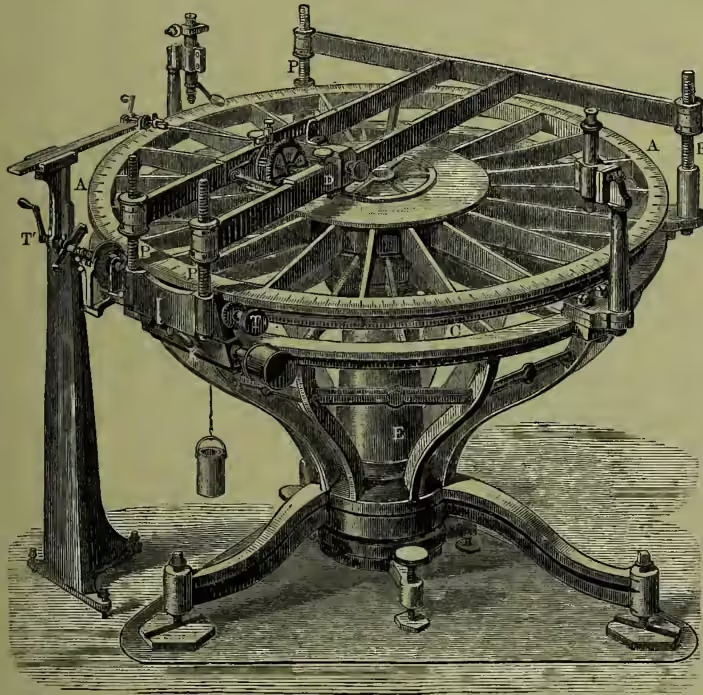
Gräfenberg, a village in the north-west corner of Austrian Silesia, 50 miles N. of Olmütz. It is celebrated as the spot where the water-cure (see HYDROPATHY) was introduced in 1826 by Vincenz Priessnitz (1799-1851). It still is visited yearly by some 1500 persons. on any work laid on the divided circle. Fig. 2 represents one form of the instrument. A, A is the circle, usually 4 or 5 feet in diameter, divided at its edge, and ratched into teeth at its lower edge, C. The axis of the circle is in the column, E. TT' is the tangent-screw; T', a handle for turning it; T, a disc-shaped head, the divisions on the circumference of which allow of the number of whole and fractional turns of the screw being counted. The carriage, D, in which works the dividing-knife (not seen in the figure), may be adjusted to different heights by the screws on the pillars, P, which support the parallel beams on which the dividing-knife carriage moves; it may also be adjusted to circles of different radii