Grafting, a mode of propagation applicable to all kinds of trees and shrubs, and even herbaceous plants whose tissues are firm. The operation consists in the inserting of a branch or bud (scion) of one tree into some part of another tree (stock), so as to bring about a union of the two. The practice of grafting is doubtless one of great antiquity, and its origin may in all probability be traced to a natural process which is of frequent occurrence. It has been observed that, when two branches of a tree or branches and even the stems of kindred trees growing closely together overlap and touch each other, the bark becomes wounded or abraded, and the returning juices exuding from the ruptured vessels in the Alburnum (q.v.) produce granulations by which a perfect incorporation of structure is effected, and the parts become one. The object of grafting is, first, to perpetuate and increase the stock of varieties and sub-varieties of fruit-trees, the innate qualities of which cannot be transmitted with certainty to their progeny by seeds, and which would be more slowly and less surely multiplied by any other artificial mode of propagation; secondly, to increase and accelerate the fruitfulness of fruit-trees—for, the elaborated sap being impeded in its descent at the junction of the scion with the stock, the process of maturation is thereby promoted, and fertility more largely and quickly induced. Old and unfruitful trees, whose stems and roots are vigorous and healthy, may be rendered fruitful in the course of two or three years by having their tops cut back and re-grafted with scions from a fruitful and healthy tree. Grafting is also employed for the purpose of dwarfing fruit-trees, while at the same time abnormally increasing their fruitfulness. This is attained partly by the selection of a stock which exerts a restrictive influence on the scion, and by double grafting—i.e. grafting twice or oftener at will. Very young trees are thus rendered prodigiously fruitful, and are in demand for the purpose of pot culture and planting in orchard-houses. Trees damaged by wind or otherwise have their injuries repaired by grafting, and those that are unequally balanced may be brought to perfect symmetry by the judicious insertion of scions in the ill-furnished parts.
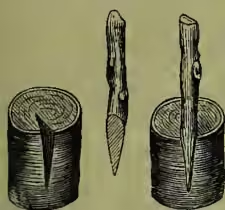
In grafting it is particularly to be attended to that the alburnum of the scion is brought into contact with that of the stock. The hard wood of the one never unites with that of the other, remaining separate and marking the place of the operation even in the oldest trees. For scions or grafts, pieces of about six to eight inches long are generally taken from the shoots of the previous summer, with several buds; but portions of shoots of two years old are sometimes successfully employed. The time for grafting is in spring, as soon as the sap begins to appear. The scion should, if possible, be taken from a healthy and fruitful tree, but scions from the extremities of lateral branches are more likely to become speedily fruitful than those from the uppermost branches, where growth is most vigorous. The scion should be kept for a few days before grafting, so that the stock may rather exceed it, not only in vigour, but in the progress of its spring growth; and for this purpose it may be placed in the ground, in a rather dry soil, sheltered from the direct rays of the sun. Scions may be kept for some time, and easily carried to a distance, by sticking their lower end into a potato or moist moss or clay. The end should always be freshly cut off when the scion is to be used. There are various modes of grafting. Cleft-grafting (fig. 1) is very commonly practised when the stock is very considerably thicker than the scion. The stock, being cut over, is cleft down, and the graft, cut into the shape of a wedge at its lower end by a sharp thin knife, is inserted into the cleft. This mode of grafting is particularly applicable to branches of large trees, when the introduction of a new variety of fruit or increased fruitfulness is sought.—Crown-grafting is used for still thicker stocks, which are cut across, and then cleft down by two clefts crossing one another at right angles, two scions being inserted close to the bark in each cleft; or no cleft at all is made, and any desired number of scions obliquely
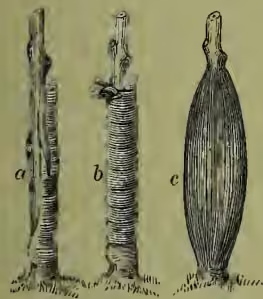
A slit or a very narrow angular incision is made in the centre of the stock downwards, and a similar one in the scion upwards, both having been first cut obliquely at corresponding angles; and, the tongue thus made in the scion being inserted into the incision in the stock, they are fastened very closely and thoroughly together. In saddle-grafting the end of the stock is cut into the form of a wedge, and the scion is affixed to it, the base of the scion having been cut or slit up for the purpose.—Shoulder-grafting, used chiefly for ornamental trees, is performed by cutting obliquely, and then cutting across a small part at top of the stock, so as to form a shoulder, the scion being cut to fit it.—Peg-grafting, not now much in use, is accomplished by making the end of the scion into a peg, and boring the top of the stock to receive it.
Whichever of these modes of grafting is adopted the graft must be fastened in its place by tying, for which purpose a strand of bast-matting is commonly used. The access of air is further prevented by means of clay, which has been worked up with a little chopped hay, horse or cow dung, and water, and which is applied to the place of junction so as to form a ball, tapering both upwards and downwards. In France a composition of 28 parts black pitch, 28 Burgundy pitch, 16 yellow wax, 14 tallow, and 14 sifted ashes is generally used instead of clay. The progress of the buds shows the union of the graft and stock, but it is not generally safe to remove the clay in less than three months; and the ligatures, although then loosened, are allowed to remain for some time longer. From some kinds of fruit-trees fruit is often obtained in the second year after grafting.
Budding (q.v.) is in principle the same as grafting; and flute-grafting is a kind of budding in which a ring of bark with one or more buds is used instead of a single bud, and, a stock of similar thickness having been cut over, a corresponding ring of bark is removed, and the foreign one substituted. This is commonly performed in spring, when the bark parts readily, and is one of the surest modes of grafting.—Inarching or grafting by approach, in which the scion is not cut off from its parent stem until it is united to the new stock, is practised chiefly in the case of some valuable shrubs kept in pots, in which success by the ordinary methods is very doubtful.
An effect is produced by the stock on the scion which it nourishes analogous to that of a change of soil; much of the vigour of a strong healthy stock is also communicated to a scion taken even from an aged tree. There is, moreover, in some degree, an influence of the elaborated sap descending from the scion on the stock which supports it. An important part of the practical skill of the gardener or nurseryman consists in the selection of the proper kinds of stocks for different species and varieties of fruit-trees. The stock and scion, however, must not be of species extremely dissimilar. No credit is due to the statements of ancient authors about vines grafted on fig-trees, apples on planes, &c., the semblance of which can only have been brought about by some delusive artifice; for all attempts at grafting fail except among plants of the same genus, or at least of the same natural family.
Herbaceous plants with firm stems, as dahlias, are sometimes grafted. Some kinds of plants, of small size, in pots, are placed in moist hothouses or hotbeds, under bell-glasses, whilst the junction of the scion and stock is going on, which in these circumstances takes place very surely and very expeditiously. But an accumulation of too much moisture under the bell-glass must be guarded against.