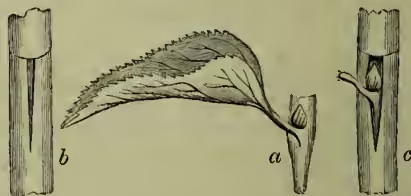
Budding, a process in the propagation of ligneous plants analogous to Grafting (q.v.). It consists in the transferring of a bud from one shoot to another on the same or different plants, although chiefly employed as the most rapid and economical method of increasing new and choice or rare kinds of fruit-trees and flowering trees and shrubs; it may also be used to improve the fruitfulness of barren fruit-trees, it being quite practicable to insert blossom-buds into the branches of trees that are deficient in them. Shield-budding, which is the most commonly practised of several modes, is preferred for fruit-trees with gummy sap, such as the plum, cherry, peach, and apricot, as it obviates the tendency in such trees to canker at the wounded parts. It may be performed at any time when the bark rises freely from the young wood. This it usually does from June to September, but the fitness of the bud for the operation is to be judged of solely by the freedom with which the bark separates from the wood. The bud must be well formed, but not necessarily mature. The subjoined cut represents the various parts in the mode known as shield-budding: a is the bud cut out, with a shield of bark attached to it; b, the stock, with a slit in the bark to receive the shield and bud; c, the bud inserted and the leaf cut away. The bud is cut by means of a sharp knife from the branch on which it has grown—usually a branch of the current year's growth—a small portion of the bark and wood being taken together, extending to about half an inch above and three-quarters of an inch below the bud. The woody part is then removed from the bark, taking care to prevent the base or root of the bud from being injured. If injured, the base will present the appearance of a circular cavity, which is caused by the removal of the centre or growing point of the bud, in which case it is worthless, and should be thrown away. A longitudinal and transverse cut in the form of the letter T, as shown at b, are then made in the bark of the stock to receive the bud; the thin ivory point of the handle of the budding-knife is used to raise the bark, and the bud is inserted. The bark extending above the bud is then cut over so as to fit exactly the transverse cut in the stock. A strand of soft matting or soft cotton-yarn is then wound firmly but not tightly around the stock to bind the bark down on that of the bud, in order to keep the latter in its place and prevent the access of dry air or heavy rains to the wounds. Of other methods of budding, the reversed shield is that commonly used by nurserymen and gardeners about Genoa in the rearing of orange-trees. The only difference between this and the mode first described is that the transverse cut in the stock is made at the bottom instead of the top of the longitudinal one. Scallopp-budding is another mode in which the wood adhering to the bark of the bud is not removed, but instead is carefully fitted to a corresponding section in the stock, made by the removal of a portion of the bark and wood. The fitting of the edges of the bark of the bud to that of the stock is essential to success in practising this method, but it is altogether less sure than ordinary shield-budding. It may, however, be performed in spring, and if it fails, the object in view may be attained by the other method during summer and autumn.