Grasshopper. a name given to numerous insects forming the family Locustidae, included in the order Orthoptera, and nearly related to Crickets (Gryllidae) and Locusts (Acridae). It is unfortunately confusing that 'locusts' are not included in the family Locustidae, and that one of our commonest grasshoppers is Locusta viridissima. It must be noted that in this article 'grasshoppers' mean the majority of Locustidae. Whether grasshoppers are herbivorous or, as is oftener the case, carnivorous, they usually live among vegetation, in woods and thickets or in the open field, keeping quiet during the day, but making the woodides merry with their love 'songs' in the summer evenings. Most of them feed on flies and cater- pillars, in catching which they use their powerful fore-legs, but many affect plants, and some combine both diets. During their courting season they may be seen flying even in the afternoon, but they are predominantly nocturnal and twilight insects. By their frequent green colour and yet subtler mimetic characters they are in many cases well concealed in their leafy haunts. The family is large and world-wide in distribution, but best represented in tropical and temperate regions.
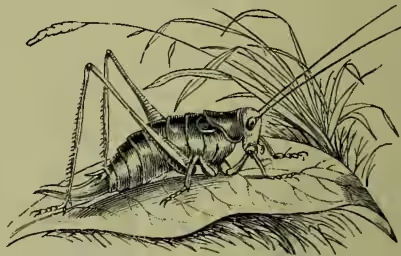
In the grasshopper family (Locustidae) the head is placed vertically; the slender antennæ are longer than the body; there are hemispherical eyes, but rarely eye-spots; wings and wing-covers are generally present. The right (and occasionally also the left) wing-cover of the male bears posteriorly a clear, round membrane stretched on a ring, which produces the well-known 'chirp' when set in vibration by the action of a serrated ridge on the under side of the opposite wing-cover. The left wing-cover is the bow, the right is the fiddle of the male grasshopper's music. There is usually a well-developed auditory organ at the base of the anterior legs. The females have a long ovipositor.
Sexually mature grasshoppers appear in late summer and autumn. The eggs are laid by means of the ovipositor either in the earth or in some dry stem. From these in spring larvæ are developed, which are virtually like the adults, but moult at least six times before they become full-grown.
The Great Green Grasshopper (Locusta viridissima), common in Europe, and occurring in Britain, has a body over an inch long. Equally large is Decticus verrucivorus, also British, which owes its specific title to the habit Swedish peasants have of making it bite their warts, which the secretion of a fluid from the mouth of the insect is said to affect favourably. Very common in Europe are Thamnotrizon cinereus, Platycleis grisea, and other species. Among American grasshoppers Conocephalus ensiger, type of those with a conical forehead, is very common, as are also various species of Xiphidiini and Orchelimum. The nearly allied Katydid—e.g. Cyrtophyllus concavus and Mierocentrum retinervis—will receive separate notice (see KATYDID). The tropical genus Copiphora is noteworthy for the length of its ovipositor, which sometimes attains a length of two inches, while Phyllophora and Phylloptera deserve mention for the exceedingly leaf-like appearance of their wing-covers. See CRICKET, KATYDID, LOCUST.