Grasses form the order Gramineæ, which with Cyperaceæ (Sedges) makes up the second great division (Glumaceæ) of Monocotyledons (q.v.). The first division (Petaloidæ) consists of orders whose flowers are of the lilaceous or orchidaceous type; while the flowers of Glumaceæ are best described as 'grassy.' The following characters are sufficient to distinguish grasses from sedges: grasses have generally cylindric or compressed jointed stems, usually with internodes becoming hollow; leaves alternate with sheath clasping the stem, but edges of sheath not joined; embryo at one side of the base of the endosperm (albumen). Sedges have generally triangular, sometimes cylindric, stems, jointed but solid; leaves in three vertical rows with leaf-sheath entire and forming a hollow cylinder round the stem; embryo within the base of the endosperm. The term 'grass' is often applied to any herbaceous plant that helps to form pasture, and agriculturists speak of natural and artificial grasses, the former only belonging to Gramineæ. Cereals (q.v.) and some pasture grasses are annual, but most pasture and woody grasses are perennial. Cereals and pasture grasses are herbaceous; bamboos are woody and may grow to a height of 100 feet in one season. There are 250 genera of grasses, and 3200 distinct species; of these 41 genera with more than 100 species are natives of the British Isles, and fully 800 species and varieties within the limits of the United States.
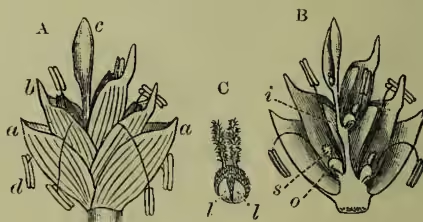
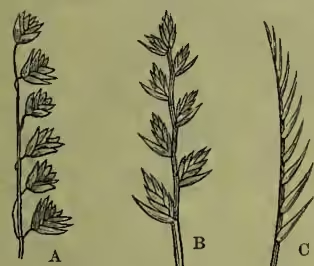
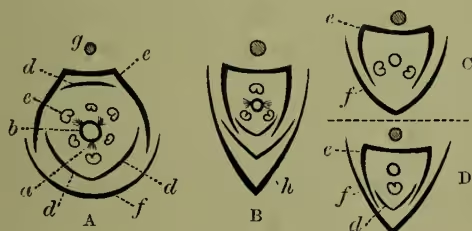
Description.—The leaves are long and tapering, one being given off at each node of the stem; the leaf-sheath is a modified stalk, and is often prolonged upwards for a short distance beyond its junction with the blade, into a membrane or ring of hairs (ligule), which forms a collar round the stem. The parallel veins of the leaves are continued downwards into the stem and anastomose only at the nodes. The stem (culm) at first consists of solid nodes and internodes, but the internodes, except in sugar-cane and a few other tropical grasses, become hollowed out, and thus the stem is rendered comparatively lighter, and at the same time better able to resist the lateral pressure of the wind; because a cylinder offers more resistance to pressure than does a solid rod of the same weight and kind of material. The stems of grasses are further strengthened by impregnation with silica. Annual grasses have tufted, fibrous roots, but most grasses perennate by means of solid underground stems (rhizomes), from the nodes of which roots are developed; roots also grow freely from the lower nodes of the aerial stems of all grasses. The flowers are mostly hermaphrodite, as in barley and oats; maize and a few others are monoecious; and some of the fescue tribe have the lower hermaphrodite and the upper male. Each flower is enclosed by two bracts (paleæ), which are the homologues of the two spathe-like bracts in the Inflorescences (q.v.) of Iridaceæ. The posterior bract is two-nerved, indicating its two-fold nature, and often clasps the fruit when mature; the anterior ('flowering glume') surrounds both, and sometimes bears an Awn (q.v.), as in barley. A number of flowers may be crowded together to form a spikelet; and, further, a number of such spikelets may be attached by stalks to a central axis, forming a raceme, as in Melica nutans (fig. 2); when the raceme is loosely branched, the inflorescence becomes a panicle, as in Oats (q.v.); or the spikelets may be sessile on a central axis, forming a compound spike, as in ryegrass (Lolium). The spike may be looked on as a reduced raceme or panicle, in which the stalks of the spikelets have not been developed; each spikelet may again be reduced to a single flower, and then a simple spike like that of mat-grass (Nardus stricta) is the result. Beneath the lowest flowers of many spikelets there are two bracts (glumes) which may or may not bear barren flowers in their axils. There is no perianth such as is found in most insect-pollinated flowers. Grass flowers are wind-pollinated and generally inconspicuous; in some, however, there are two or rarely three scales (lodicules) within the flower bracts; and these, from their position and relation to the other parts of the flower, may be regarded as segments of a rudimentary perianth. These scales, becoming turgid at the period of sexual maturity, press the anterior bract outwards, and expose stigmas and stamens for pollination. Should wet weather occur when this stage is reached the powdery pollen may become clogged and kept from being blown about; thus preventing fertilisation and the opportunity of producing seed.
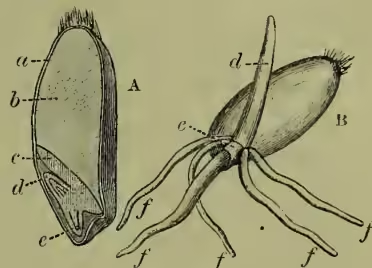
Stamens vary from six or more to one; in British grasses usually three, but three to one in the fescue tribe. The slender filaments are inserted at the bases of the anthers, but the anther lobes grow downwards below the point of insertion, and the anthers appear to be, but are not, versatile. The ovary is one-celled; there are three or two styles, with long and hairy, or short and feathery stigmas, which are thus enabled to catch the wind-borne pollen. The fruit is one-seeded (caryopsis); the seed is adherent to the pericarp. The embryo by the great development of the farinaceous endo- spikelet surface to the embryo, digesting the substance of the endosperm, and passing it on in a soluble state to the embryo, which soon begins to develop roots and leaves. When all the endosperm has been used up the seedling grass has put forth roots enough to draw a sufficient supply of sap from the soil, and green leaves to transform the sap into food materials for the tissues of the plant. The scutella of grains may be compared to the suckers (haustoria) of mistletoe, for it is by means of suckers that plant parasites fix upon, and draw sap from, their hosts.
Classification.—The order is divided into two divisions, the divisions into tribes, genera, and species. The genera are omitted here, and only the better-known species are given as examples. (a) Panicæe.—Spikelets articulate with the pedicels below the lowest glume, with a single terminal fertile flower, while the lower inferior is male or sterile.
| Tribe. | Examples. |
|---|---|
| PANICEÆ..... | Panicum; Setaria. |
| MAYDEÆ..... | Job's Tears (Coix); Maize (Zea). |
| ORYZÆ..... | Rice (Oryza); Cut Grass (Leersia). |
| TRISTEGINÆ..... | Arundinella. |
| ZOYSIÆ..... | Tragus. |
| ANDROPOGONÆ..... | Sugar-cane (Saccharum); Durra (Andropogon); Millet (Sorghum). |
(b) Poaceæ.—Spikelets usually articulated above the lowest glume, 1- or many flowered; male or imperfect flower above the fertile ones.
| Tribe. | Examples. |
|---|---|
| PHALARIDÆ..... | Reed Canary Grass (Phalaris); Sweet Vernal Grass (Anthoxanthum); Fox-tail Grass (Alopecurus). |
| AGROSTIDÆ..... | Millet Grass (Milium); Timothy Grass (Phleum); Bent (Agrostis). |
| AVENÆ..... | Hair Grass (Aira); Soft Grass (Holcus); Oats (Avena). |
| CHLORIDÆ..... | Dog's-tooth Grass (Cynodon); Eleusine. |
| FESTUCEÆ..... | Reed (Phragmites); Dog's-tail Grass (Cynosurus); Cock's-foot Grass (Dactylis); Melic Grass (Melica); Quaking Grass (Briza); Poa; Fescue; Bromus. |
| HORDEÆ..... | Rye (Secale); Ryegrass (Lolium); Wheat (Triticum); Barley (Hordeum); Mat Grass (Nardus). |
| BAMBUSÆ..... | Bambusa; Arundinaria. |
Distribution.—Grasses are almost universally distributed on land, and are found at all elevations up to the snow-line, wherever there is soil. In temperate climates they form natural pastures, but in warm regions they are more tufted, and, like the sugar-cane and many bamboos, often attain a great height. The species of a single genus have often widely different habitats—e.g. Poa annua is a low-growing field-grass, while a closely allied species, P. aquatica, forms tall reed-like growths by the margins of rivers and lakes. The distribution of grasses in time dates from the Upper Eocene (q.v.) and subsequent formations.
Uses.—The seeds of cereals furnish the principal material for Bread (q.v.) in most countries. By the process of malting, the starch of grains is converted into sugar, which is then allowed to undergo alcoholic fermentation; Beer or Ale (q.v.) is made in this way from barley, and from this liquor Whisky (q.v.) is obtained by distillation. Sugar is also obtained directly from the juices of some grasses—e.g. Sugar-grass (Sorghum saccharatum), unripe maize, and Sugar-cane (q.v.). Rum is the fermented and distilled liquor produced from the sugar of sugar-cane. Some grasses form Pasture (q.v.) and Fodder (q.v.). A few are medicinal, as Job's Tears (Coix lachryma) (q.v.); the reeds, Phragmites arundinacea, Calamagrostis, and Arundo Donax; and Couch-grass (Triticum repens), the rhizomes of which form a mild diuretic. Very few have poisonous properties. Darnel (q.v.) is held by some to be poisonous. Coldstream (Grasses of S. Punjab) says: 'There is a curious fact regarding the qualities of Sorghum vulgare as food for cattle—viz. that in a dry season, before it flowers, the plant is poisonous to cattle. This poisonous quality is also shared by its congener, S. halepense.' Some grasses are fragrant; Sweet Vernal Grass (Anthoxanthum odoratum) contains coumarine, a crystalline aromatic substance which gives the sweet scent to meadow hay. Some East Indian grasses are even more strongly scented, as Lemon-grass (Andropogon citratus) and others of the same genus, which yield grass-oil. The woody stems of bamboos and other large grasses are applied to a great variety of economical purposes; and the straw of many of the smaller grasses is used for thatching, rope-making, plaiting, &c. (see STRAW-MANUFACTURES). Thus the fibres of the Moonja (Saccharum Munja) of India, the Esparto (q.v.) of Spain, and a few others are made into ropes, mats, sacks, and other coarse fabrics. Paper is made in China from the young shoots of bamboo; and in most civilised countries from the straw of esparto, rye, wheat, barley, and oats. All grasses, by means of their roots, help to fix the soil, and prevent it being washed away by rain and floods.
See Parnell's 'British Grasses,' and 'Gramineæ' in Engler's Pflanzenfamilien. For classification, see also Bentham and Hooker's Genera Plantarum. The U.S. Department of Agriculture has published several valuable bulletins and monographs on American grasses, by Dr George Vasey.