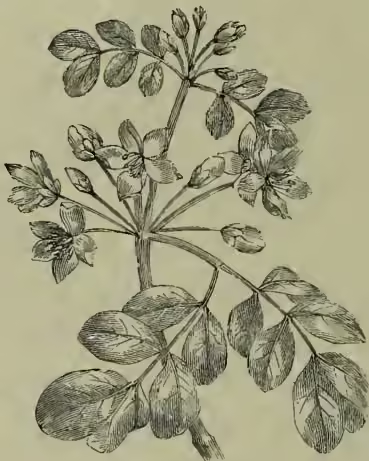
Guaiacum, a genus of trees of the natural order Zygophyllaceæ, natives of the tropical parts of America. The flowers have a 5-partite calyx, five petals, ten stamens, and a tapering style; the fruit is a capsule, 5-angled and 5-celled, or the cells by abortion fewer, one seed in each cell. The trees of this genus are remarkable for the hardness and heaviness of their wood, known variously as Lignum Vitæ, as Guaiacum-wood, and as Brazil-wood; as well as for their peculiar resinous product, Guaiacum, often but incorrectly called a gum. The species to which the commercial Lignum Vitæ and Guaiacum are commonly referred is G. officinale, a native of some of the West India islands, and of some of the continental parts of America; a tree 30 or 40 feet high, leaves abruptly pinnate, with two or three pairs of ovate, obtuse, and perfectly smooth leaflets, pale blue flowers in small clusters, which are succeeded by compressed roundish berries, a furrowed bark, and generally a crooked stem and knotty branches. It seems probable, however, that other species, as well as this, supply part of the gnaiacum-wood and resin of commerce. At present they are obtained chiefly from Cuba, Jamaica, and St Domingo. The wood is imported in billets about 3 feet long and 1 foot in diameter, of a greenish-brown colour. This is the colour of the heart-wood; the sap-wood is pale yellow. Guaiacum-wood is remarkable for the direction of its fibres, each layer of which crosses the preceding diagonally; annual rings are scarcely to be observed, and the pith is extremely small. It sinks in water. It is much valued, and used for many purposes, chiefly by turners; ships' blocks, rulers, pestles, and bowls (see BOWLS) are among the articles most commonly made of it. When rubbed or heated, it emits a faint disagreeable aromatic smell; its taste is also pungent and aromatic. Shavings and rasps of the wood are bought by apothecaries for medicinal use. The bark is also used in medicine on the continent of Europe, although not in Britain. The virtues of both wood and bark depend chiefly on the resin which they contain, and which is itself used in powder, pill, and tincture. It is an acrid stimulant, and has been employed with advantage in chronic rheumatism, in chronic skin diseases, in certain cases of scanty and painful menstruation (and hence it is occasionally an effectual remedy in cases of sterility), and in chronic catarrh. It has also been highly praised as a preventive of gout. The resin is an ingredient of the well-known Plummer's Pills. In the 16th and 17th centuries Guaiacum was the remedy most in repute for syphilis. It is used in testing Blood-stains (q.v.). The resin sometimes flows spontaneously from the stem of the Guaiacum tree; it is sometimes obtained artificially. It is of a greenish-brown colour, and has a brilliant resinous fracture.
It has scarcely any taste, but leaves a burning sensation in the mouth. One of its most striking characteristics is that it is coloured blue by its oxidising agents. It contains guaiacic acid, , which closely resembles benzoic acid, and yields, on distillation, certain definite compounds known as guaiacin, pyroguaiacin, and hydride of guaiacyl.