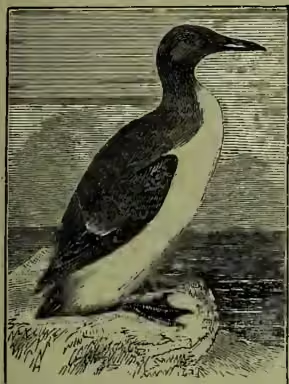
Guillemot (Uria), a genus of diving birds of the Auk family (Alcidae), represented by eight species in the arctic and north temperate zones. The bill is moderately long, straight, and feathered to the nostrils; the feet are three-toed, the hind-toe being absent, and they are completely webbed. The wings and tail are short, and the legs are placed very far back, so that the bird stands erect. Its walk is awkward, and its flight heavy though well sustained; but it dives with great agility, using its half-opened wings to aid its progress. The guillemots breed in large colonies on rocky cliffs, building no nests, but laying their eggs on the bare rock, and the male shares with the female the labour of hatching and rearing the young. Their food consists of crustaceans and small fishes. The Common or, as it is often called, Foolish Guillemot (U. troile), is very abundant on the British coasts. In summer the head, neck, and upper parts of the body are of a dark brown, the under parts white, the bill, legs, and feet black; in winter the neck and some parts of the head are white or mottled brown and white. The male measures about 18 inches in length; the female is coloured like the male, but is slightly smaller. She lays only one egg, 3 inches in length, which she hatches by holding it between her legs as she sits erect facing the cliff. The eggs are pear-shaped, and vary in colour from pale green to a deep reddish-brown. It seems, however, as if one bird laid the same colour of egg in successive seasons. The Ringed Guillemot is sometimes considered as a distinct species (U. ringvia), but as it differs from the common guillemot only in having round the eyes a ring of white continued backwards as a fine line, and as it is never found except where the latter also occurs, most ornithologists now agree in regarding it as a variety. The Black Guillemot (U. grylle)—sometimes placed in a separate genus (Cephus)—is found in Caithness and on the west coast of Scotland, and is fairly abundant in the Hebrides, Orkney, and Shetland. It is smaller than the preceding species, its length being only 14 inches, and it differs from it in laying two eggs. Its summer plumage is sooty-black, with the exception of white patches on the wing-coverts; and in winter the head and back have white markings, and the under parts are nearly white. In America U. grylle breeds as far south as the Bay of Fundy; U. troile is occasionally found on the coasts of New York. Where guillemots congregate in vast numbers, as at Flamborough Head, scaling the cliffs in search of their eggs is a regular profession, and one which requires much skill and courage. The eggs are occasionally used as food, as is also, indeed, the coarse flesh of the bird itself; but they are chiefly valued for their albumen, of which it is said large quantities are used in clarifying wine and in the preparation of patent leather. See Howard Saunders, Manual of British Birds.