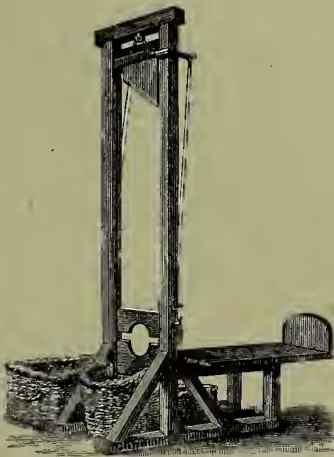
Guillotine, the instrument of decapitation introduced during the French Revolution by the Convention, and named after its supposed inventor, Joseph Ignace Guillotin, a physician (born 1738—died in his bed, not, as often said, by his own instrument, 1814), who, however, was only the person who first proposed its adoption. It was erected and first employed to execute a highwayman on the Place de Grève, Paris, 25th April 1792. It is composed of two upright posts, grooved on the inside, and connected at the top by a cross-beam. In these grooves a sharp iron blade, having its edge cut obliquely, descends by its own weight on the neck of the victim, who is bound to a board laid below. The invention of machines of this kind is ascribed to the Persians. In Italy, from the 13th century, it was the privilege of the nobles to be put to death by a machine of this kind, which was called mannaia. An instrument resembling the guillotine was likewise employed during the middle ages in Germany, where it has been reintroduced since 1853, and at a later date in France and Holland. During the 16th and 17th centuries a machine called the Maiden, which differed but slightly from the guillotine, was employed in Scotland for the purpose of decapitation; among its victims were one of Rizzo's murderers (1566), the Regent Morton (1581), and the Marquis (1661) and the Earl of Argyll (1685). Morton is commonly, but falsely, said to have introduced it, taking the idea from the similar engine at Halifax (q.v.), which was in use till 1650. See J. W. Croker, History of the Guillotine (1853); L'Abbé Bloeme, Notice sur la Guillotine (1865); Chereau, Guillotin et la Guillotine (1871); and Dubois, Recherches historiques et physiologiques sur la Guillotine (1881).—The name of guillotine is also given to a powerful machine used by bookbinders for cutting paper and cropping the edges of books, the blade having an oblique motion.