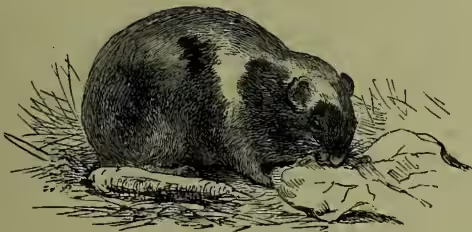
Guinea-pig, or CAVY (Cavia), a genus of small South American rodents, widely represented in Britain by the familiar domesticated species. The genus, comprising nine species, is typical of the family Caviidae (included in the porcupine-like section of Rodents), and is nearly related to the largest member of the order—the Capybara or Hydrochærus. The guinea-pigs have short limbs, the fore-feet bearing four toes, the hind-feet only three; the fore-feet are not webbed; the upper lip is not cleft, the ears are short and rounded, and the tails are wanting. The Common Guinea-pig or Cavy (C. cobaya)—whose name Guinea is believed to be a corruption of Guiana—was introduced into Europe from South America in the 16th century. Its supposed wild original, the Restless Cavy (C. aperea), abounds on the banks of the La Plata, and is found in Bolivia and Brazil. Its colour is dark brown on the back and yellowish-gray underneath. It lives in small troops near the borders of forests, whence it emerges at dusk and on gloomy days in search of food. It is timid and stupid, and falls an easy prey to carnivores and serpents. The common guinea-pig resembles it closely in nearly all points except colour, which is very variable, as in other domesticated animals. The guinea-pig multiplies with great rapidity, and may begin to bear young when two months old, producing one to four at a birth, five or six times a year. The other species occur from the Strait of Magellan to Brazil, and one is found in Peru. Although now exclusively South American, fossil forms are said to have been found in the Miocene deposits of Switzerland and France. Some species of Cavia are shot for food, but no such use is made of the domesticated form.