Gymnosperms (Gr. gymnos, 'naked;' hence the name Gymnosperms, 'naked-seeded' plants), the lower or more primitive group of seed-plants (Phanerogams, q.v.), differ in many points from the higher group, the Angiosperms. The chief differences are summarised in the article Angiosperms (q.v.). Gymnosperms consist of the orders Cycadaceæ (q.v.), Conifere (q.v.), and Gnetaceæ (see SEA-GRAPE). Although these orders do not resemble one another externally, their morphological characters and mode of sexual reproduction are very similar. In structure their stems resemble those of Dicotyledons (q.v.); the secondary wood is formed in concentric rings from permanent cambium, contains tracheides with bordered pits, but no true vessels; and secretory passages are present in most stems, containing resin in conifers and gum in cycads. It is, however, from their mode of sexual reproduction that we are able most clearly to assign their place among plants, as a connecting link between the higher cryptogams and angiosperms.
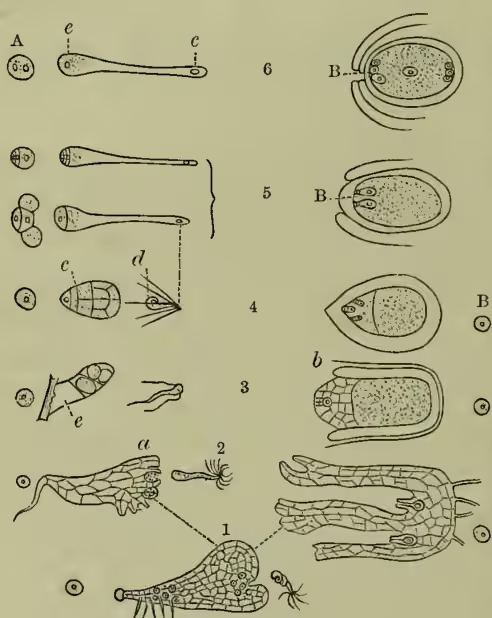
In gymnosperms we first meet with an organ which is morphologically, and at the same time physiologically, a Flower (q.v.). The flowers are unisexual; and the plants either monoecious or dioecious; while hermaphroditism prevails among Angiosperms. The male flowers are stamens bearing pollen-sacs, which develop free unicellular pollen-grains; those three sets of structures being respectively the homologues of sporophylls, microsporangia, and microspores of cryptogams. Each pollen-grain divides into a large reproductive cell and one or more vegetative cells (the male prothallus of higher cryptogams). Each cell has a nucleus, and that of the reproductive cell, the male pronucleus, is the homologue of the spermatozoid of cryptogams. When the stamens are matured, the sacs open; the grains are shaken out, and some are borne by the wind to the surfaces of ripe ovules (macrosporangia of cryptogams). When a pollen-grain reaches an ovule it begins to germinate, its coat ruptures, the reproductive cell grows at the expense of the vegetative to form a pollen-tube (antheridium of cryptogams) which ultimately penetrates the nucellus of the ovule, and its pronucleus fertilises the pronucleus of the oosphere (see FERN). This is a step in advance of the higher cryptogams, for their microspores are shed from the parent plant, and germinate only in a substratum where they develop into prothalli-bearing antheridia from which spermatozoids are eventually set free. The microspores of Salvinia natans, a heterosporous fern, form the only exception, because they develop prothalli and antheridia within the sporangium. Spermatozoids can fertilise only with the help of water; while pollen-grains of gymnosperms are carried by the wind to the female flowers.
In gymnosperms, then, we have a very marked transition in the process of fertilisation. Spermatozoids readily pass down the neck canals of archegonia and so reach the oosphere, but they would be unable to pierce the nucellus of gymnosperms; hence the necessity of a slow-growing pollen-tube in the latter. The female flower is a macrosporangium borne at the end of an axis or shoot, or a carpellary leaf (sporophyll), with a macrosporangium in its axil, on its upper surface, or on its margin. The ovule has never more than one coat; while in many angiosperms there are two. Further, the carpellary leaves never unite to form an ovary round the ovule, which, therefore, remains naked (hence the name); in angiosperms the ovules are always enclosed in ovaries. The ovule is filled at first with a mass of tissue, the nucellus, in which is afterwards developed the embryo-sac or mother-cell (macrospore of cryptogams); this sac forms within itself a prothallus (also called endosperm of phanerogams) which develops at its anterior end several archegonia (see FERN, fig. 2). The endosperm of gymnosperms is formed before, that of angiosperms after fertilisation. Inside each archegonium is an oosphere which, after fertilisation of its pronucleus by the male pronucleus, develops the embryo. Part only of the oosphere forms the embryo, the rest forms a kind of nutritive yolk, thus resembling the eggs of many animals. This is the only example of meroblastic segmentation of the ovum in the vegetable kingdom (see EMBRYOLOGY). The embryo lies straight in the prothallus, and never curved as in many angiosperms. Concealment of alternation of generations thus takes place for the first time in gymnosperms. In vascular cryptogams there are two distinct sets of individuals—viz. the asexual (sporophyte generation) represented by the fern-plant, and the sexual (oophyte generation) represented by the minute fern-prothallus. The sexual individuals of cryptogams, with the exception of the microspores of Salvinia, lead independent lives for a time; but those of phanerogams are parasitic on the parent plant; and as parasitism leads to degeneration of parts, so we have the prothalli in gymnosperms reduced, and still more reduced in angiosperms. The evolution of plant-forms has thus been a progressive increase of the sporophyte generation at the expense of the oophyte, and this is in harmony with the characteristically anabolic nature of plants. See Goebel's Morphology of Plants, Sach's Physiology of Plants, and Vines's Physiology of Plants.