Gyroscopic (Greek) is the name given to an instrument for the exhibition of various properties of rotation and the composition of rotations. It differs from a top in having both ends of its axis supported. The invention is probably French or German, and in some of its forms it dates from about the end of the 18th century.
If a mass be set in rotation about its principal axis of inertia of greatest or least moment, it will continue to revolve about it; and, unless extraneous force be applied, the direction of the axis will remain unchanged. Such, for instance, would be the case with the earth, were it not for the disturbances (see NUTATION and PRECESSION) produced by the sun and moon: the direction of the axis would remain fixed in space. It is for this very reason that modern artillery is rifled. If, then, a mass of metal, as, for instance, a circular disc, loaded at the rim, and revolving in its own plane, be made to rotate rapidly about its axis of greatest moment of inertia, and if it be freely supported (in gimbals, like the box of a compass), the direction of its axis will be the same so long as the rotation lasts. It will therefore constantly point to the same star, and may, of course, be employed to show that the apparent rotation of the stars about the earth is due to a real rotation of the earth itself in the opposite direction. This application was made by Foucault shortly after his celebrated Pendulum (q.v.) experiment, as it had been many years before (March 1836) by Dr Sang (see the Trans. of the R. Scot. Soc. of Arts). It is, in practice, by no means so perfect a mode of proving the earth's rotation as the Foucault pendulum; but this arises solely from unavoidable defects of workmanship and materials. Professor Piazzi Smyth has applied this property of the gyroscope to the improvement of our means of making astronomical observations at sea. A telescope, mounted on the same support as the ends of the axis of the gyroscope, will, of course, be almost unaltered in position by the rolling or pitching of a vessel; and a steady horizon, for sextant observations of altitude, may be procured by attaching a mirror to the support of the gyroscope, and setting it once for all by means of spirit-levels.
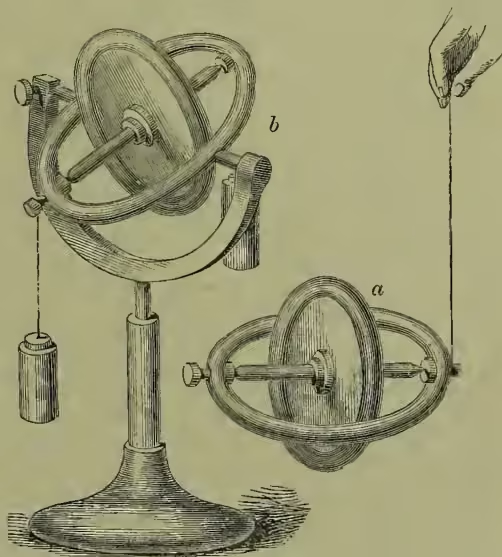
But the most singular phenomena shown by the gyroscope are those depending on the composition of rotations (see ROTATION). Any motion whatever of a body which has one point fixed is of the nature of a rotation about an axis passing through that point. Hence, simultaneous rotations about any two or more axes, being a motion of some kind, are equivalent to a rotation about a single axis. The effect, then, of impressing upon the frame in which the axis of the spinning gyroscope is suspended a tendency to rotate about some other axis, is to give the whole instrument a rotation about an intermediate axis; and this will coincide more nearly with that of the gyroscope itself, as the rate of its rotation is greater. The compound motion consists in the rolling of an imaginary cone fixed in the gyroscope upon another fixed in space; the rotation of the axis of a top round the vertical (when it is not 'sleeping' in an upright position), and the precession of the earth's axis, are precisely similar phenomena. Thus, when the gyroscope is spinning, its axis being horizontal, a weight attached to the framework at one end of the axis (fig. b) makes the whole rotate about the vertical; attached to the other end, the rotation takes place in the opposite direction. And the framework may be lifted by a string attached near one end of the axis (fig. a) without the gyroscope's falling. Its axis still projects horizontally from the string, but it revolves as a whole round the string. Various other singular experiments may be made with this apparatus; and others, even more curious, with the gyrostat of Sir W. Thomson, which is simply a gyroscope enclosed in a rigid case, by which the ends of its axis are supported. When a gyrostat is made the bob of a pendulum under certain conditions, the plane of vibration of the pendulum turns, as in Foucault's celebrated experiment, but in general at a much greater rate.
H
the eighth letter in our alphabet, is derived from the Phœnician letter cheth, which was obtained from the Egyptian hieroglyphic symbol which goes by the name of the sieve (see ALPHABET). The Semitic name, which means a 'fence' or 'palisade,' is explained by the form of the letter Ḥ, which resembles a three-barred stile. The sound was that of a strongly-marked continuous guttural, produced at the back of the palate, which does not exist in English, but is heard in the Scotch loch and the German laehen. When the Phœnician alphabet was transmitted to the Greeks the name cheth became ēta. As early as the 7th century B.C. this sign had two values among the Greeks; it normally represented the long ē, but was permissively used for the simple aspirate h. In the alphabet of Italy it was used exclusively for the aspirate; but in the later alphabet of Greece the two sounds came to be represented by a differentiation of the symbol, the form H being used for the vowel and the mutilated forms Ⲭ, ⲭ, for the aspirate. Hence we see how the symbol H stands for h in the Latin alphabet and for ē in the Greek.
In Old English h was a guttural, or throat sound, but it gradually softened down to a spirant, and has now become almost a vowel. No letter is more misused, and this misuse is of very ancient date. In Latin MSS. and inscriptions it is sometimes improperly inserted, as in the words harena, harundo, hauetoritas, or improperly omitted, as in omini, abitat, onustus—spellings which prove the uncertainty of the usage. In English as early as the 12th century we find ard written for hard, and hold for old. Americans, as a rule, rarely misuse it, and in England an untaught peasant is usually more correct than a self-made man. It has long disappeared from Italian, and is now rapidly vanishing from French. The Spaniards substitute h for a Latin f, the Spanish hijo representing the Latin filius, just as the Latin hordeum represented the Sabine fordeum. Not only f, but e and s are frequently represented by h. Thus, hundred and century, heartiness and eordiality, hall and cell are true doublets, while the Latin canis, centum, and caput correspond to the English hound, hundred, and head, and the first syllables of hexagon and heptarchy, which are derived from the Greek, correspond to the English numerals six and seven. We get hemi-sphere from the Greek and semi-circle from the Latin, hyper-critical from the Greek and super-ficial from the Latin. The Irish have retained s, which in Welsh has faded down to h, the Welsh hen, 'old,' being the Irish sen and the Latin senex. In English h has been lost in the words it, loaf, neck, ring, tear, fee, which were formerly written hit, klaf, hneeaa, hring, taher, and feoh, while in droht and genoh, now written draft and enough, it has become f, and in the words huge, wharf, whelk, and whelm it is intrusive. In hwit and hweol, and many other words, the decay of the aspirate caused them to be written white and wheel, and except in the north of England the h in these words is hardly heard. In the west and south of England, which are Saxon, the aspirate as a rule is fainter and more liable to be lost than in East Anglia, Yorkshire, and Scotland, where we have the descendants of Angles and Danes.
The correct pronunciation of this difficult letter is one of the most delicate tests of good breeding. The quality of the sound depends partly on that of the following vowel, and its intensity to some extent on the accentuation. The aspiration is stronger in humble than in humility, in himan than in humane, in history than in historical, in hostile than in hostility, but it is the same in happy and happiness, since the accent rests on the same syllable. It is stronger in who than in when, in hole than in whole. In honour it is very faint, in honourable and honesty it is almost inaudible. It is stronger in host than in hospital, while in hostler it has so completely disappeared that the spelling ostler has become usual. It is retained in harbour, but has been lost in arbour. It is retained in hair and hare, but is evanescent in heir and hour, though retained in hereditary and horologe. No general rule can be laid down for the pronunciation; it depends on the usage of good society, which changes from generation to generation. In good French society the aspirate is disappearing; in England and America the reverse is probably the case. The reasons why persons who omit h where it should be inserted and commonly insert it where it should be omitted are obscure, but have been referred by Mr Douse in his book on Grimm's Law to what he designates as the Principle of Cross Compensation.
In German musical notation the letter H is used to denote B natural, the letter B being applied to our B flat. This anomalous distinction is derived from the ancient notation by letters, before the invention of the stave, in which B natural was written in a square form (B quadratum), like a small black-letter b, while B flat was written as a Roman b (B rotundum). The awkwardness of having two B's led to the introduction of the H, which in small black letter (h) resembles b closely. See 'Accidentals' in Grove's Dictionary. In the French and Italian system the same note is denoted by the syllable Si. See MUSIC, SCALE, SOLFEGGIO.