Handcuffs, the instruments used for securing prisoners under arrest. In the 15th and 16th centuries they are spoken of as swivels, manacles, and shackbolts. Until within the latter half of the 19th century, those in common use seem to have been only of two kinds—viz. the rigid or figure-8 handcuffs, employed chiefly in prisons for the punishment or restraint of refractory or violent prisoners, and the flexible or chain handcuffs used by the police and military when conveying a person in custody from one place to another. With the former the wrists are so confined as to be fixed in one position either in front or behind the body of the prisoner, the latter method being the one generally adopted when they are put on for infraction of prison regulations. This punishment is a much dreaded one, the confinement of the wrists together at the prisoner's back even for a short period being exceedingly irksome and uncomfortable. The chain handcuff, which is in most common use, is made so that, while depriving the prisoner of the free use of his hands and arms, a change in the position of these to some extent is permitted, and the rigidity of the figure-8 handcuffs is avoided. Of recent years several improvements have been made in the construction of the handcuffs. They are much lighter, and many of them are now adjustable (a in fig.). By means of a ratchet arrangement they are made to fit any size of wrist, and the difficulty which was formerly met by an officer taking two or three pairs of different sizes with him when going a distance to bring a prisoner has thus been overcome. For the removal of gangs of prisoners from one prison to another a long chain is used, running through and connecting the handcuffs by which each prisoner is secured. Gangs of eight or ten men are thus fastened together, the chain passing through a ring fixed on each handcuff, and made fast at both ends by what are known as end-locks.
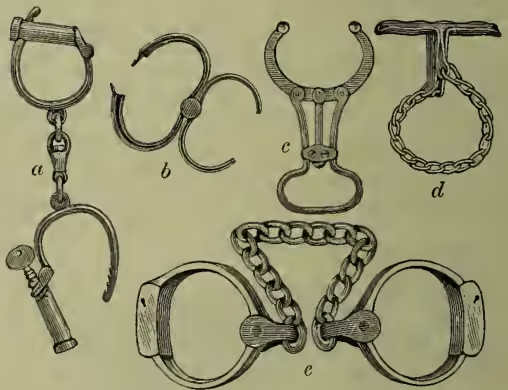
In addition to the handcuffs above described there are several appliances, mostly of recent invention, which are employed by the police in securing prisoners, but which are not known among the officers of the law as handcuffs. They have a variety of names—such as snaps (b in fig.), nippers (c in fig.), twisters (d in fig.), &c. They are distinguished from the handcuffs by the fact that they are intended only for one wrist, the other part or handle being held by the officer conveying the prisoner. They are mostly of American origin, their chief design being to enable an offender to be instantaneously secured, and thus prevent attempts to resist capture. The snap is the one most in use in Great Britain among detective officers; the smaller loop is slipped on the wrist of the offender, and the fastening is snapped into place and held in the hand of the detective; in an emergency this instrument is very effective when used as a knuckle-duster. In the United States and the colonies the nippers are recognised as the most effectual for prompt operation; by an ingenious arrangement of the centre-bar, shown in the fig., it can be instantaneously fastened by one hand on the wrist of an offender. The twister is now generally forbidden in Great Britain, instances having arisen in which its application has been attended with serious injury to the prisoner; but it is still frequently used in some parts of America and in other countries where open resistance to the law is of more frequent occurrence. It is composed of a chain attached to two handles. The chain is put round the wrist, the handles brought together and twisted till the chain grips tight enough. In cases where prisoners have to be removed who are charged with crimes of a desperate kind, the culprit is occasionally secured by leg-irons (e in fig.) in addition to the handcuffs, and these are also used in convict establishments upon prisoners who have shown themselves to be dangerous. The leg-iron is fastened above the ankle and locked by a key.