Heat, the cause of the sensation of warmth, and of a multitude of common phenomena in nature and art. In considering this subject scientifically it is necessary from the outset to discard the ideas conveyed by the popular use of such words as hot and cold. A number of bodies, however different, left for a long enough time in the same room, must, as we shall see further on, acquire the same temperature, or become in reality equally warm. Yet in popular language some, as metals, stones, &c., are pronounced to be cold, and others, as flannel and fur, warm. The touch, then, is not a means by which we can acquire any definite idea of the temperature of a body.
Nature of Heat.—A heated body is no heavier than it was before it was heated; if, therefore, heat be a material substance, as it was long considered, it must be imponderable. And, in fact, under the name of caloric, it is classed in almost all but modern treatises as one of the family of imponderables. But if it were matter, in any sense of the word, its quantity would be unchangeable by human agency. Now we find that there are cases in which heat is produced in any quantity without flame, combustion, &c., as in melting two pieces of ice by rubbing them together, and also cases in which a quantity of heat totally disappears. This is utterly inconsistent with the idea of the materiality of heat. The only hypothesis that at all accords with the phenomena is that heat depends upon motion of the particles of a body, being in fact Energy (q.v.), not matter; and with this idea we shall start.
Temperature.—When two bodies are placed in contact, heat will in general pass from one to the other, with the effect of cooling the first and warming the second. This process goes on until the two acquire the same temperature. Thus temperature is a condition of a body, determining, as it were, the head of the heat which the body contains—to take the obvious analogy of water in a cistern or a mill-pond. In this sense it is analogous also to the pressure of gas in a receiver, or to the potential in an electrified conductor. By the help of the 'specific heat' of bodies (which will be treated later) we can determine from their change of temperature how much heat they gain or lose. The scientific or absolute measurement of temperature can only be alluded to here. It depends upon theoretical considerations, for which see THERMO-DYNAMICS.
Measure of Heat.—Whether it be a vibration, such as light and sound (as in some cases it certainly is), or consist in independent motions of the particles of a body, leading to a succession of impacts on each other and on the walls of the containing vessel (as is almost certainly the case in gases), it is none the less certain that the amount of heat in a body is to be measured by the energy of moving particles. But as we cannot observe those particles so as to ascertain their vis-viva, we must have as a preliminary some artificial unit in terms of which to measure heat. This will be described later. But in order that this process may be applied we must have some means of measuring the temperature of a body, depending upon an effect of heat. Whatever that effect may be, it is obvious that, as the laws of nature are uniform, it will afford us a reproducible standard, by which we can estimate at any time and at any place an amount of heat, and compare that amount with another observed somewhere else; just as the French Mètre (q.v.) is reproducible at any time, being (at least by its original definition) the ten-millionth part of a quadrant of the meridian.
Dilatation or Expansion.—Now, one of the most general and notable effects which heat produces on matter is to expand it. The length of a metallic bar varies with every change of temperature, and is ever the same at the same temperature. The fixing of the tire of a cart-wheel is a very good instance. No hammering could fit an iron hoop so tightly on the wood-work of the wheel as does the simple enlarging of the tire by heat, and its subsequent contraction by cold. It is thus possible to slip it on, and an enormous force is seemed to bind the pieces together. In almost every kind of structure the expansion and contraction from changes of temperature require to be guarded against. In the huge iron tubes of the Britannia Bridge the mere change of the seasons would have produced sufficient changes of length to tear the piers asunder, had each end of a tube been fixed to masonry. Watches and clocks, when not compensated (see PENDULUM), go faster in cold weather, and slower in hot, an immediate consequence of the expansion or contraction of their balance-wheels and pendulums.
If a flask full of water or of alcohol be dipped into hot water or held over a lamp, the flask is heated first, and for a moment appears not quite full, but as heat reaches the liquid it expands in turn, and to a greater degree than the flask, so that a portion of the liquid runs over; a glass shell which just floats in a vessel of water, sinks to the bottom when the water is heated; and as water is gradually heated from below, the hotter water continually rises to the surface. Indeed, if this were not the case, it would be impossible to prevent explosions every time we attempted to boil water or any other fluid. If a bladder, partly filled with air, and tightly tied at the neck, be heated before a fire, the contained air will expand, and the bladder will be distended. As it cools it becomes flaccid again by degrees.
These and like instances are sufficient to show us that in general all bodies expand by heat. In order, then, to prepare a reproducible means of measuring temperature, all we have to do is to fix upon a substance (mercury is that most commonly used) by whose changes of volume it is to be measured, and a reproducible temperature, or rather two reproducible temperatures, at which to measure the volume. Those usually selected are—that at which water freezes, or ice melts, and that at which water boils. In both of these cases the water must be pure, as any addition of foreign matter in general changes the temperature at which freezing or boiling takes place. Another important circumstance is the height of the barometer (see BOILING). The second reproducible temperature is therefore defined as that of water boiling in an open vessel when the barometer stands at 30 inches. In absolute strictness, this should also be said of the freezing-point, but the effect on the latter of a change of barometric pressure is practically insensible. The practical construction of a heat-measurer or thermometer on these principles, the various ways of graduating it, and how to convert the readings of one thermometer into those of another, are described in the article THERMOMETER. In the present article we suppose the Centigrade thermometer to be the one used.
If we make a number of thermometer tubes, fill them with different liquids, and graduate as in the Centigrade, we shall find that, though they all give 0° in freezing and 100° in boiling water, no two in general agree when placed in water between those states. Hence the rate of expansion is not generally uniform for equal increments of temperature. It has been found, however, by very delicate experiments, which cannot be more than alluded to here, that mercury expands nearly uniformly for equal increments of temperature. However, what we sought was not an absolute standard, but a reproducible one; and mercury, in addition to furnishing this, may be assumed also to give us approximately the ratios of different increments of temperature.
We must next look a little more closely into the nature of dilatation by heat. And first, of its measure. A metallic rod of length at 0° increases at by a quantity which is proportional to and to . Hence, being some numerical quantity, the expanded length . Here is called the coefficient of linear dilatation. For instance, a brass rod of length 1 foot at 0° becomes at feet; and here , or the coefficient of linear dilatation for one degree (Centigrade), is .0000187; or a brass rod has its length increased by about one fifty-three thousandth part for each degree of temperature.
If we consider a bar (of brass, for instance) whose length, breadth, and depth are , , —then, when heated, these increase proportionally. Hence
and therefore the volume of, or space occupied by, the bar increases from or to or .
Therefore we may write , where we shall have as before , the coefficient of cubical dilatation for 1° of temperature. And, as , we see that, for the same substance, the coefficient of cubical dilatation is three times that of linear dilatation.
In the following table these coefficients are increased a hundredfold, as it gives the proportional increase of length for a rise of temperature from 0° to 100° Centigrade. It must also be remarked that, while the linear dilatation of solids is given, it is the cubical dilatation of liquids and gases which is necessarily given. Moreover, as the latter are always measured in glass, which itself dilates, the results are only apparent: they are too small, and require correction for the cubical dilatation of glass. This, however, is comparatively very small, and a rough approximation to its value is usually sufficient.
| Glass..... | .00086 | Water..... | .0432 |
| Iron..... | .00122 | Alcohol..... | .116 |
| Zinc..... | .00294 | Air..... | .3665 |
| Mercury..... | .01803 | Hydrogen..... | .3668 |
There is one specially remarkable exception to the law that bodies expand by heat—viz. that of water under certain circumstances. From 0° (Centigrade), at which it melts, it contracts as the temperature is raised, up to about 4° C., after which it begins to expand like other bodies. We cannot here enter into speculations as to the cause of this very singular phenomenon, but we will say a few words about its practical utility. Water, then, is densest or heaviest at 4° C. Hence, in cold weather, as the surface water of a lake cools to near 4°, it becomes heavier than the hotter water below, and sinks to the bottom. This goes on till the whole lake has the temperature 4°. As the surface-cooling proceeds further, the water becomes lighter, and therefore remains on the surface till it is frozen. Did water not possess this property, a severe winter might freeze a lake to the bottom, and the heat of summer might be insufficient to remelt it all.
Specific Heat.—The thermometer indicates the temperature of a body, but gives us no direct information as to the amount of heat it contains. Yet this is measurable, for we may take as our UNIT the amount of heat required to raise a pound of water from 0° to 1°, which is of course a definite standard. As an instance of the question now raised—Is more heat (and if so, how much more) required to heat a pound of water from zero to 10° than to heat a pound of mercury between the same limits? We find by experiment that bodies differ extensively in the amount of heat (measured in the units before mentioned) required to produce equal changes of temperature in them.
It is a result of experiment (sufficiently accurate for all ordinary purposes) that, if equal weights of water at different temperatures be mixed, the temperature of the mixture will be the arithmetic mean of the original temperatures. From this it follows, with the same degree of approximation, that equal successive amounts of heat are required to raise the same mass of water through successive degrees of temperature. As an instance, suppose one pound of water at 50° to be mixed with two pounds at 20°, the resulting temperature of the mixture is 30°; for the pound at 50° has lost 20 heat units, while each of the other two pounds has gained 10 such units, transferred of course from the hotter water. Generally, if pounds of water at degrees be mixed with pounds at degrees (the latter being the colder), and if be the temperature of the mixture—the number of units lost by the first is , since one is lost for each pound which cools by one degree; and that gained by the second is , and these must be equal. Hence ; whence, at once,
But if we mix water and mercury at different temperatures, the resulting temperature is found not to agree with the above law. Hence it appears that to raise equal weights of different bodies through the same number of degrees of temperature requires different amounts of heat. And we may then define the specific heat of a substance as the number of units of heat (as above defined) required to raise the temperature of one pound of it by one degree.
From the definition of a unit of heat it is at once seen that our numerical system is such that the specific heat of water is unity; and, in general, the specific heats of other bodies are less, and are therefore to be expressed as proper fractions. For example, if equal weights of water and mercury be mixed, the first at 0°, the second at 100°, the resulting temperature will not be 50° (as it would have been had both bodies been water), but 3°·23 nearly; in other words, the amount of heat which raises the temperature of one pound of water 3°·23 is that which would raise that of one pound of mercury 96°·77, or the specific heat of mercury is th of that of water. The following may be given as instances of the great differences which experiment has shown to exist among bodies in respect of specific heat: Water, 1·000; turpentine, .426; sulphur, .203; iron, .114; mercury, .033.
It is mainly to the great specific heat of water that we are indebted for the comparatively small amount of it required to cool a hot body dropped into it; for its comparatively small loss of temperature when it is poured into a cold vessel; and for the enormous effects of the water of the ocean in modifying climate, as by the Gulf Stream.
It has been found generally that the specific heats of elementary solids are nearly inversely as their Atomic Weights (q.v.). Hence their atoms require the same amount of heat to produce the same change in their temperature. Thus, for simple bodies, we have atomic weight of mercury, 100; its specific heat, .033; product, 3·3; atomic weight of iron, 28; its specific heat, .114; product, 3·2. A similar remark may be made, it appears, with reference to compound bodies of any one type; but, in general, the product of the specific heat and the atomic weight differs from one type to another.
Latent Heat, Fusion, Solution, and Vaporisation.—We are now prepared to consider the somewhat complex effects produced by heat on the molecular constitution of bodies; and, conversely, the relations of solidity, fluidity, &c. to heat. All solid bodies (except carbon, which has been softened only) have been melted by exposure to a sufficiently high temperature. The laws of this fusion are:
(1) Every body has a definite melting-point, assignable on the thermometric scale, if the pressure to which it is subjected be the same.
(2) When a body is melting, it retains that fixed temperature, however much heat may be supplied, until the last particle is melted. The last result is most remarkable. The heat supplied does not raise the temperature, but produces the change of state. Hence it seemed to disappear, as far as the thermometer is concerned, and was therefore called latent heat.
A pound of water at 79° C. added to a pound of water at 0° C. produces, of course, two pounds of water at 39°·5. But a pound of water at 79° C. added to a pound of ice at 0° C. produces two pounds of water at 0°. Heat, then, has disappeared in the production of a change from solidity to fluidity. And this we might expect from the conservation of Energy (q.v.), for energy in the shape of heat must be consumed in producing the potential energy of the molecular actions of the separate particles in the fluid. For every pound of ice melted, without change of temperature, 79 units of heat are thus converted into potential energy of molecular separation.
We give a few instances of latent heat of fusion: Water (as above), 79·0; zinc, 28·1; sulphur, 9·4; lead, 5·4; mercury, 2·8.
In law 1 it is mentioned that constancy of pressure is necessary. In fact, the freezing (or melting) point of water is lowered by increase of pressure, while those of sulphur or wax are raised; but these effects, though extremely remarkable, are very small. Most bodies contract on solidifying; but some, as water, cast-iron, certain alloys, &c., expand. Thus a severe frost, setting in after copious rain, splits rocks, &c., by the expansion of freezing water; and thus also we obtain in iron the most delicate and faithful copy of a mould, and in the fusible alloy a clear-cut copy of a type. The modern dynamical theory of heat (thermo-dynamics) enables us to see that a perpetual motion would be procurable if bodies which contract on solidifying had not their melting-point raised by pressure, and vice versa.
Analogous to the fusion of a solid is its solution in a liquid, or the mutual conversion into liquids of two solids which are intimately mixed in powder. Here, also, we should expect kinetic energy, in the shape of heat, to be used up in producing the potential energy of the liquid state; and, indeed, such is always the case. Such changes of arrangement destroy heat or produce cold; but this in many cases is not the effect observed, as there is generally heat developed by the loss of potential energy if there be chemical action between the two substances. Hence, in general, the observed effect will be due to the difference of the heat generated by chemical action and that absorbed in change of state.
If a quantity of pounded nitrate of ammonia (a very soluble salt) be placed in a vessel, an equal weight of water added, and the whole stirred for a minute or two with a test-tube containing water, the heat required for the solution of the salt will be abstracted from all bodies in contact with the solution, and the water in the test-tube will be frozen. In this sense the arrangement is called a freezing mixture. For additional illustrations of heat becoming latent, see FREEZING MIXTURES.
Of course the converse of this may be expected to hold, and latent heat to become sensible when a liquid becomes solid. As an example, when a supersaturated solution of sulphate of soda begins to deposit crystals of the salt with great rapidity the temperature rises very considerably; and it is the disengagement of latent heat that renders the freezing of a pond a slow process, even after the whole of the water has been reduced nearly to the freezing-point.
Vaporisation.—Almost all that has been said on the subject of fusion is true of vaporisation, with the change of a word or two. Thus, however much heat we supply to a liquid, the temperature does not rise above the boiling-point. Heat, then, becomes latent in the act of vaporisation, or rather is converted into the potential energy involved in the change of state. It is found by experiment that 540 units of heat (each sufficient to heat a pound of water 1° C.) disappear in the conversion of a pound of water into steam. Hence a pound of steam at 100° C. is sufficient to raise 5·4 pounds of water from zero to the boiling-point.
COMMUNICATION OF HEAT.—There are at least three distinct ways in which this occurs, and these we will take in order.
Conduction.—Why is it that, if one end of a poker and of a glass or wooden rod be put into a fire, we can keep hold of the other end of the latter much longer than we can of the former? The reason is that heat is more readily transmitted in the iron from particle to particle than it is in glass or wood. This is conduction. It is to be noticed, however, that in this experiment a great portion of the heat which passes along each rod is given off into the air by the surface. The mathematical theory of conduction has been most exquisitely investigated by Fourier, but on the supposition that the rate at which heat passes from a warmer to a colder portion of a body is proportional to the difference of temperature. As most of the experiments which have been made with the object of ascertaining the conductivity (not conductibility, the erroneous word too commonly in use) of different bodies have been made in this way, it is not surprising that our knowledge on this point is very meagre indeed. We know that silver and copper conduct better than most other metals, and that the metals in general conduct better than other solids; but our further information is neither very extensive nor very definite. The first determinations of conductivity which are at all trustworthy are those of Forbes. His method was immensely superior to those of his predecessors. Before we give one or two numerical data, we must explain what the numbers mean. The following definition is virtually that of Fourier:
The thermal conductivity of a substance is the number of units of heat which pass per unit of surface per unit of time, through a slab of unit thickness, whose sides are kept at temperatures differing by 1° C. Taking the unit of heat as above described, a foot as unit of length and a minute as unit of time, the conductivity of iron is about 0·8, while that of copper varies from 4 to little more than 2. (Very slight impurities affect to a great extent both the thermal and the electric conductivity of copper.) Contrasted with these we find that the conductivity of rocks is very small, ranging from 0·015 to 0·04.
In conjunction with their radiating power (see next section), the conductivity of bodies is most important as regards their suitability as articles of clothing for hot or cold climates, or as materials for building or furnishing dwelling-houses. We need but refer to the difference between linen and woollen clothing, or to the difference (in cold weather) of sensation between a carpet and a bare floor, in order to show how essential the greater or less conducting power of bodies is to our everyday comfort.
Radiation.—By this is understood the passage of heat, not from particle to particle of one body, but through air or vacuum, and even through solid bodies (in a manner and with a velocity quite different from those of conduction) from one body to another. There can be no doubt whatever as to radiant heat being identical with light, differing from red light, for instance, as red light differs from blue—i.e. having (see LIGHT) longer waves than those corresponding to red light. This idea might easily have arisen during the contemplation of a body gradually heated. At first it remains dark, giving off only rays of heat; as its temperature increases it gives us, along with the heat, a low red light, which, by the increase of the temperature, is gradually accompanied by yellow, blue, &c. rays, and the incandescent body (a lime-ball, for instance) finally gives off a light as white as that of the sun, and which therefore contains all the colours of sunlight in their usual proportions. In fact there is great reason to believe that the sun is merely a mass of incandescent matter, probably in the main gaseous, and that the radiations it emits, whether called heat or light, merely differ in quality, not in kind. Taking this view of the subject at the outset, it will be instructive to compare the properties of radiant heat with those of light throughout. It must be understood when we make this comparison that the term heat is improperly used in this connection. Radiant heat is not heat in the ordinary sense of the word. It is a form of energy, a transformation of the heat of a hot body, and can be transformed into heat again when it is absorbed, but on its passage it is not what we ordinarily understand by the word heat.
Light, then, moves (generally) in straight lines. This is easily verified in the case of heat by the use of the thermo-electric pile and its galvano- meter. Placing the pile out of the line from a source of heat to an aperture in a screen, no effect is observed; but deflection of the needle at once occurs when the pile is placed in the line which light would have followed if substituted for the heat.
A concave mirror, which would bring rays of light proceeding from a given point to a focus at another given point, does the same with heat, the hot body being substituted for the luminous one, and the pile placed at the focus. Heat, then, is reflected according to the same laws as light. A burning lens gives a capital proof of the sun's heat and light being subject to the same laws of refraction. When the solar Spectrum (q.v.) is formed by means of a prism of rock-salt (the reasons for the choice of this material will afterwards appear), the thermo-electric pile proves the existence of heat in all the coloured spaces, increasing, however, down to the red end of the spectrum, and attaining its maximum beyond the visible light, just as if radiant heat were (as it must be) light with longer waves.
Some bodies, as glass, water, &c., transmit, when in thin plates, most of the light which falls on them; others, as wood, metal, coloured glass, &c., transmit none or little. A plate of rock-salt, half an inch thick, transmits 96 per cent. of the rays of heat which fall on it; while glass, even of a thickness of one-tenth of an inch, transmits very little. In this sense, rock-salt is said to be diathermanous, while glass is said to be adiathermanous, or only partially diathermanous. Most of the simple gases, such as oxygen, hydrogen, &c., and mixtures of these, such as air, oppose very little resistance to the passage of radiant heat; but the reverse is in general the case with compound gases. It has recently been asserted that water-vapour in particular is exceedingly adiathermanous. The question is one of very considerable difficulty, owing to the fact that it is almost impossible to experiment upon vapour alone. The presence of dust particles always produces deposition of water, which is a very good absorber of radiant heat.
But there are other remarkable phenomena of radiant heat which are easily observed, and which have their analogy in the case of light. (1) Unstained glass seems equally transparent to all kinds of light. Such is the case with rock-salt and heat. (2) Light which has passed through a blue glass (for instance) loses far less per cent. when it passes through a second plate of blue glass. Similarly heat loses (say) 75 per cent. in passing through one plate of crown-glass, and only 10 per cent. of the remainder (say) in passing through a second. (3) Blue light passes easily through a blue glass, which almost entirely arrests red light. So dark heat passes far less easily through glass than bright heat does. These analogies, mostly due to Melloni, are very remarkable.
Again, light can be doubly refracted, plane polarised, circularly polarised. All these properties have been found in radiant heat by Principal Forbes.
The beautiful investigations of Stokes, Balfour Stewart, and Kirchhoff have shown us that bodies which most easily absorb light of a particular colour give off most freely, when heated, light of that colour; and it is easily shown by experiment that those surfaces which absorb heat most readily also radiate it most readily. Thus, it was found by Leslie that when a tinned-iron cube full of boiling water had one side polished, another roughened, a third covered with lampblack, &c., the polished side radiated little heat, the roughened more, while the blackened side radiated a very great quantity indeed. And again, that if we have (say) three similar thermometers, and if the bulbs be (1) gilded, (2) covered with roughened metal, (3) smoked, and all be exposed to the same radiation of heat, their sensibility will be in the order 3, 2, 1. A practical illustration of this is seen in the fact that a blackened kettle is that in which water is most speedily made to boil, while a polished one keeps the water longest warm when removed from the fire. Again, if a willow-pattern plate be heated white-hot in the fire, and then examined in a dark room, the pattern will be reversed—a white pattern being seen on a dark ground. It is this law of equality of radiating and absorbing powers that mainly gives rise to the superior comfort of white clothing to black in winter as well as in summer; radiating less in winter, it absorbs less in summer.
Much has been argued about the separate existence of cold, from such facts as these: A piece of ice held before the thermo-electric pile produces an opposite deflection of the galvanometer to that produced by a hot ball. If a freezing mixture be placed at one focus of a spheroidal mirror, and a thermometer with a blackened bulb at the conjugate focus, the latter will fall speedily, though very far off from the mixture. Now, the true explanation of such observations is to be found in what is called the 'Theory of Exchanges,' first enunciated by Prévost, and since greatly extended and carefully verified by Stewart, which is to this effect: 'Every body is continually radiating heat in all directions, the amount radiated being greater as the temperature is higher.' Thus the radiation from a body depends on itself alone, the amount absorbed depends on the radiation which reaches it. Hence the apparent radiation of cold in the experiments above mentioned is due to the fact of the pile or thermometer radiating off more heat than it receives, as its temperature is higher than that of the freezing mixture to which it is opposed. From this it is evident that any number of bodies left near each other tend gradually to assume a common temperature. By this theory of exchanges we explain the cold felt in sitting opposite an open window in a frosty day, even when there is no draught.
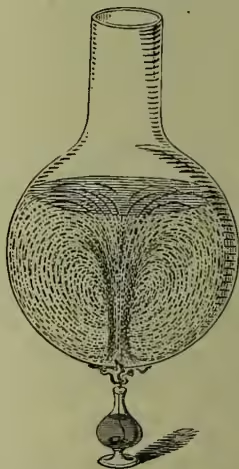
Convection.—A hot body cools faster in a current of air than in a still atmosphere of the same temperature, evidently because fresh supplies of the colder air are continually brought into contact with it. This carrying off of its heat by a stream of air is an example of convection. It is by convection mainly that heat is conveyed throughout liquids and gases. Thus, when a lamp is applied to the bottom of a vessel of water the heat does not diffuse itself in the water as it would (by conduction) in a mass of metal, but the expansion of the heated water at the bottom rendering it lighter, bulk for bulk, than the superincumbent fluid, causes it to rise to the surface; and thus, by convection, the heat is diffused through the mass. Conduction, properly so called, can scarcely be shown, though it really exist, in liquids or gases, on this account. The tremulous appearance of any object as seen by light which passes near a hot surface, as that of a boiler or a red-hot poker, is due to the convection of heat in the air, the warm current refracting light less than does the cold air. See VENTILATION.
For the mechanical applications of heat, see AIR-ENGINE, STEAM-ENGINE, &c., and for their theory, see THERMO-DYNAMICS.
Sources of Heat.—They may be, so far as we know, ultimately reduced to two—chemical combination and mechanical energy; and, indeed, in all probability the former is only a variety of the immensely different forms in which the latter is manifested. A more full examination of this point, and a general statement of the ultimate nature of the various sources of heat, will be found in the article ENERGY above referred to. See also COMBUSTION, FUEL; and for heating apparatus, see WARMING.