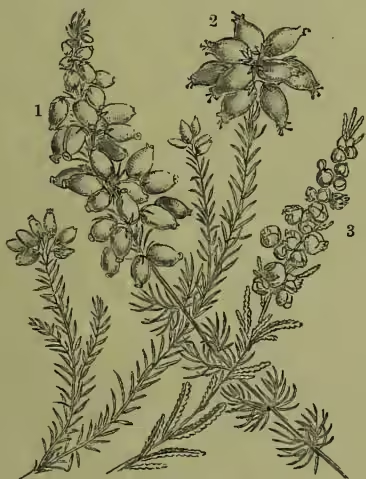
Heath (Erica), a genus of small shrubs of the natural order Ericæ, distinguished by a calyx of four leaves, a bell-shaped or ovate—often ventricose—corolla, and a 4-celled, 4-8-valved capsule. The leaves are small, linear, and evergreen. The genus consists of about 400 species, besides innumerable hybrids and varieties raised in gardens. The home of the genus is in the western part of South Africa, but a few species are distributed over western and northern Europe. E. vulgaris—now generally named by botanists Calluna vulgaris (fig. 1)—is the most widely distributed of all heaths, extending as it does over central and northern Europe to the Arctic Circle. It is the ling, heath, or heather of British moors and mountains. The genus is not found in Asia, America—except in Labrador, Cape Breton, Nova Scotia, and parts of New England, where the common heath occurs—nor in Australia. Six species, including the ling, are found in the British Isles.
Cross-leaved Heather (E. tetralix) (fig. 2) and Fine-leaved Heather (E. cinerea) (fig. 3) are common plants in most parts of Britain, and, like most of the genus, are very beautiful when in flower. The heather-bells of Scottish song are the flowers of one or both of these species. A sprig of E. cinerea was the badge of the Macdonalds at the time when they existed as a distinct clan. E. carnea, common in the southern parts of Europe, is a very frequent ornament of British flower-borders. Many species, remarkable for the size and beauty of their flowers, are much cultivated in greenhouses. Some of the south African or Cape heaths attain in their native region a much greater size than any European heath except E. arborea, which in the Pyrenees sometimes grows to the height of 20 feet. The so-called Briar-root (q.v.) of which tobacco-pipes are made is a heath.
In the Highlands of Scotland the common heath served in former times a great variety of purposes. The poorer folks formed walls for their cottages with alternate layers of heath and a kind of mortar made of earth and straw, and they made comfortable if not luxurious beds of it, placing the roots downwards, and laying the plants in a sloping direction. With heath cottages are also thatched, besoms are made, and faggots are formed to burn in ovens. In the island ofIslay ale was made by brewing one part of malt with two of the young tops of the common heath, and this liquor, according to Boece, was used by the Picts. Sheep and goats sometimes browse on the tender shoots, but they do not like them. The young tops form almost exclusively the food of grouse. From the flowers bees extract a great quantity of honey, which is of a very deep colour.