Hemp (Cannabis), a genus of plants of the natural order Cannabinaceæ (q.v.), having the male and female flowers on different plants; the male flowers with five-partite calyx and five stamens; the female flowers with a spathe-like calyx of one leaf, rolled round the ovary and partially split along one side, and two threadlike stigmas. There is only one known species (C. sativa), varying considerably, however, from soil, climate, and cultivation. It is an annual plant, a native of the warmer parts of Asia, but has been cultivated in Europe from the earliest historic times, and is now naturalised in many parts of Europe and America. Like flax, it adapts itself wonderfully to diversities of climate, and is cultivated equally under the burning sun of the tropics and in the northern parts of Russia.
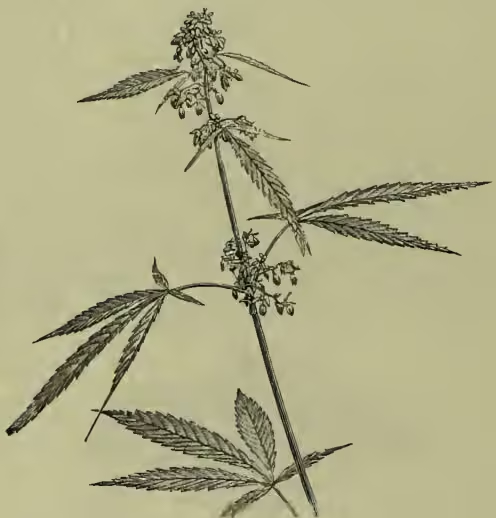
It is, however, readily injured by frost, particularly when young; and in many countries where it is cultivated it succeeds only because the warmth of the summer, though of short duration, is sufficient for its whole life. Hemp varies very much in height, according to the soil and climate, being sometimes only 3 or 4 feet, and sometimes 15 or 20 feet, or even more. Notwithstanding the coarseness of its leaves, it is an elegant plant, and is sometimes sown on this account in shrubberies and large flower-borders. The stem is erect, more or less branched; the leaves are five to nine fingered. The flowers are yellowish-green, small, and numerous; the male flowers in axillary racemes on the upper parts of the plant; the female flowers in short axillary and rather crowded spikes. The female plants are higher and stronger than the male. The stem of hemp is hollow, or only filled with a soft pith. This pith is surrounded by a tender, brittle substance, consisting chiefly of cellular tissue, with some woody fibre, which is called the reed, boon, or shove of hemp. Over this is the thin bark, composed chiefly of fibres extending in a parallel direction along the stalk, with an outer membrane or cuticle.
Hemp is cultivated for its fibre in almost all countries of Europe, and in many other temperate parts of the world, most extensively in Poland, and in the centre and south of European Russia, which are the chief hemp-exporting countries. French hemp is much esteemed in the market, as is also that of England and Ireland, of which, however, the quantity is comparatively inconsiderable. Bolognese Hemp and Rhenish Hemp are varieties remarkable for their height; and a fibre of very fine quality, 8 or 9 feet long, is known in commerce by the name of Italian Garden Hemp. In the United States most of the hemp is grown in
Kentucky. In England the cultivation of hemp is almost confined to Lincolnshire, Holderness in Yorkshire, and a few other districts, of which the moist alluvial soil is particularly suited to it. In cultivating hemp it is very necessary to have the soil so rich, and to sow the seed at such a season, that the plants shall grow rapidly at first, as they thus form long fibres. A crop of short scrubby hemp is almost worthless. The finer kinds of hemp are used for making cloth, the coarser for sailcloth and ropes. Hemp sown thin produces a coarser fibre than hemp sown thick. Something also depends on the time of pulling, for the crop is pulled by the hand. When a rather fine fibre is wanted, and the seed is not regarded, the whole crop is pulled at once, soon after flowering; otherwise, it is usual to pull the male plants as soon as they have shed their pollen, and to leave the female plants to ripen their seed, in which case the fibre of the female plants is much coarser. The treatment of hemp by retting, &c. is similar to that of Flax (q.v.). The fibre of hemp is generally used for coarser purposes than that of flax, particularly for sailcloth, pack-sheet, ropes, and the caulking of ships.
The seed of hemp is produced in great abundance. It is commonly sold as food for cage-birds; and birds are so fond of it that not only the ripening fields, but the newly-sown fields, must be carefully guarded against their depredations. A fixed oil, oil of hempseed, is obtained from it by expression, which is at first greenish-yellow and afterwards yellow, and has an acrid odour, but a mild taste. This oil is used in Russia for burning in lamps, although the wick is apt to get clogged, also for making paints, varnish, and a kind of soft soap.
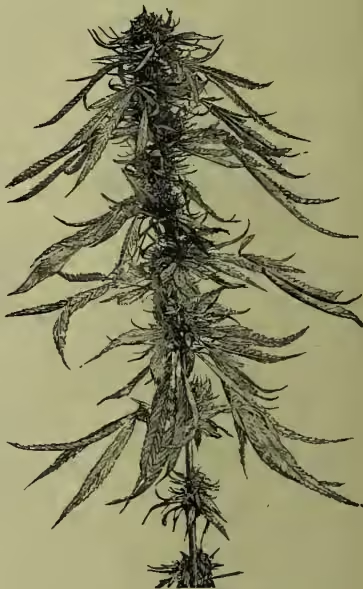
Hemp is cultivated in warm countries not so much for its fibre as for a resinous secretion, which has narcotic or intoxicating qualities (see HASHISH). Hemp is also used as a therapeutic agent under the name of Indian Hemp, or Bhang, and may be administered in the form of resinous extract or of tincture; and it is usually prescribed (like opium) for its hypnotic, anodyne, and antispasmodic properties. Although less certain in its action than opium, it possesses these advantages over that drug—that it does not constipate the bowels, create nausea, or check the secretions, and that it is less likely to occasion headache.
The name Hemp (Ger. Hanf) is from the Greek and Latin cannabis, and that from Sanskrit cana. The name hemp is often extended with some distinctive prefix to many of the fibres used for ropes and coarse fabrics—Sunn Hemp, Manila Hemp, Decan Hemp, Sisal Hemp, &c. See APOCYNACEÆ, BOWSTRING HEMP, FIBROUS SUBSTANCES.