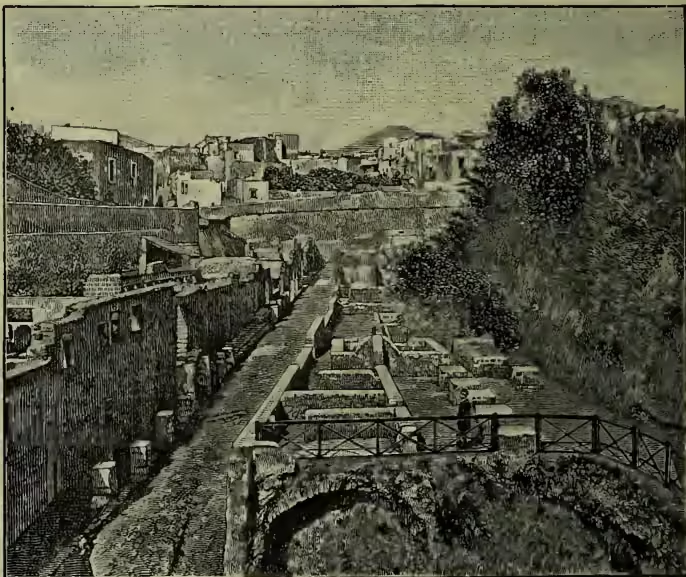
Herculaneum, an ancient city of Italy, so called from the local worship of Hercules, was situated at the north-western base of Mount Vesuvius, about 5 miles E. of Naples. Considerable obscurity envelops its early history; it is supposed, however, to have been of Phœnician origin, and to have been occupied afterwards by Pelasgians and Oscans. It subsequently was conquered, with all the rest of Campania, by the Samnites, and later it fell into the hands of the Romans. In 63 A.D. the city was seriously injured by a violent earthquake; and in 79 it was buried, along with Pompeii and Stabiae, by the memorable eruption of Vesuvius (q.v.) which took place in that year. It now lies at a depth of from 40 to 100 feet below the surface, and is filled up and covered with volcanic tufa, composed of sand and ashes, and consolidated to some extent by water, which is often thrown up in great quantities during volcanic eruptions. Above it, on the modern surface, are Portici and Resina, two villages now absorbed in the suburbs of Naples. In 1706, on the occasion of deepening a well, fragments of mosaics were first brought up; but little was done for systematic excavation till 1738, when explorations were commenced under royal authority. It was then discovered that the building near the bottom of the well, from which the first relics were obtained, was the theatre. This building was forthwith explored and cleared, and several statues, both in bronze and marble, were extracted from it. Excavations were carried on but to a limited extent, not only in consequence of the hardness of the tufa, but from the fear of undermining the dwellings on the surface. Hence but a portion of this entombed city is yet visible, the chief edifice shown being still the theatre, which had been built a short time before the fatal eruption. It has eighteen rows of stone seats, and could accommodate 8000 persons. Part of the Forum with its colonnades, a colonnade (mistaken at first for a basilica), two small temples, and a villa have also been discovered; and from these buildings many beautiful statues and remarkable paintings have been obtained. Of late years excavations have been resumed under government, with important results, particularly as to the plan of Herculaneum, and in 1880 ruins of extensive baths and of the accessory buildings were brought to light. A general view of the exposed city (1889) is given from a photograph. Among the art-relics of Herculaneum, which far exceed in value and interest those found at Pompeii, are the statues of Æschines, Agrippina, the Sleeping Faun, the Six Actresses, Mercury, the group of the Satyr and the Goat, the busts of Plato, Scipio Africanus, Augustus, Seneca, Demosthenes, &c. These treasures, together with such vases and domestic implements as have been found, are on view in the National Museum at Naples. For the classical student La Villa Ercolaneese dei Pisoni, by Comparetti and De Petra (Turin, 1883), is recommended.