Hercules (Gr. Hēracles), the beloved son of Zeus by Alcmena (of Thebes), was intended by his father to be king of the Argives; but Hera, the jealous spouse of Zeus, by a trick caused Eurystheus to become king of Argos. Nor was her wrath satisfied with this; she made Hercules serve Eurystheus, by far the inferior man. And he enjoined hard adventures on Hercules, even sending him to Hades to fetch up the dog Cerberus. Thus Hercules was doomed to a life of trouble, and became the type amongst the Greeks not only of manly strength, but of manly endurance. Besides the labours imposed on him by Eurystheus, Hercules undertook adventures on his own account, killing a sea-monster that ravaged Troy, and destroying Troy when the maars promised him as reward for killing the monster were denied him. His love of horses also led him to kill Iphitus, though his guest. Finally, after death, he himself joined the banquet of the deathless gods, with Hebe as his wife; but his phantom, armed with bow and arrow and gold baldric, with wild boars and lions wrought upon it, terrified the dead in Hades. Thus far according to Homer.
Hesiod adds four more labours, imposed by Eurystheus—the destruction of the Nemean lion, of the Lernæan hydra, fetching the oxen of the triple-bodied Geryones, and the golden apples of the Hesperides; and Hesiod includes amongst the parerga, or voluntary exploits, freeing Prometheus from the eagle which tortured him. From later authors we hear of yet more labours, the number of which was first fixed at twelve by Pisander (who lived about 650 B.C., and wrote an epic poem on the adventures of Hercules), though this number was not regarded as a canon either of poetry or art. They are the destruction of the Erymanthian boar, and of the Stymphalian birds; the capture of the Cretan bull, of the stag of Ceryneia, and of the horses of Diomedes; the cleansing of the stables of Augeas; and obtaining the girdle of the queen of the Amazons. Many voluntary exploits are added by later writers to the parerga mentioned by Homer and Hesiod, and are as a rule brought into connection with the Homeric story of Hercules, the outlines of which they fill up. Thus, Homer mentions Megara as the wife of Hercules; later writers recount that she was the daughter of the king of Thebes, and that her hand was bestowed on the hero in reward for having freed the Thebans from their tribute to the Minyæ. The story of Hercules' service as a slave to the Lydian Omphale is connected with the Homeric story as being the atonement for the murder of Iphitus. When all other resources fail, topography is made to afford the connection. Thus, the fight with the Centaurs is connected with the labour of destroying the Erymanthian boar, because the scene of the one adventure is in the neighbourhood of the other. It is on his way to Thrace in quest of the horses of Diomedes that Hercules rescues Alcestis, who had given her life for that of her husband Admetus, the guest-friend of Hercules. It is on his way back from the west, when he is returning with the cattle of Geryones by way of Italy to Greece, that he destroys the monster Cacus, who stole his oxen. It is on his way to Gadira in search of Geryones' oxen that he travels in the mystic beaker given to him by the sun-god. And finally, it is en passant that he finds the Olympian games also. But in all cases we find that Hercules has become the national hero of the Greeks, and that he is regarded not only as the type of manly endurance, but also as the self-sacrificing hero who succours the oppressed and rids earth of its monsters. As to the manner of his death nothing is said by Homer, but in later times the story was, that, in the agonies caused by the poisoned robe of Nessus sent to him in all innocence as a love-charm by his wife, Deianira, he threw himself on to a funeral pyre on Mount Æta, and was thence carried up to heaven.
It is maintained by some scholars that the origin of Hercules as a mythical figure is not Greek, not even Indo-European, but oriental. And in support of this view there are traits to be found both in literature and art which are undoubtedly oriental. Thus in literature the mystic beaker in which Hercules travels to Gadira is undoubtedly the symbol of the oriental sun-god. The number (twelve) of Hercules' labours is that of the signs of the zodiac. In art the lion-skin which is the characteristic garb of Hercules is undoubtedly a loan from the East; and the resemblances between ancient types of Hercules and the idols of the Phœnician god Besa are undeniable. And even the Greeks themselves identified Hercules with MelcARTH of Tyre. In his physical strength Hercules brings to mind Samsou, and Samson, on the other hand, has been explained by a venturesome mythologist (Goldziher) as being, like Hercules, a solar hero. But on examination the hypothesis of the oriental origin of the figure of Hercules breaks down. It is quite true that there are amongst the many and diverse elements in the myth of Hercules some of undoubtedly oriental origin; but none of these can be traced back further than the time of Pisander. The story of Hercules as told in Homer is purely Greek. Thus the number (twelve) of Hercules' labours, which forms such an admirable basis for the theory that Hercules is a solar hero and of oriental origin, cannot be traced back further than the time of Pisander, by whom it may well have been borrowed from some eastern story, for he lived in Rhodes, which was exposed to oriental influences. The beaker of the sun-god, again, is borrowed from the East, but is no part of the equipment of the original Homeric Hercules. The lion-skin, which subsequently became the characteristic garb of Hercules, was imported from the Orient. This is indicated by the fact that Pisander first introduced it into literature, and is confirmed by the circumstance that it appears in art for the first time in images from Cyprus, which were plainly produced (as might be expected in Cyprus) under oriental influences. But the lion-skin is not found in literature older than Pisander, and it is uniformly absent from older works of art. Finally, the resemblances between the ancient types of Hercules and the idols of the Phœnician Besa are in part due to the fact that the latter date from the time when Phœnician art was already under the influence of Greek.
That the Greeks themselves identified Hercules with some strange god, whether of Egypt or of
Tyre, is natural enough, but proves nothing. They, like the Romans, were ever on the alert to identify the gods they knew of old with the new deities of foreign nations. Indeed, it is in this tendency that we have to look for the explanation of the growth of the story of Hercules. It is because the Greeks recognised, or thought they recognised, their national hero in the oriental sun-god, that traits and stories belonging to the latter became attached to the former. In this way the hero of the Lydian story was identified with Hercules, and the story of his service to Omphale transferred to Hercules. On the same principle we may probably detach the Italian story of the monster Cacus as an accretion. The Italians recognised in Hercules their own native Genius Jovis, of whom the Cacus-story was originally told. Not only was the story absorbed into the Hercules-cycle of myths, but Hercules eclipsed the Genius Jovis in Italy itself. It has, indeed, been supposed that the story of Hercules was known to the Greco-Italians, the common ancestors of Greeks and Italians; but, apart from the doubt which now attaches to the very existence of Greco-Italians, the Latin name Hercules is undoubtedly (like that which it stands for) borrowed from the Greek. Hercules, as a matter of philology, is a loan-word from the Greek Heracles.
Not only, however, is it possible to strip the original Homeric story of Italian and oriental accretions; it is also possible to trace its growth within the limits of Hellas itself. For as the Greeks identified their national hero with foreign deities and heroes, so Hercules came to be the national Greek hero, because the various Greek states identified him with various local heroes. Thus the Ætolian myth of Deianira and the robe of Nessus came to be attached in the time after Homer to Hercules. And even in the Hercules of Homer and Hesiod we can detect at least two local heroes. The son of Alcmenæ of Thebes was probably not originally the same hero as the Hercules whose exploits in destroying the Lernean hydra, Nemean lion, and the Erymanthian boar are localised in the Peloponnesian. And this view is confirmed by the fact that, whereas the Peloponnesian hero is named Heracles, the Theban hero was known as Alceus ('the strong man'), or Alcides ('son of strength'), and compilers of myths had to allege that the change of name from Alcides, the less known name, to Hercules, the better known, was ordained by the Delphian oracle.
Further back than this it seems impossible to trace Hercules. There is no reason to imagine that Hercules was known to the Indo-Europeans before their dispersion; and even if some of his adventures (e.g. the oldest labour—that of fetching up Cerberus from the nether world) are really solar in character, we need not close our eyes to the fact that the strong man is a natural subject for myths.
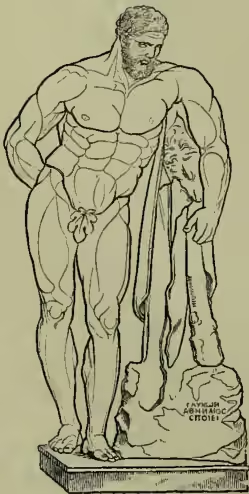
In art, Hercules is represented as the type of manly strength, with muscular limbs, curly hair, and somewhat small head; a club and lion's skin are often added. The most notable statue is the so-called Farnese Hercules, found in the baths of Caracalla in 1599, and now in the museum at Naples. It is the work of the Athenian Glycon, but probably a copy of a work by Lysippus.