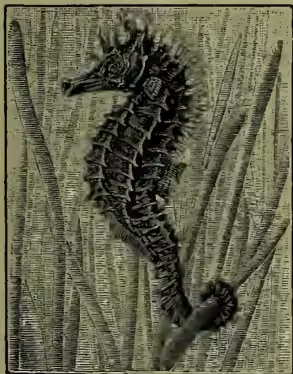
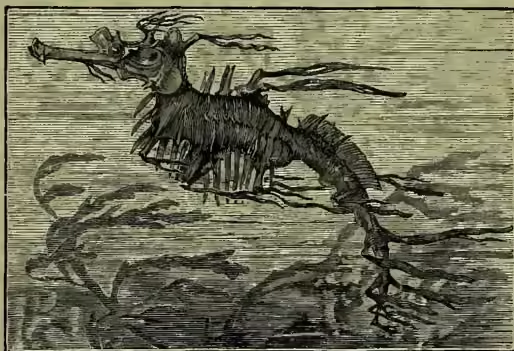
Hippocampus (Gr.; a sea-monster on which the gods rode), commonly called SEA-HORSE, a genus of curiously modified marine fishes, which, with the Pipe-fish (q.v.), compose the family Syngnathidae, belonging to the order Lophobranchii, whose gills are disposed in tufts. They derive their generic name from the remarkable likeness which the head and neck bear to those of a horse, or perhaps even more strikingly to those of the knight in a set of chessmen. They are all characterised by the prehensile tail devoid of a fin, by which they cling to the stems of seaweeds or corals, or even to each other; the body is compressed and more or less elevated; the shields have more or less prominent tubercles or spines; the hinder part of the head forms a flattened crest, terminating above in a prominent knob (coronet); pectoral fins and a dorsal fin are present. The males have a pouch beneath the tail, in which they carry the eggs until they are hatched. As in all other fishes of the order, there is a long snout, and at its extremity a small toothless mouth. The fins vibrate with great rapidity, and present the appearance of a rotating wheel or a delicate waving web, but the animals move only slowly and for a short distance at a time, usually in a half upright posture. There are about twenty species, mostly inhabiting tropical seas; some have a wide area of distribution, as they are not unfrequently carried to great distances by floating materials to which they have attached themselves. H. antiquorum of Australia, the Atlantic, and Mediterranean, is occasionally found on British shores. The allied genus Phyllopteryx, of which three species are known from Australia, is remarkable for its long streaming filaments, which very closely mimic the fronds of the Fucus among which it lives.