Holland, the popular and generally-accepted name of a country which is officially described as 'Netherland,' or 'The Netherlands,' applies to a maritime kingdom lying between 50° 43' and 53° 36' N. lat., and 3° 22' and 7° 16' E. long. It is bounded on the N. by the North Sea, E. by Prussia, S. by Belgium, W. by the North Sea. Its greatest length from north to south is 195 miles, and its greatest breadth from west to east 110 miles. It contains 12,630 sq. m.—little more than one-tenth of the size of Great Britain and Ireland. Luxemburg was long included, but this grand-duchy had a distinct government as a separate state, and Holland only possessed a dynastic interest in it, which passed away with the death of William III. in 1890 (see LUXEMBURG). The following table gives the population of Holland in 1888, the area of the provinces, and the provincial capitals:
| Provinces. | Area in sq. m. | Pop. in 1888. | Provincial Capitals. |
|---|---|---|---|
| North Brabant..... | 1980 | 510,249 | Bois-le-Duc. |
| Guelderland..... | 1950 | 511,273 | Arnhem. |
| South Holland..... | 1160 | 943,495 | The Hague. |
| North Holland..... | 1070 | 819,253 | Haarlem. |
| Zealand..... | 690 | 201,847 | Middelburg. |
| Utrecht..... | 530 | 218,638 | Utrecht. |
| Friesland..... | 1280 | 339,030 | Leeuwarden. |
| Overijssel..... | 1290 | 295,696 | Zwolle. |
| Groningen..... | 800 | 276,052 | Groningen. |
| Drenthe..... | 1030 | 130,208 | Assen. |
| Limburg..... | 850 | 260,161 | Maastricht. |
| 12,630 | 4,505,932 |
At that date the population of Luxemburg (213,000) was also under the king of the Netherlands. At the census of 1889 the total population of the Netherlands was 4,511,415; in 1895 it was 4,795,646.
Thus, in spite of increased emigration to America North and South, and Africa, the population shows 379 inhabitants to the square mile. Holland is the most densely peopled country of Europe, after Saxony (605 inhabitants to sq. m.) and Belgium (558). The population is thinnest in the eastern provinces, and densest in North and South Holland, where it averages about 850 per square mile. About three-fifths of the population are Protestants, and two-fifths Roman Catholics, besides 100,000 Jews.
In 1895 there were eight towns with more than 40,000 inhabitants—viz. Amsterdam, the capital, 450,000; Rotterdam, 235,000; The Hague, residence of the royal family and seat of the government, 180,000; Utrecht, 93,000; Groningen, 60,000; Haarlem, 58,000; Arnhem, 53,000; and Leyden, 45,000.
Physical Aspect.—Voltaire's words, 'Canards, canaux,' aptly describe the leading features of the country—flat, full of water and waterways, swarming with aquatic birds. Like Egypt, Holland, in its greater part, is a delta formed by the alluvium deposited by the great rivers that flow through it into the North Sea. But Holland is not only flat; it is also hollow, and this explains its name—Hollowland. In a large measure the soil lies under the level of the water, salt or otherwise. Along the canals the meadows are 10 or 12 feet, sometimes more, beneath the water-line; by the sea, at high tide, there may be a difference in the level of the soil and of the ocean of quite 25 feet or more. Of course all these lands have to be protected by embankments or dykes, the tops thereof, broad and flat, being used for carriage-roads and foot-paths. The constant battle of the Hollanders against the watery element finds expression in the motto of the province of Zeeland: Luctor et emergo! They utilised the mighty rivers, the Rhine, Waal, and Maas, that traverse and fertilised their country, at an early date; and they have covered the land with a network of canals that is probably unique in the whole world. Apart from forming convenient boundaries, these canals serve a twofold purpose: they are mostly navigable for small craft, and they help to irrigate the land. Large windmills are posted at the main points to pump out the superfluous water; hence they form a conspicuous feature of Dutch landscapes. Other windmills near the towns and villages frequently work for different purposes, but they are one and all remarkable for their peculiar shape and the enormous size of their sails, one single sail reaching often to 120 feet. The canals also provide, when frozen, an important medium of communication to skaters.
HOLLAND
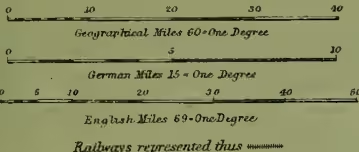
Railways represented thus
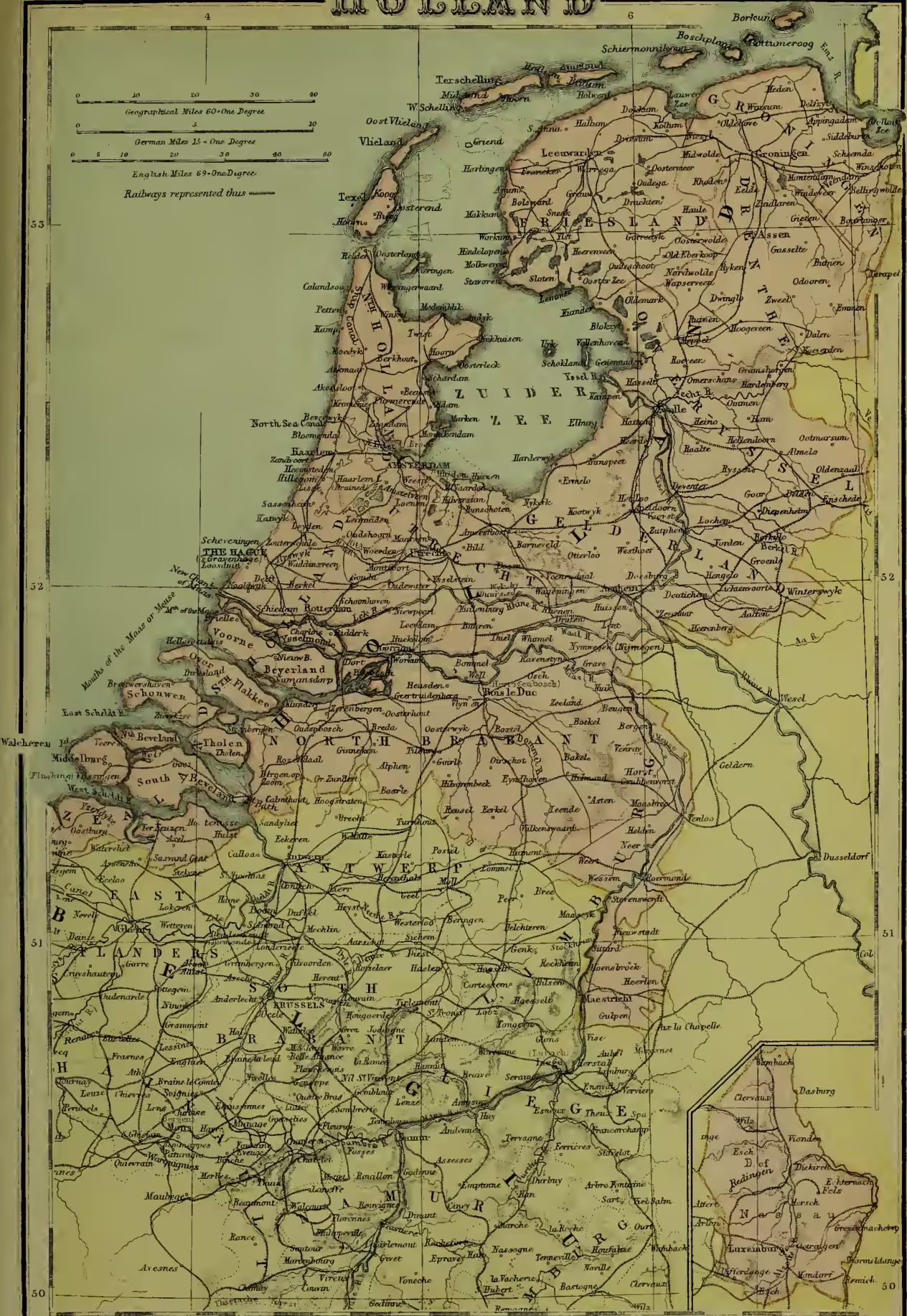
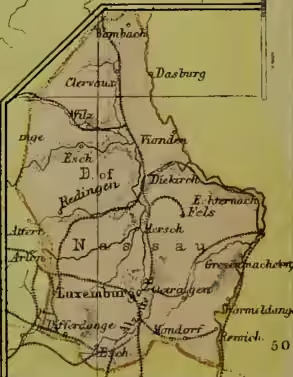
Longitude East 4 5 6 from Greenwich

Some of them date back for centuries; the most ancient is certainly the fossa Drusi in the east, made in the time of Augustus, and referred to by Tacitus. Many canals, regulated by locks (which were probably known in Holland a hundred years before they were introduced into Italy in the 15th century), connect the parallel rivers, and the Yssel forms a link between the Rhine and the canals and meres of Friesland. The latter are vast and somewhat shallow lakes. Thus it is possible to travel on water through the whole of Holland. The principal canals are the North Holland Canal, from Amsterdam to Den Helder, 51 miles long; the William's Canal, through North Brabant and Limburg, which has a length of 71½ miles; the North Sea Canal, from Amsterdam to Ymuiden, on the German Ocean; and the canal from the Maas, near Rotterdam, to the so-called Hoek van Holland, named the New Waterway, which now enables ocean-steamers to reach Rotterdam at all times. We have already described the most important (see CANAL), and we will only add here that in 1890 it was proposed to do away with the locks on the North Sea Canal, making it a level navigable channel for ocean-steamers from end to end. The cutting and maintaining of canals in Holland is one of the chief functions of the Waterstaat, a public department that is carried on under an independent minister of the crown, and is entirely confined to hydraulic engineering. The reclamation of land by the drainage of lakes, and by pushing back the sea and creating what are styled 'polders,' is likewise a leading feature in the operations of the Waterstaat. These newly-reclaimed polderlands always fetch high prices amongst the agricultural classes, as was the case with the Haarlem Lake (q.v.) polder, which was sold in plots at such prices that the state made an excellent bargain. The draining of Haarlem Lake will be eclipsed, should the scheme of laying dry the Zuider Zee (q.v.), which involves an estimated outlay of £26,000,000, be carried out. This would enrich Holland with a new province of about one and a half million acres.
The maintenance of dykes by the Waterstaat forms another task of vital moment; the safety of the state depends upon their constant strength and resisting power where there are no hills or dunes to offer a natural protection against the encroachments of water. It is a mistake to suppose that the ocean is Holland's most treacherous and formidable foe; the rivers, when swollen by heavy rains or falls of snow, are much more dangerous. As the riverbeds naturally rise by alluvial deposits, the embankments have to be made higher and higher. In times of peril a special dyke service is organised, and headquarters are kept informed night and day by a body of Waterstaat engineers, who direct their trained workmen to the points that are more immediately threatened. Dykes form a very expensive item in the budgets of Holland. Half a million pounds will not cover the annual cost to the state. Besides, many dykes are almost entirely maintained out of local rates. The most formidable and costly sea-dykes are round the western coast-line of Walcheren Island, and near Den Helder in North Holland. These dykes are veritable ramparts, formed by piles at the base, which support a superstructure of earth and stones. The annual cost of keeping one in repair frequently reaches £8000 to £10,000. Despite the care and precautions of ever vigilant and ingenious men, disasters through inundations form but too familiar a feature in the history of Holland. A series of irruptions of the ocean created the Zuider Zee between 1170 and 1395. As Goldsmith says in his Traveller, the Dutchman has 'scooped out an empire' from the ocean, and the old Dutch proverb that God made the sea but the Hollander the land holds true to this very day.
Communications.—The oldest railway of Holland is the line connecting Amsterdam and Rotterdam by way of Leyden, which was commenced in 1837. The principle of state railways was settled in 1860, and extended in 1873 and 1875. The whole country is now covered by a network of railways built out of state funds, and in 1890 there were 1630 miles open for traffic. They are not worked by the government, but by a company, which pays the treasury a certain proportion of the net profits. There are several private railways, but the present tendency is to make them state properties. The country roads, mostly paved with bricks, are broad and excellent, but tolls are still maintained. The old-fashioned way of navigating the canals in trek-schuiten, or boats drawn by horses, or men and even women, along a towing-path, is tending to disappear. The number of passengers carried by state and private railway lines in 1894 was over 24,300,000. During the year 1894, 130,000,000 letters and 4,385,000 telegrams were forwarded. Postal savings-banks were instituted in 1881; in 1895 the deposits amounted to 32,250,000 guilders.
Climate, Agriculture, Produce, &c.—The climate of Holland is much like the climate of England, especially in its frequent and rapid changes; but, as a rule, the Dutch summer is hotter and the Dutch winter colder. Ague is prevalent in the low-lying regions of the west, and foreigners are particularly liable to suffer from its ravages.
Agriculture in its various branches forms one of the leading pursuits of the Dutch. In 1896 there were 25,555 farm-owners and farm-tenants. Land tenure is similar to that in France, and fee-simple with peasant-propriety is the rule. Cattle-rearing and dairy-farming have been the Dutch farmer's chief occupations from time immemorial. This explains why arable land in Holland only covers an area of 2,150,000 acres, while meadows cover 2,800,000 acres. The farm-stock in the year 1886 consisted of 272,700 horses, 1,530,800 head of cattle, 802,700 sheep, 1,161,200 goats, and 458,200 pigs. Dutch sheep, very large in size, were formerly exported to England in great numbers, until disease stopped the trade, and the same thing happened with cattle. In 1889 the British Privy-council again authorised the importation of live Dutch cattle and sheep. Dutch farmers have suffered heavily through cattle disease, which was at its worst in 1874; but the government has succeeded in stamping it out entirely. Dutch beef and Dutch milch-cows are much esteemed in England and in America. The United States and South Africa buy many horned cattle in Holland for breeding purposes, also Friesland horses, which are extremely strong, and Holland trotters. Dairy-farming had fallen off very much, especially in Friesland, once famous for its butter, because the Dutch dairy-farmers clung to antiquated methods, and so were outstripped by foreign competitors. Holland, formerly one of the chief markets for dairy produce, has now become the principal producer of butter substitutes. But, taught by disastrous experience and the example of Denmark, the Dutch dairy-farmers are at last introducing the 'factory system' and other improvements. Holland exported in 1895 butter to the value of £1,403,000, and cheese to the value of £1,160,000. The common Dutch cheese comes from Gonda, and the round balls are from Edam in North Holland. The staple agricultural products are wheat, rye, oats, potatoes, beet-root, chicory, flax, and tobacco. The use of modern implements, such as steam-ploughs, &c., is now spreading rapidly, like the application of artificial manures.
The soil of Holland is not uniformly fertile. Large tracts of land, especially in the eastern provinces, are simply heath; and the waste lands of Holland covered an area of more than 1,700,000 acres in 1897. A society has been founded for the afforestation of these tracts. The orchards of Boskoop, producing excellent fruit, like the prolific district of Westland, should be mentioned, as also the famous culture of Dutch bulbs at Haarlem and the surrounding districts.
Minerals.—As may be readily believed, minerals are scarce in Holland; but valuable clay for the manufacture of tiles, bricks, and pottery is found everywhere in great abundance, and the making of the famous old Delft-ware is now reviving. Coal is worked in Limburg, and also a soft sandstone.
Manufactures, Industries, &c.—The chief manufactures are linen, woollen, cotton, and silk fabrics, paper, leather, glass, &c. Leyden, Tilburg, and Veenendaal are famed for woollen blankets, wool-dyed pilot, fine cloths, and friezes; 's Hertogenbosch (Bois-le-Duc) for linens and rich damasks. Calicoes, shirtings, drills, table-cloths, striped dimities, &c. are made at Almelo, Amersfoort, and other leading towns. Excellent imitation Suyma carpets are manufactured at Deventer, and imitation Scotch and other kinds are made at Delft, &c.; turkey-red yarns, dyed silks, and silk stuffs at Roermond, Utrecht, Haarlem, &c.; leather, glass, firearms at Maastricht and Delft; iron-founding, rolling and hammering of lead and copper, cannon-founding are carried on at The Hague, &c. Breweries are numerous (541 in 1887): Middelburg, Bois-le-Duc, Amsterdam, Nimeguen, &c. have important ones, those of Bois-le-Duc and Amsterdam manufacturing large quantities. Waalwijk, Heusden, and surrounding districts manufacture boots and shoes. Gin is distilled at Schiedam, Delft, Rotterdam, and Amsterdam. The distilleries of gin ('Hollands') form an important branch of Dutch industry, over 500 existing at the end of 1897. The liqueur factories are of national importance. Amsterdam once had the largest diamond-cutting trade in the world, 10,000 persons depending on that branch of industry; but latterly, owing to various causes (the dearness of rough stones being one of them), the trade has fallen off. Sugar-refining was carried on by 11 establishments in 1895, and there were then also 30 beetroot sugar factories, 50 salt-works, and nearly 600 breweries. The manufacture of cocoa has assumed enormous proportions in the last few years, and there are large works at Weesp, at Amsterdam, and at Rotterdam. North Brabant is the principal centre of the Dutch margarine trade, exported to England in immense quantities. Something like ninetenths of all the margarine sent to England (value £2,498,500 in 1896) comes from Holland.
Fisheries.—The fisheries of Holland, although no longer so important as at one time, are still noteworthy. At the end of 1895 they gave employment to 17,650 men and boys, on board 5189 vessels. The herring-fishery produce annually between 3,000,000 and 4,000,000 barrels from the North Sea alone, and 300,000 tons of salt herrings may be exported in a single year. Trawling is extensively resorted to. 'Dutch cooperating' has been virtually abolished by the international North Sea Conventions (see COOPERAGE). Between 25,000,000 and 35,000,000 oysters are annually taken, and a fourth thereof exported to England. The fisheries of Holland are estimated to yield annually £3,000,000.
Imports, Exports, and Shipping.—The Dutch are no longer the 'carriers of Europe,' but their carrying trade is still very considerable. The total imports into Holland and exports thence were, in 1894, £121,750,000 and £93,000,000; and the imports from and exports to the United Kingdom in 1894 were £27,606,400 and £8,787,500 respectively. Holland of all European countries does the largest amount of foreign trade per head of population; in 1888, £37, 7s. 1½d. per head (more than thrice that of Great Britain and Ireland). In 1895 the mercantile marine consisted of 425 sailing-vessels of a burden of 110,800 tons, and 157 steamers of 183,000 tons.
Revenue, Expenditure, &c.—The revenue of 1890 was estimated at about £10,109,000, and the expenditure at £11,256,000. The East Indies revenue for 1890 was estimated at £10,677,000, the expenditure at £11,700,000. The East India colonies, once a burden, were long a source of profit, but are now a burden again. From 1850 to and with 1874 £25,376,218 was paid off from the national debt. In 1880 the debt amounted to £78,601,216, and the annual interest payable on it was £2,328,000; in 1888 the debt proper was upwards of £88,000,000, besides £1,250,000 in paper money. The annual charge, even after a recent reduction, was still estimated at £2,581,000 for 1890. The great bulk of the national debt is held in Holland; the national prosperity is increasing, and an enormous amount is invested in foreign funds and American railways.
Colonies.—The colonies of Holland are stated to have an area of upwards of 700,000 sq. m. (more than three times the area of the German empire), with a population of about 30,000,000. They fall into two groups: (1) the East Indian possessions, including Java and Madura, Sumatra, the Moluccas, Celebes, Timor, parts of Borneo, and the western part of New Guinea; and (2) the West Indies, of which the chief are Surinam and Curacao. The factories on the coast of Guinea were disposed of by sale to Great Britain in 1872. The principal colonies are treated at length in separate articles.
Government.—The government of Holland is a limited constitutional monarchy. The modern Grondwet, or Constitutional Law, of 1848, was altered in 1887 to suit new electoral and other requirements. The crown is the executive power; legislation is vested in the States-general. The king presides at a council of state, whose members are appointed by him. Its functions are similar to those of the Privy-council in Britain. He also selects ministers, who countersign all royal decrees, and whose responsibility is settled by a special law. The States-general is divided into a first and a second chamber. The second chamber consists of one hundred members, the first chamber of fifty members, the former being elected by direct suffrage, the latter by the provincial councils from among the highest-taxed citizens in the state, or those that hold or have held important public posts. The members of the second chamber are elected for four years. Only male subjects thirty years old, in the full possession of their civic rights, are eligible. Each member receives by way of salary £166 a year, and, besides, a stipend for travelling and incidental expenses during each session. The members of the first chamber are elected for a term of nine years. No one can be a member of the two chambers simultaneously. Ministers may sit in both, but only possess a consultative voice. The second chamber alone has the right of amendment and of initiating legislation. All judges are appointed by the crown for life. There is a supreme tribunal (at The Hague), and ministers, members of the States-general, and certain high officials can be arraigned only before it. There is no state religion, but the state supports financially the different churches.
Education.—Primary instruction is provided by the state in all places where it is required. Private schools are freely permitted, but subject to inspection; and teachers must qualify for their task under a government examination. There are ancient universities at Leyden, Utrecht, and Groningen, and since 1877 a new university at Amsterdam, supported by the municipality. The four universities have upwards of 3000 students. There are Latin schools in the leading municipalities. There are also the Royal Military and Naval Academy at Breda, and that for engineers and the Indian civil service at Delft, besides seminaries in several places for the training of the Roman Catholic clergy, &c. The state pays 30 per cent. of the expenditure on the public schools, and the communes or parishes 70 per cent. In 1895 there were over 3000 elementary public schools, 1351 elementary private schools, and about 150 secondary schools. The pupils in the public elementary schools number 475,000. About 600,000 children under twelve receive some sort of school education, but 10 per cent. none. There is no compulsory attendance in Holland, and many can neither read nor write (5 per cent. of illiterate recruits).
Army, Navy, &c.—The strength of the regular army in Europe is about 62,000 men, and of the colonial army about 40,000 men, some 15,000 thereof being Europeans. Dutch troops are not allowed to be sent to India. The Dutch home army is composed of volunteers, and of a varying proportion of men drawn by lot for five years' service. There is also a local force, called Schutterij, drawn by lot from those between twenty-five and thirty-four years of age, to assist in keeping order in peace, and in case of war to act as a mobile corps, and do garrison duty. North and South Holland can be inundated at short notice.
The royal navy on 1st January 1897 consisted of 120 men-of-war, 24 being ironclads. Six are large cruisers, each of 3400 tons, built of iron and steel. There are also numerous torpedo boats for the defence of the coasts and river-mouths.
History.—About a century and a half before our era, a Teutonic people, known to the Romans as the Batavi, and who came from Hesse, occupied the land between the Rhine and the Waal. At this time the Frisians occupied the country north of the Rhine to the Elbe. The Batavi and Frisians differed little in appearance, manner of life, and religion. They clothed themselves with skins, fished, hunted, and led a pastoral life; were faithful, frank, chaste, and hospitable. The songs of the bards composed their literature and history. Warlike and brave, they selected their leader for his courage and prowess, and were armed with a bow and a short spear. They worshipped the sun and moon, and held their meetings in consecrated woods.
The Romans having subdued the Belgæ, next attacked the Frisians, who agreed to pay a tribute of ox-hides and horns, but continued restless and rebellious. The Batavi became allies of Rome, paying no tribute, but supplying a volunteer contingent, chiefly of cavalry, which was renowned for its impetuous bravery, and helped to win the battle of Pharsalia for Cæsar. About 70 A.D. Clandius Civilis, a Batavian, made a bold effort to overthrow the Roman power in Rhenish or Germanic Gaul, but failed in the end. Roman supremacy endured until the 4th century, when the inroads of the Salic Franks were followed by the Saxons and other tribes. The Franks took possession of the Insula Batavorum, and the name of the Batavi vanished. Christianity spread among these tribes, and even the Frisians, who were violently opposed to it, were forcibly converted by Charles Martel. At the end of the 8th century all the Low Countries submitted to Charlemagne, who built a palace at Nimegnen, on the Waal. The feudal system now began to develop itself, and dukedom, counties, lordships, and bishoprics arose, the bishops of Utrecht, the dukes of Guelderland, and the counts of Holland being among the most powerful of these petty rulers, who owned but very little allegiance to their lords. During the 9th and 10th centuries the districts of the modern Netherlands belonged to Lotharingia, which acknowledged alternately French and German sovereignty. The nucleus of the county of Holland, and the beginning of its power, were the work of Dirk III., who died in 1039. Count William II. was even made King of the Romans (1248) through the influence of Pope Innocent IV. The Crusades weakened the power and resources of the nobles and prelates, so that, during the middle ages, cities began to assume importance, strengthen themselves with walls, and choose their own rulers.
In 1384 the earldom of Flanders passed, through marriage, to the Duke of Burgundy, whose grandson, Philip the Good, made it his special life-effort to form the Netherlands into a powerful kingdom. He bought Namur, inherited Brabant with Limburg, and compelled Jacoba of Bavaria to resign Holland and Zealand. Charles V., as heir to Burgundy, inherited and united the Netherlands under his sceptre. He fostered trades and industries in the Low Countries, and under his rule they attained a great prosperity, whilst cities like Bruges and Ghent reached the zenith of their wealth and power. But he also tyrannised over the land with an iron will and hand, drained the life-blood of the nation for his continual warfare, and depopulated north and south by an implacable Inquisition, which it is computed put to death in various forms at least 100,000 persons for heresy. Yet he was at times popular with the people. He spoke their language. He always remained a Fleming; and Ghent, after attempting to betray him and rising in rebellion against him in 1539, owed her ultimate escape from the destruction which Alva counselled entirely to the fact of the emperor's citizenship. His son Philip II., who succeeded to the throne in October 1555, was a character of the very opposite type. A Spaniard born, he remained a Castilian to his dying day—austere, harsh, narrow, domineering, fanatical. He never spoke a word of Dutch, nor did he understand the people. With Philip II. commenced that terrible and desperate and long-fought struggle of Holland and Spain which finally resulted in the throwing off of the Spanish yoke, in the establishment of a free, strong, and prosperous commonwealth among the marshes of the low-lying delta. This heroic contest of the few against the many, of a handful of isolated burghers against the combined forces of the most powerful state in Europe, has excited a wonderful amount of interest in the civilised world. Motley, with the now countless editions of his great work, The Rise of the Dutch Republic, and its continuation, has done more to popularise the story of the so-called Eighty Years' War of the Low Countries against Spain than any of his predecessors.
Philip II. only remained in Holland for four brief years and then left it, never to return, appointing as regent Margaret of Parma, mother of the famous Farnese, and a natural daughter of Charles V., with a council, to which belonged Viglius, Berlaymont, the afterwards notorious Cardinal Granvella, Bishop of Arras—all friends and flatterers of the young king and enemies of the people—as well as Egmont, who had won the battles of St Quentin and Gravelines for Philip, and the king's lieutenant in Holland, Zealand, and Utrecht, young William of Orange, then completely unknown to fame. As the latter took leave of Philip, who was embarking at Flushing to return to Spain, the king bitterly complained to him of the opposition already mani- fested against his measures. These were mainly the maintenance of a standing Spanish army and of the Inquisition—both contrary to the laws and privileges of the people, as well as to his own solemn vows before ascending the throne. Orange tried to persuade the king that he had nothing to do with the resistance complained of, as the Estates were acting on their own responsibility when they had petitioned his majesty. Whereupon Philip seized the Prince of Orange by the wrist, shaking it violently, and exclaiming in Spanish, No los Estados, ma vos, vos, vos! ('Not the Estates, but you, you, you!'). The king on this memorable occasion showed as much perspicacity as his reign betrayed perverseness and perfidy. In William of Orange, then only twenty-six years old and six years his junior, Philip had truly recognised his worst foe, his most dangerous opponent, and the soul of the coming struggle against the royal authority. The king's secret correspondence is there to confirm this view. Born on 16th April 1533, William belonged to an ancient family ruling a small principality in the south of France (see ORANGE), but his ancestors, originally vassals of the pope, had settled in the Netherlands, where they occupied high functions under the princes of the House of Burgundy. William had been a favourite with Charles, whom he accompanied everywhere. It was thus that William had been able to acquire that profound knowledge of the military art, and to grasp the intricacies of the prevalent occult diplomacy in which he afterwards proved himself such a consummate master. It was while he was hunting with the king of France in the Forest of Vincennes that Henry II. communicated to William of Orange the fiendish plot France and Spain had concocted to massacre all the Protestants in both countries. Henry II. did not know then the man to whom he had been so communicative: he had spoken to William the Silent. The prince never betrayed the least emotion. He buried in his bosom the project of a crime which, although a devout Catholic himself (though a Protestant afterwards), he had resolved to prevent at all hazards. He saw the storm coming. He determined to face it, to devote his fortune, his best powers, and his life to the cause of the weak against the strong, of the free against crushing despotism, fighting Philip with his own weapons, and having but one noble, self-sacrificing ambition—the welfare and the liberty of the people.
There is no doubt that Philip was betrayed by those in whom he had most implicit confidence, and that William of Orange knew of all the king's intentions and movements. Thus he was aware that Alva had collected an army in Italy by the orders of Philip in order to extirpate an abominable rebellion of heretics by sword, and re-establish the Inquisition. The prince warned his friends Egmont and Hoor in good time against the imminent danger; but they heeded not what he said, and paid for their folly on the scaffold of Brussels as soon as Alva had arrived there with 10,000 picked troops and had established his Council of Troubles. This was no better than a council of butchers, and by means of it 20,000 inoffensive burghers were hurried to their doom. William escaped to Germany in order to organise the national defence with his brothers. But his task was well-nigh hopeless. What could he do with a handful of half-paid and under-fed hirelings? In 1572 the position of affairs could scarce have been more desperate. The Spaniards were absolute masters of the land, and the people, crushed under a reign of bloody rapine, had ceased to hope for deliverance, when the bold capture of Briel, by the Beggars of the Sea, on the 1st of April 1572—a great date in Dutch history, duly honoured in 1872—changed the whole aspect of affairs. They were marauders, those Beggars of the Sea, desperadoes clinging to the broad, hospitable ocean, after having been driven from the land by the Spaniard; but they were also patriots who had adopted as a title of honour the opprobrious epithet that Berlaymont had given them when they were petitioning the regent for the maintenance of their rights, and they held Briel for 'Father William.' Their daring capture became the sign of a general revolt, and soon William the Silent was again at the head of affairs, 'in the name of the king,' still nominally maintained as the ruler of the land. Orange's projects, which consisted of a junction with the French Huguenots, were indeed direfully frustrated by the butchery of St Bartholomew. The southern portion of the Low Countries could not be delivered from the clutches of the enemy and were for ever lost to the cause of freedom; but the north continued the struggle single-handed, and at last Alva had to depart in disgust without having accomplished his mission. His successors could do nothing to retrieve Philip's fortunes or damp the inspiring influence which the heroic defence of towns like Haarlem, Leyden, and Alkmaar had infused into the burghers of the new state. The military chest of the Spanish commanders was always empty, as the Dutch, masters on the sea, cut off all supplies, and revolts were frequent among the Spanish soldiery. Ottavio Farnese, Duke of Parma, who succeeded to the lieutenancy in 1578, saw but one way of settling the question, and that was the forcible removal of William of Orange. Philip, who had held all along the same sinister designs, was only too eager to fall in with this plan. In June 1580 there appeared that infamous ban, which declared William a traitor, a miscreant, and an outlaw, putting a heavy price upon his head (25,000 gold crowns), and promising the king's pardon and titles of nobility to whosoever might be found willing to rid the land of him. William replied in his famous Apologie; but he was not able to cope with a royal assassin. Numerous attempts against the prince's life were made, and although they failed for a time, the bravo's work was finally accomplished. Balthasar Gerards, the miserable instrument of a royal murderer, shot William dead with a pistol, purchased with the very money the prince had given him by way of alms to a 'poor Calvinist.' This took place at Delft on 12th July 1584, near the top of a staircase which has been preserved in the same state ever since. Gerards was arrested, tortured, and finally put to death in an atrocious manner; but no expiation, however awful, could bring to life again the noble patriot.
The blow was crushing and irreparable, yet William might have fallen at a moment even more critical to Holland than July 1584. He did not leave his country in a state of paralysed chaos. The Union of Utrecht, accomplished in January 1579, had cemented the alliance of the northern provinces banded together against the king of Spain; and the solemn declaration of July 1581, by which the free Netherlands for ever renounced their allegiance to Philip II., had virtually completed William's task of deliverer. His manifesto of renunciation and denunciation would alone have sufficed to stamp him as a man of genius in the eyes of posterity. It is a remarkably clear, bold, and spirited defence of a people's rights against the claimed rights of the anointed king at a time when the former had been forgotten. Yet William's doom, far from undoing his work, as Philip and Parma hoped, only tended to make it more durable. The bloody deed seemed to spur the whole nation to a revolt fiercer than ever. Maurice of Nassau followed in his father's footsteps, and the successes of the Dutch, especially at sea, became more numerous. Parina, indeed, took Antwerp after a long siege, but failed to effect a junction with the Armada in 1588, as the Hollanders prevented his fleet from leaving the Scheldt; and when the great general died in 1592, six years before his master, he had not accomplished his mission. Philip III. was not more fortunate, and could do nothing better than sign in 1609 the twelve years' armistice with the 'rebels,' who were already masters of the sea, had laid the foundations of their great Indian empire by the establishment of the East India Company in 1602, and practically had made their own conditions. Maurice had been against the armistice, but he was overruled by the States, who wanted peace for trading. Unfortunately, the breathing time to 1621 was in a large measure filled up with religious and political dissensions between the adherents of Gomarus, the orthodox Lutherans, and the Arminians, the milder-mannered followers of Arminius, to whom Hugo Grotius and other celebrated men of the time belonged. These disputes culminated in the persecution of the Arminians, who were forced to flee, like Grotius, or were put on their trial for high-treason, like Olden Barneveldt, the Grand-pensionary of Holland, and one of her most distinguished sons, who was beheaded in 1618 with the approval of Maurice. But these internal troubles did not check the progress of the new republic. Maurice died in 1625, and his brother Frederick Henry finally freed his country from the Spaniards, who in 1648 were compelled to recognise the 'rebels' as an independent nation by the treaty of Munster.
In this epoch lies, perhaps, the period of Holland's greatest material and intellectual development. Her ships could be seen everywhere, and the Dutch had become the general carriers of the world's trade. Amsterdam, grown powerful and rich, was the Venice of the north, where, besides commerce proper, both banking and stockbroking reached a flourishing stage at an early period. From this emporium started the fleets of the great trading companies, and the vessels of intrepid explorers like Hudson, Heemskerck, Houtman, Lemaire, Tasman, and many others. Dutch agriculture and floriculture, gaining new experience and teaching fresh methods, grew famous, and so did many branches of science and industry. The first optical instruments came from Holland, and Huygens gave us the pendulum-clock. Arts and letters flourished, and the names of Erasmus, Grotius, Vossius, Burman, Gronovius, Boerhaave, Spinoza, Huygens, Rembrandt, Cuyp, Van der Helst, Hobbema, Potter, and many more became known and illustrious far beyond the national frontiers. The art of printing, perhaps not a glory of Holland in its inception (see PRINTING), had at any rate attained a high degree of perfection there in the 17th century, as the names of Plantin and Elzevir testify. The liberty of the press, secured at an early date, led to the establishment of numerous newspapers, Dutch and foreign. The foreign news-sheets of Holland, mostly published in French, were sent all over the world, as they contained the latest intelligence and things that were not allowed to appear in print elsewhere. The Gazette de Leyde was among the oldest and most powerful of these early journals (1680-1814).
The rising power of Holland had the natural result of creating envy and cupidity in her nearest neighbours. The first serious antagonism came from England, where trade and navigation were also rapidly coming to the front. Both countries were then pure commonwealths—Cromwell ruling in England, and the Grand-pensionary John de Witt having virtually the destinies of the United Provinces in his hands since the death of Frederick Henry's son, the last stadtholder before William
III. Cromwell's Act of Navigation, which aimed at the destruction of Holland's monopoly in the carrying trade, led to the great naval war of 1652-54, during which twelve important battles, more or less decisive, were fought, and both nations distinguished themselves by the intrepid daring of their commanders and seamanship. Yet otherwise the result was barren, though the names of De Ruyter, Tromp, Evertsen, and Van Galen shone forth ever afterwards. These hostilities between Holland and England were renewed when Charles II. had been restored by General Monk; but the war of 1664-67 remained as undecisive as its predecessor, despite De Ruyter's daring feat of sailing up the Medway, which caused for a while wild panic in the British capital.
An ensuing war with France, now allied with England against the United Provinces, was much more serious, as De Witt had done his best to strengthen the navy, but at the cost of a totally neglected army. The hosts of Louis XIV., under captains so famous as Condé and Turenne, made short work of all resistance that Holland could offer on land, although De Ruyter's fleet kept the allied squadrons at bay, and thus, probably, saved his country from political annihilation. At the most critical juncture a violent popular reaction set in against De Witt and his brother Cornelis, and in favour of the young Prince of Orange, who had been held back by their party. John de Witt, one of the most clear-headed and bold statesmen of his day, was murdered as a traitor by an infuriated mob at The Hague, and the stadtholdership re-established in the person of a prince then (1672) only twenty-two years of age. But the people's instinct had been right after all, for William III.'s accession proved the salvation of Holland, as it also accomplished, later on, the political regeneration of England. The fortunes of the war changed immediately with William at the head of affairs. He showed himself an able tactician and a still more skilful diplomatist. By dexterously manoeuvring between Holland's enemies he managed to gain time and isolate France. At last, in 1678, Louis XIV. was compelled to sign the treaty of peace of Nimeguen, as William had become, for the time being, the ally of the king of England, by his marriage with Mary, daughter of the Duke of York. William was not satisfied with what the peace of Nimeguen gave to Holland; and the following years were passed in preparing for the great events which he no doubt saw rapidly approaching. The revocation of the Edict of Nantes flooded Holland once more with political refugees, who here found a new fatherland, and who subsequently helped to fight the battles of Europe against their common tyrant. In the English Revolution of 1688 by William III., many of these Huguenots played an active and prominent part. To Holland the inauguration of the new era in England did not mean peace, but it meant an honourable alliance and security from further encroachments of the French king. The Dutch troops fought bravely in the battles of England, even after William's death in 1702; and Ramillies, Oudenarde, and Malplaquet, which saw Louis's greatest humiliation, were as much Dutch victories as La Hogue was an English victory.
The peace of Utrecht, in 1713, marks the close of Holland's activity as a great power in Europe. For her the 18th century was the century of demoralisation and decay. After William's death she became a republic once more; the stadtholdership was re-established in 1747, but it made no difference in the downward course. The National Convention of France having declared war against Great Britain and the stadtholder of Holland in 1793, French armies overran Belgium (1794); they were welcomed by the so-called patriots of the United Provinces, and William V. and his family (January 1795) were obliged to escape from Scheveningen to England in a fishing-smack, and the French rule began. The United Provinces now became the Batavian Republic, paying eight and a half millions sterling for a French army of 25,000 men, besides giving up important parts of the country along the Belgian frontier. After several changes Louis Bonaparte, 5th June 1806, was appointed king of Holland, but, four years later, was obliged to resign because he refused to be a mere tool in the hands of the French emperor. Holland was then added to the empire, and formed into seven departments. The fall of Napoleon I. and the dismemberment of the French empire led to the recall of the Orange family and the formation of the southern and northern provinces into the ill-managed kingdom of the Netherlands, which in 1830 was broken up by the secession of Belgium (q.v.). In 1839 peace was finally concluded with Belgium; but almost immediately after national discontent with the government showed itself, and William I. in 1840 abdicated in favour of his son. Holland being moved by the revolutionary fever of 1848, King William II. granted a new constitution, according to which new chambers were chosen, but they had scarcely met when he died, March 1849, and William III. (born 1817) ascended the throne.
The bill for the emancipation of the slaves in the Dutch West Indian possessions, passed in 1862, decreed a compensation for each slave, and came into force in 1863. The expenses of this emancipation came to £1,065,366, and the number of slaves set free was about 42,000, of whom 35,000 were in Dutch Guiana.
In 1863 the naval powers bought up the right of the king of Holland to levy toll on vessels navigating the river Scheldt (q.v.), the king of Belgium binding himself also to reduce the harbour, pilot, and other charges on shipping within that kingdom. In 1868 the Luxemburg (q.v.) question was settled in a manner satisfactory to Holland. Next year capital punishment was abolished. In 1872 a new treaty with England, defining and limiting the sphere of influence and action of Britain and Holland in the Indian Archipelago, and removing the restrictions of the treaty of 1824 as to Sumatra, was followed by a war with Atcheen, until then an independent Malay state in North Sumatra (see ATCHEEN), a war that severely taxed the military and financial resources of the Dutch-Indian government, and is still carried on, in a modified form, the so-called conquest of 1873-75 notwithstanding. William III. having no living male issue, the succession to the crown was vested in the Princess of Orange, Wilhelmina, the only child of the king's second marriage, born in 1880. For many years the great question of internal politics was the new constitution, which, promulgated November 30, 1887, increased the electorate of Holland by no less than 200,000 voters. A revision of the school-laws in a sectarian sense was carried in 1889. In 1888 the queen, Emma of Waldeck, had been appointed regent in the event of the king's demise; and on the death of the king (23d November 1890), when Luxemburg ceased to be connected with the crown of Holland, the Princess Wilhelmina became queen.
Language and Literature.—Dutch is an essential link in the chain of Teutonic languages, a wonderful storehouse of old and expressive Germanic words and phrases. It has been said that Old English is Dutch, and to no other nation is the study of the Netherlandish more interesting than to the English. Without a knowledge of Dutch it is almost impossible to properly understand the historical development of English. It is a common mistake to suppose that Dutch is merely a German dialect. As a language it has existed as long as German, and passed through the same series of evolutions. It possesses many affinities with German, because, like Frisian, Danish, &c., it sprang from the common Teutonic stock (see DUTCH; and for the relation of Dutch and Low German to High German, see GERMANY, Vol. V. p. 186); but between modern High German and modern Dutch there is less similarity in vocabulary than between modern English and modern Netherlandish, although the pronunciation differs much more in the latter case. Three great periods of development must be distinguished in the Netherlandish language, as in the German; the first was the period of inception, or of Old Netherlandish, when doubtless various Teutonic dialects existed among the tribes and peoples that had penetrated westward from the Elbe and the Oder. A curious relic of this ancient Netherlandish exists in a fragmentary translation of the Psalms, dating from the 9th century. It does not seem to belong to any one language, but looks like an attempt at combining the dialects then existing. The second period comprises the Middle Netherlandish, which developed soon after the 11th century, and became the popular tongue of a very considerable area, spreading far beyond the Rhine in the east, and covering not only the greater part of Belgium, as it now exists, but also the northern portions of France, where Old Dutch persists to this very day in the villages, with the wondrous tenacity of popular tongues. The second period is rich in fabliaux and romances of chivalry, but these were nearly all of foreign origin, mostly French and some English. Among them we name Fergus, Roman van Lancelot, Walewein, Floris en Blancefloer, all republished of late, but not easily understood without a dictionary of Middle Netherlandish. Reinaert (see REYNARD THE FOX) is a truly national epic of considerable importance. But the most prominent representatives of Middle Netherlandish literature are Jakob van Maerlant (13th century) and Jan Boendale (14th century). The former was the author of the famous Spiegel Historiæ; the latter wrote didactic poems, the best known of which is Der Leven Spiegel. To this period also belong Jan van Heelu's description of the battle of Woeringen and Melis Stoke's chronicles of Holland.
The origin of new Netherlandish or Dutch is to be found with the Rederijkers, whose rise can be traced to the commencement of the 15th century. They were mainly lovers of letters and the theatrical art, banded together in Kamers, 'chambers,' or clubs, for the purpose of study and mental recreation. In the course of time, when the troubles with Spain arose, these clubs no doubt also became centres of political agitation, and this led to their suppression in the southern provinces; but in the north, as soon as political freedom had been attained, they developed into literary associations of considerable importance. The most famous was the 'chamber' called In Liefde Bloeiende ('thriving in love') at Amsterdam, to which Coornhert (1522-90), Spiegel (1549-1612), and Roemer Visscher (1547-1620) belonged, the latter a literary merchant, and the father of two ladies who became celebrated for their learning amongst the men of letters of that period. Coornhert, Spiegel, and Visscher in 1584 caused a Dutch grammar to be published, and this may be called the foundation-stone of modern Netherlandish. Hooft (1581-1647) was the first to recognise the worth of his mother-tongue and to write a classical Dutch in which he strove to eliminate as much as possible all foreign elements, although a great admirer of classical lore and foreign literature, especially
French and Italian. At Muiden he formed a literary club which exercised very great influence. Hooft wrote his Historiën, but he also excelled in poetry and in the drama. Among his famous contemporaries is Vondel (1587-1679), who is considered the greatest of Holland's poets, and who, indeed, soars high in his dramas, still performed before appreciative audiences in our days. Milton, it is said, borrowed from Vondel, and passages taken from the masterpieces of the two poets certainly bear a curious resemblance. Vondel, some of whose dramatic works have been translated into German and English, was a very prolific poet. Yet his poetry can hardly be called so popular as that of Jacob Cats (1577-1660), whose maxims were for a long time, with the Bible, the only book found in every cottage. Cats is witty, but coarse; and Bredero, whose comedies deserve mention, is scarcely better in this respect. Van der Goes, who composed a beautiful poem on Amsterdam, ranks among the best of Vondel's disciples (1647-84); Oudaen (1628-92) is noted for his political poems and his dramas; Constantyn Huyghens, the father of the great mathematician, for his epigrams and his didactic poetry (the Korenbloemen, 'corn-flowers,' is still read and admired); and Brandt, for his historical writings.
This is the great period of literary activity in Holland previous to the revival which marked the end of the 18th century. Writers who were desirous of being read beyond the limits of their vernacular had to use Latin; and Erasmus, Boerhaave, Grotius, Spinoza, to mention only a few of the most famous, would scarcely have been so well known had they written exclusively in the language of Vondel.
The 18th century is the period also of literary decadence in Holland; the only great names are those of Feith and Bilderdijk (1756-1831). The latter wrote poetry such as has not been equalled since in the Dutch language, and it is a national loss that his great epic poem, The Destruction of the First World, remained unfinished. Bilderdijk also ranks high as a historian, and his philological studies deserve credit, though his learning was sometimes misled by his ingenuity. Among Bilderdijk's contemporaries are Helmers, whose patriotic songs against the French created in Holland as profound a sensation as Körner's in Germany, and the two literary ladies, Deken and Bekker, whose novels (one of them translated into German), written in conjunction, are true pictures of Dutch life in those days. The poems of Tollens (1780-1856) came later, and still retain their hold on the popular fancy (especially in the words of the national hymn) notwithstanding the appearance of numerous still more modern competitors, among whom we can only mention here Van Beers, Beets, Da Costa, Schimmel, Hofdijk, and J. Van Lennep. Schimmel is also noted for his dramas and historical romances, the plots whereof he loves to place in England, when not in Holland. Beets has been truly called the Charles Dickens of the Dutch, as his inimitable Camera Obscura (sketches of Dutch life) proves. These two authors are not unknown in England and America, as portions of their work have been translated. So have some of the stirring novels of Van Lennep. Hofdijk, who died in 1888, is known for his faithful and eloquent historical writings not less than for his lyrical poetry. Potgieter, Ter Haar, Heye, Ten Kate, and many others have each excelled in a particular branch of poetry. Among noteworthy novelists we must mention Hendrik Conscience, 'Miss Wallis' (a daughter of Dr Opzoomer), and Mrs Bosboom Toussaint; and we cannot conclude without paying a tribute to the undoubted gifts of 'Multatuli' (Douwes Dekker), whose Max
Havelaar has been translated into nearly every European language. 'Maarten Maartens' writes powerful novels in English; and Maeterlinck has been called 'the Flemish Shakespeare.' In law and theology the names of Opzoomer, Kruenen, and Kern are almost as well known without as within the kingdom.
In this necessarily rapid sketch we have made no distinction between Dutch writers in Belgium and Dutch writers in Holland. In fact, there is no distinction; they express their thoughts in the same language. The words 'Flemish' and 'Flemlander' have been invented by the French, and only serve to obscure what is a fact—viz. that there never has been a greater difference between the Dutch as taught at Antwerp and the Dutch as taught in Amsterdam than between Boston, Edinburgh, or Manchester English. There have been slight varieties in the spelling; but these have disappeared since the orthography of 1864 has been adopted in both the north and the south, and modern Netherlandish is now the language of some 7,000,000 Netherlanders, of whom 2,500,000 politically belong to Belgium. This is perfectly well understood in the two countries themselves, where Dutch philological and literary congresses are annually held in a northern and a southern centre by turns. In Belgium there are more Dutch than Walloons, and the Belgian constitution does not recognise a preponderating French language. No doubt the Dutch Belgians have only latterly insisted upon the maintenance of their rights in this respect; but ever since the so-called 'Flemish movement' commenced they have steadily gained ground, and all the French encroachments are being swept away. Dutch is being taught everywhere in the schools, and a knowledge of Dutch is essential in many functions, even in those of the king, who was taught Netherlandish by the great novelist Hendrik Conscience. The latter was one of the prime movers in the Dutch reaction in Belgium, wherever the names of Willems, Blommaert, Snellaert, Snieders, Hiel, Van Beers, &c. will for ever remain associated—some as fiery poets, some as noted prose-writers.
For statistics, consult the annual Staatsalmanak, which possesses a semi-official character; the publications of the Dutch Statistical Society, Amsterdam, particularly Jaarcijfers, a statistical annual in French and Dutch, in two parts, one of which deals with the colonies; the Algemeene Statistiek, in several volumes, which is an official survey of the kingdom, with full particulars, but now somewhat antiquated in many details; the annual reports of British consuls in the Netherlands; the Almanach de Gotha, &c. For general descriptions and travel, see the works of Montégut, Esquiros, and particularly Henri Havard; his volumes in pleasant French (three of which, The Heart of Holland, Picturesque Holland, and The Dead Cities of the Zuyder Zee, exist in English) have much contributed towards propagating sound knowledge of the land and people. D'Amicis' Ollanda (trans. into English) is also useful. For history, the writings of Prescott, Motley, Thorold Rogers, Wagenaar, the very valuable collections of Gachard and Groen, the histories of Th. Juste, Bilderdijk, Fruin, Arend, Nuijens, Hofdijk, &c. (all in Dutch, except Juste, who wrote in French) should be consulted. The most accessible literary history is Schneider's Geschichte der Niederl. Literatur (Leip. 1888), which is also the best in many ways.