Horn, FRENCH (Fr. cor, cor de chasse; Ital. cornu, cornu de caccia; Ger. horn, waldhorn), one of the most important, as it is the softest toned, of brass instruments used in orchestral music. Its soft and peculiar tone is due to the length of the tube, the shape of the bell, and the funnel-like bore of the mouthpiece.
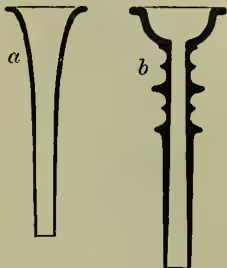
This latter important point will be understood from fig. 1, which shows a section of the horn mouthpiece (a) contrasted with that of the trumpet (b), the most brazen of brass instruments. The original French horn was used in hunting, and consisted of a long tube with two or three turns made large enough to go over the shoulders of the hunter. It was used from a very early period, but it was Louis XV. who composed the complete set of sounds and fanfares still used in the French hunting-field.
It was introduced into the orchestra in the early part of the 18th century, and it gradually acquired the important position it now holds from the smooth softness of its tones as a foundation for harmony in chords, and its fine contrast with other instruments.
For orchestral purposes the instrument was improved by the addition of crooks of varying lengths, so as to pitch it in different keys; and thus horn music is always written in C with the key added to show the crook to be used. These crooks are usually eight in number, and extend from A♯ in alto to C basso; the lowest crook making the total length of the instrument a little over 16 feet. There are also tuning crooks, raising or lowering either of the others a semitone, and also a tuning slide for the more accurate tuning with the other instruments. The open notes of the horn are the harmonics of its fundamental note (see HARMONICS), and as this, from the length of the tube, is very low, the harmonics in the middle scale are at very short intervals with many consecutive notes. It may be given approximately thus:
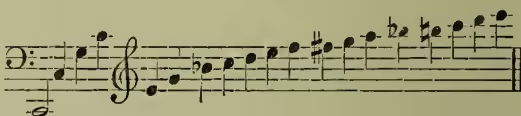
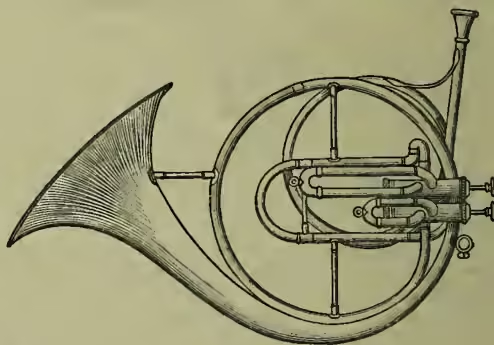
The notes actually sounded, of course, depend on the crooks used. The method of forming the intermediate notes by hand-stopping was discovered by a player named Hampl at Dresden about 1770. The open hand, with the fingers close together, is introduced into the bell, lowering the pitch a semitone. These stopped notes, however, have a muffled sound, and in modern times the horn is almost always made with two or three valves to bridge over the intervals. Fig. 2 shows the horn with two valves as commonly used. On account of the frequent changes of pitch, and the number and tenderness of its open notes, it is a difficult instrument to play. The horn is very seldom used singly; either two or four being the usual number in the orchestra.
Handel, Mozart, Beethoven, Schubert, Weber, Mendelssohn, Rossini, Schumann, and all composers of note have given the horns a most important place in their works. See article 'Horn' in Grove's Dictionary of Music.
POSTHORN, a straight brass or copper instrument, varying from 2 to 4 feet in length, and somewhat resembling the bugle in its taper bore; it has a small cupped mouthpiece. It was used as a signal instrument by the guards of mail-coaches, but has occasionally been introduced into light music. It has the same open notes as the Bugle (q.v.). The hunting-horn, used in England, is a shorter instrument of the same kind. The Saxhorn (q.v.) is a different instrument.