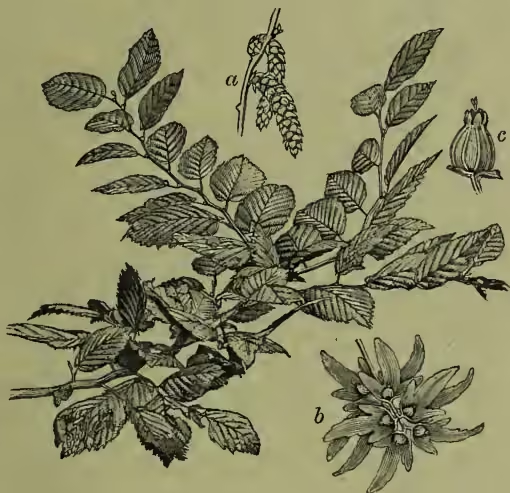
Hornbeam (Carpinus), a genus of the natural order Amentaceæ, consisting of trees with compact, tough, hard wood; bark almost smooth and of a whitish-gray colour, deciduous leaves, and monœcious flowers. The male catkins are cylindrical and sessile; their flowers consist merely of a little scale-like bract and twelve to twenty-four stamens. The female catkins are slender, several inches long when in fruit, and conspicuous for their long leaf-like bracts, and containing small, ovoid, prominently ribbed nuts. The flowers appear in spring as the leaves come out. Such are the characteristics of the Common Hornbeam (Carpinus betulus), which is believed to be indigenous to Britain, but is best known as a plantation tree. It has a wide range of distribution on the continent of Europe.
The tree attains a height of from 30 to 80 feet—rarely the latter. The wood is white, very compact, hard, and tough, but does not now rank high commercially. It is occasionally used by joiners, turners, and wheelwrights, but, being capable of receiving a fine polish, is more in demand for purposes of ornament than utility. It was formerly in Britain, and is yet in many parts of Europe, preferred for making yokes for cattle—hence, according to some authorities, the name hornbeam. It is one of the best of firewoods, and, the leaves, like those of the beech, being persistent in winter, it is employed as a hedge plant for purposes of shelter. There are a very few other species of Carpinus natives of Europe, Asia, and North America, differing chiefly in the size and shape of the fruiting bracts.