Hyacinth (Hyacinthus), a genus of plants of the natural order Liliaceæ; bulbous-rooted plants with corolla-like, bell-shaped, 6-cleft perianth, six stamens fixed in the tube of the perianth, and dry capsular fruit. The flower was fabled to have sprung from the blood of the beautiful Spartan Hyacinthus, beloved of Apollo and Zephyrus. Zephyrus, jealous because Hyacinthus favoured Apollo, caused Apollo's quoit to strike and slay the beauteous youth while the two were at play.—The Oriental Hyacinth (H. orientalis), one of the most favourite of florists' flowers, is a native of Asia Minor, Syria, and Persia. It is now naturalised in some parts of the south of Europe. It has broad linear leaves, and a scape with a raceme of many flowers pointing in all directions. The flowers in cultivation exhibit great variety of colour, chiefly blue, purple, and white. They are very beautiful and very fragrant. The fragrance is strongest about or after eleven o'clock at night. Among cultivated hyacinths are many with double flowers.
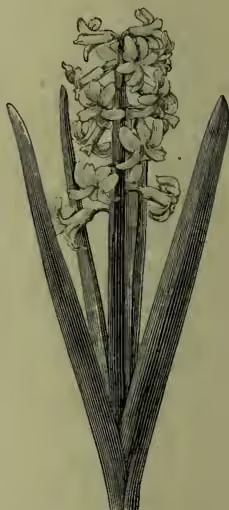
(Hyacinthus orientalis).
The hyacinth has been cultivated from a remote period. It was introduced into Europe, probably by the Dutch, about the beginning of the 16th century, soon after the revival of commerce, when the traders of Holland carried their merchandise to the eastern shores of the Mediterranean and the Archipelago. It was very little known in Britain till towards the beginning of the 17th century, but soon after its cultivation had become a passion with the wealthy, as it had for some time been with the Dutch. Extravagant prices—as much as £200—were paid for a single bulb of varieties having special or rare merits. This passion declined towards the middle of the 18th century, and the cultivation of the hyacinth became very much depressed. In recent years, however, it has been very much extended, and forms one of the principal industries of florists around Haarlem, which is and always has been the centre of the Dutch bulb trade; but their efforts are now directed with the view of meeting the demand of the million rather than the special requirements of the fanciful wealthy few. Hyacinth bulbs, planted in pots, readily produce beautiful flowers; and flowers almost equally beautiful are obtained—for one year only, however—by placing them in water in hyacinth-glasses, in which they form a favourite ornament of apartments in winter and early spring. The cultivation of hyacinths in the open ground is much more difficult, their early growth being liable to be destroyed by adverse weather. New varieties are raised from seed. Several other species of hyacinths are natives of the south of Europe, Africa, &c.—The Grape-hyacinth and Globe-hyacinth, frequently cultivated as garden flowers, are now referred to the genus Muscari.—A common British plant, growing in woods and copses, with beautiful blue flowers very like those of the oriental hyacinth, but all drooping to one side (H. non-scriptus, also known as Scilla nutans, Endymion nutans, and Agraphis nutans), is sometimes called the Wild Hyacinth, and sometimes the Blue-bell (q.v.). The bulbs have been used for making starch.—The name hyacinth is also given to varieties of garnet, topaz, sapphire, and zircon.