Hydrangea, a genus of plants of the natural order Hydrangeaceæ, which many botanists make a sub-order of Saxifragæ, distinguished by having four to six petals, eight to twelve or many stamens, a more or less inferior ovary, and two to five styles. In hydrangea the flowers are in cymes, the exterior flowers sterile and dilated. Few species are known, and they are chiefly natives of the southern parts of North America, and of China and Japan. The species popularly known as the Hydrangea (H. hortensis) is a native of China and Japan, and has long been in cultivation there as an ornamental plant. It was introduced into Britain by Sir Joseph Banks in 1788, and speedily became very popular, being readily propagated by layers and cuttings, so as to be not only a favourite greenhouse plant, but a frequent ornament of cottage windows. In the south of England, and south-west of Scotland, it endures the open air. It seems almost impossible to water it too freely; and in favourable circumstances it becomes a magnificent shrub. A plant in Devonshire has had 1000 large cymes of flowers expanded at once. The flowers, generally pink, are sometimes blue; the blue colour is owing to peculiarities of soil.
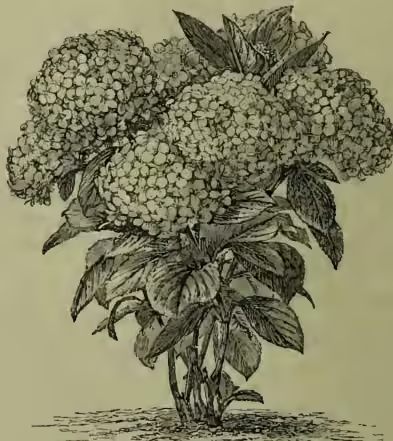
Peat and iron ore are said to be productive of blue flowers in the hydrangea. H. Japonica, introduced into Europe from Japan by Siebold, is remarkable for its very large cymes of flowers.—H. nivea and H. quercifolia, American species, are not unfrequently to be seen in flower-gardens in North America.