Hydra, a fresh-water polyp, the simplest and most familiar representative of the class Hydrozoa (q.v.), sub-kingdom Cœlenterata (q.v.). The animal consists of a tube, varying from to inch in length, closed at the proximal end by an adhesive plate (pedal disc), whereby it is commonly attached to some water weed; at the other (distal) extremity is the mouth, at the apex of a blunt cone (hypostome), round whose base arise from six to
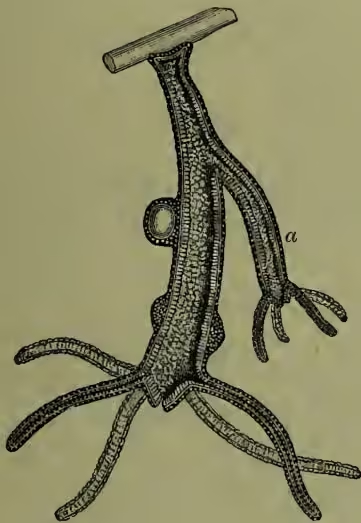
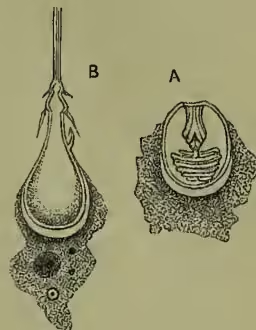
Semidiagrammatic longitudinal section of an adult specimen, with reproductive organs and a bud (a); magnified eight diameters. (After Marshall and Hurst.) eight tentacles. These are slender tubes closed at the end, but continuous internally with the main cavity of the animal; they have a warty appearance and, according to their degree of contraction, may be either small rounded nodules or stretch out to several times the length of the body. The prey, which is benumbed by the thread-cells to be presently described, is drawn by the tentacles into the mouth. The body-wall consists of three distinct layers: I. The Ectoderm, or outer covering, consists of the following kinds of cells: (1) covering cells in a single layer, subconical, with the broader ends outwards. (2) Muscle-cells, whose base forms a filament, disposed longitudinally. (3) Interstitial cells, small, rounded and placed in groups between the bases of the larger cells. (4) Cnidoblasts, so called because they contain the thread-cells (cnidocysts, nematocysts). These latter have rather a complicated structure; they consist of an ovoid sac, at the outer end of which the wall is invaginated or tucked in to form a long tube coiled up like a string: the commencement of the invaginated portion contains some pointed barbs, the end is filiform and pointed. The young cnidoblasts, in which the development of the thread-cells is just beginning, are situated deeply among the interstitial cells; when mature they are placed on the surface, and form noticeable prominences between the covering-cells; the cnidoblast remains as a sharply-defined capsule round the thread-cell, and near the aperture of invagination it gives out a little process (cnidocil), which seems to serve the purpose of a trigger, for upon touching it the tube contained in the thread-cell is suddenly everted, and then presents the appearance of a long pointed filament, with barbs, disposed in circles of three each, at its base. It is, however, only certain forms of irritation which produce this effect; it seems to be under the control of the nervous system. (5) Nerve-cells, with numerous processes, some of which are continuous with the cnidoblasts. (6) Glandular cells, which are restricted to the pedal disc. II. The Endoderm, or internal layer, consists of three kinds of ciliated cells: (1) a layer of large cells which often contain granules of greenish matter resembling that of leaves (chlorophyll). They have the power of throwing out processes (pseudopodia) during digestion, and almost always have empty spaces or vacuoles in them; they may furthermore give rise to muscular filaments, both circular and longitudinal. (2) Small glandular cells in the hypostome. (3) Glandular cells with vacuous spaces at the base of the body-cavity. III. The Mesoderm is a thin structureless lamella, separating the ectoderm and endoderm.
The hydra reproduces by two distinct modes: (1) asexually by gemmation. When the weather is warm and food abundant, a hollow outgrowth takes place from the side of the body of the parent; a mouth and tentacles are formed at its distal extremity, and eventually it separates by constriction of its base, and commences an independent existence. Several buds may form at once, and these may even produce secondary buds before their separation from the parent, but this formation of colonies is merely temporary. (2) Sexual reproduction takes place when the conditions of life become unfavourable—e.g. if a hydra which has just begun to bud be placed in a vessel in which food is scarce, sexual organs will be formed and the bud will not improbably be absorbed. The male organs (testes) are conical swellings, situated not far below the tentacles: generally they are more than one in number. They arise by the multiplication of the interstitial cells of the ectoderm, and when mature their contained spermatozoa are shed into the water. The ovum is as a rule single, and is due to the development of one of a mass of interstitial cells; the surrounding cells form a protective capsule which eventually retracts and leaves the most prominent part of the ovum bare to receive the spermatozoa. After this the ovum undergoes segmentation, a hard capsule is formed around it, and it falls to the bottom and there develops into a young hydra. Prior to sexual reproduction the hydra often retires into the shade of moss or similar dark objects. As regards its reproductive organs it seems most probable that hydra has undergone great modifications as compared with other hydrozoa, and that its simplicity is not primitive but the result of degeneration. The food of hydra consists of organisms more minute than itself, which it is able to paralyse by its thread-cells; after the nutritive portion of these has been extracted the effete portions are ejected through the mouth. The animal can creep slowly upon its disc and swim by the same organ, hanging suspended below the surface of the water; it creeps by bending the body, attaching a tentacle to the surface upon which it rests, and then moving the foot up to the tentacle and refixing it.
Various species of the genus Hydra have been described, as H. viridis, H. fusca, and H. vulgaris. The first is distinguished by the presence of green chlorophyll granules in the cells of the endoderm. It has been maintained that these were algae living within the cells in a state of Symbiosis (q.v.), but the facts that the green hydra does not lose its colour in the dark, that the coloured bodies have neither nucleus nor cell-membrane, and that they are found in the ovum where they originate from colourless bodies, tend to prove that they are integral parts of the animal.
If a hydra be cut in two, it appears that within certain limits each portion will develop into a complete animal; but the statement so often repeated, as the result of Trembley's experiments, that when a hydra is turned inside out the endoderm and ectoderm will mutually take on each other's functions, and the animal continue to live, is erroneous: the animal will, on the contrary, rectify its position, or, if prevented, it will perish. When a hydra captures a fragment of food too large to be taken into the mouth, it everts the endoderm so as to bring the digestive cells in contact with the food, but it speedily regains its original state; this explains the power it has of rapidly recovering after artificial inversion. Two hydæe can be permanently fused with each other either by pinning them together with bristles or by inserting one inside the other.
List of more important references in addition to the ordinary text-books of zoology: Kleinenberg, Hydra (Leip. 1872); Jickeli, Morphologisches Jahrbuch, viii. (1882-83); Parker, Proc. Roy. Soc., xxx. (1880); Lankester, Nature, xxvii. (1882-83); Korotnev, Ann. and Mag. Nat. Hist. (5) xi. (1883); Ischikawa, Zeitschr. f. wiss. Zool. xlix. (1890).