Hydrozoa, one of the main divisions of the phylum or sub-kingdom Cœlenterata (q.v.), the other two being Ctenophora (q.v.) and Anthozoa or Actinozoa (q.v.). Two animal forms (zooïds), reducible to one common plan, are present, which often alternate in the life-history of the individual. Of one of these, the Hydroid or Polyp, the common fresh-water Hydra (q.v.), may be taken as the simplified type; the other is the Medusa or jelly-fish. It is only in this latter or in some degenerate form of it that sexual organs are produced (except in the case of Hydra). The Hydrozoa may be free or fixed, simple or colonial, and these variations in habit, along with the existence of two kinds of zooïds just referred to, render their constitution so complex that it will be advantageous to describe briefly one or two typical forms before giving the systematic arrangement of the group.
In the case of Sarsia the egg produced by the jelly-fish develops first into an ovoid ciliated cellular larva (planula), which attaches itself to some solid object by one end, whilst the other grows into a polyp with mouth and tentacles, a colony being afterwards produced by budding. In the most essential points of its structure the Hydra may be regarded as the type of these polyps; the tentacles, however, are solid, and arranged in more than one circle; they have club-shaped ends beset with thread-cells. The name Syncoryne has been given to the polyps of this genus. Upon the walls of the expanded extremities appear buds, each of which, gradually enlarging and assuming the structure of a Medusa, drops off when ripe and leads an independent existence. It consists of a high bell, the mouth of which is partly closed by a circular veil attached round its margin. The clapper of the bell (manubrium) is long, cylindrical, and contractile, and has a mouth at its extremity leading into a stomach within its base, from which four canals radiate within the substance of the bell. At the margin of the bell they are united by a ring-canal, and beyond this they are produced into long hollow contractile tentacles. Near the origin of these from the ring-canal are situated eyes, which are not merely sensitive to light, but capable of vision. A double nerve-cord passes along the ring-canal, and sexual organs are developed in the wall of the manubrium. The inner and outer surfaces of the bell are covered with ectoderm, whilst the cavity of the stomach and the canals leading from it are lined with ciliated endoderm. There are ectodermal muscles in the sub-umbrella. The eggs produced by the process of sexual reproduction develop into polyps and the whole life-circle is repeated.
In certain cases the Medusa or sexual person, instead of becoming free, has remained attached to the Hydroid polyp, and under such circumstances has undergone more or less degeneration. It may (1) present the principal structural features of a Medusa, except that it is mouthless, and that it has the form of a closed sac owing to the adhesion of the margins of the bell ('adelocodonic gonophore' of Allman), or (2) it may be merely a bud containing sexual products ('sporosac').
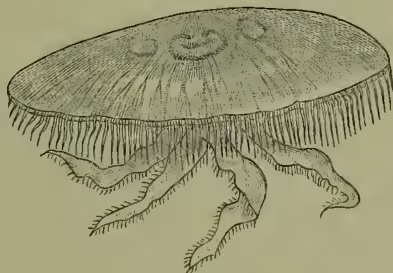
Aurelia aurita, one of the commonest jelly-fishes of our coasts, may be selected as an example of a Medusa of quite different structure. The bell is flattened, thickest in the centre, and notched round the margin. The manubrium is split up into four long pointed processes with fringed margins, and from the stomach and from its four saecular expansions there proceed eight unbranched canals, and eight which bifurcate several times, and are united by a marginal ring-canal. Four ring- or ear-shaped reproductive glands are developed in the base of the stomach, but hang down on the lower surface of the bell. In each of the eight marginal notches, which correspond to the main stems of the branched canals, is a so-called 'marginal corpuscle,' or sense-organ, containing an otolith and a pigment mass. These sense-organs appear to be nerve-centres, and, by their connection with a nervous plexus in the sub-umbrella, to control the movements of the animal: there is no closed nerve-ring. Between the marginal corpuscles are a large number of short tentacles. The egg gives rise to a ciliated planula, which, after swimming freely for some time, becomes fixed and gives rise to a polyp (Scyphistoma) which has at first four, then eight, and then many tentacles. Four internal septa, reaching from the base to the margin of the mouth, divide the cavity of the polyp into a central space and four lateral recesses. Usually the polyp undergoes a series of transverse constrictions, which produce a series of Medusæ, which are set free after the tentacles of the polyp have been absorbed. The organism in this stage is known as a Strobila. After a whole series of Medusæ has been thus set free the polyp can form tentacles afresh, and the whole process can be repeated. The Medusæ when first set free have neither arms, marginal tentacles, radial canals, nor reproductive organs, so that they have to undergo a complicated development in the free state.
The Hydrozoa are widely distributed, and all marine, with few exceptions (e.g. Hydra, Cordylophora). The Hydroid polyps and colonies are attached to foreign substances, the Medusæ and Siphonophora are free-swimming, in most cases near the surface, though certain forms appear to be denizens of deep water (Pectis, Nauphanta, Rhodalia). They are carnivorous, and some are beautifully phosphorescent (Pelagia, Diphyes). A few are fossil—e.g. the palæozoic Graptolitidae and
Stromatoporidæ, and some Medusæ from the Jurassic period, and some from the Chalk. There are about 1000 species, arranged under some 350 genera, which may be classified as follows :
I. CRASPEDOTA (Hydromedusæ).—Hydroid form, either free and temporary, or free or fixed, simple or colonial, and permanent. Sometimes tentaculate, tentacles usually solid ; mouth prominent, gastric cavity simple, skeleton usually chitinous, rarely calcareous. Asexual reproduction, usually by gemmation. Medusoid form, with tubular manubrium, and an inverted velum ; sensory organs, ocelli, or auditory organs. It may become sessile and degenerate. Sexes separate. Almost all marine. (i) Trachymedusæ (Monopsea, Haplomorpha).—Free-swimming Medusæ, with the gelatinous substance of the disc hard and stiff ; no hydriiform phase in development ; tentacles primitively solid ; auditory vesicles present. Examples : Geryonia, Egina. (ii) Hydroidea.—Hydriiform person, with small polyps ; generally colonial, with a chitinous (rarely calcareous) exoskeleton. Sexual only in Hydra. Medusiform person produced by gemmation from the hydriiform, often degenerate. (1) Tubulariæ (Gymnoblasteæ, Anthomedusæ), hydriiform person usually colonial ; no special receptacles for the polyps (theceæ), or the medusiform buds (gonangia) ; sexual organs in the outer or oral wall of the stomach. Medusæ have neither ootocysts nor tentaculocysts, but ocelli at the bases of the tentacles ; and are of the kind known as Anthomedusæ. Examples : Tubularia, Coryne, Cordylaphora. (2) Campanulariæ (Calypptoblasteæ, Leptomedusæ), hydriiform person in permanent colonies, with a single circle of solid tentacles ; hydrothecæ and gonangia usually present ; medusiform persons belong to the division Leptomedusæ, being flattened, having the velum feebly developed ; tentacles 2, 4, 6, 8, up to several hundred, sometimes with ocelli at the base ; auditory organs sometimes present ; sexual glands in the radial canals. Examples : Campanularia, Sertularia, Flumularia. (3) Eleutheroblasteæ, colonies not permanent ; no differentiated gonophores. Examples : Hydra, Protohydra. (4) Hydrocorallia, skeleton calcareous, containing the Stylasteridæ and the Milleporæ (q. v.). (5) Rhabdophora, containing certain Cambrian and Silurian fossils known as Graptolites (q.v.). (iii) Siphonophora.—Pelagic colonies, with several different kinds of modified polyps or Medusæ (see special article).
II. ACRASPEDA (Acalephæ, Scyphomedusæ).—Medusæ, generally of considerable size, with lobed margin, bearing sensory spherules ; manubrium square, usually produced into prolonged angular lappets ; no velum ; the sexes are separate ; nervous centres in the marginal sensory bodies. Hydroid form known in but few instances ; small and fixed, mouth surrounded by a disc, provided with sixteen or more solid tentacles ; multiplies by lateral buds on a creeping shoot ; Medusæ formed from it by transverse fission. All marine. (i) Tessaronia.—Umbrella high, parts disposed in fours, four gastric pouches. (1) Stauromedusæ, without sensory bodies. Example : Lucernaria. (2) Peromedusæ, with four sensory bodies, disposed between the principal radii. (3) Cubomedusæ, with four sensory organs, placed in the principal radii, four simple tentacles, and eight marginal pouches. Example : Charybdea. (ii) Ephyroniæ (Discomedusæ).—Umbrella flattened, parts disposed in eights. (1) Rhizostomeæ, no central mouth, numerous suctorial apertures on eight long root-like arms ; no tentacles. Example : Crambessa. (2) Semistomeæ, four long arms surrounding a simple cruciform mouth. Example : Aurelia. (3) Cannostomeæ, no arms round the mouth, which is square ; tentacles solid, usually short. Example : Nausithoe.
In addition to text-books of Zoology in general, the following works may be consulted : Forbes, Monograph of British Naked-eyed Medusæ (Ray Society, Lond. 1848) ; Agassiz, North American Acalephæ (Camb. U.S.A. 1865) ; Hincks, British Hydroid Zoophytes (1868) ; Allman, Monograph of Gymnoblasic Hydroids (Ray Society, 1872) ; Report on the Hydroidea (Challenger Reports, Zoology, parts 20 and 70, 1883 and 1888) ; Claus, Untersuchungen über die Organisation und Entwicklung der Medusen (1883) ; Haeckel, System der Medusen (1879-81) ; Deep-sea Medusæ (Challenger Reports, Zoology, part 12, 1882) ; Lendenfeld, The Australian Hydro-medusæ (1885) and other papers.