Hydraulic Ram, a simple and conveniently applied mechanism, by which the energy of water falling from a height, , can be made available to force a portion of itself to a greater height, . There is a supply-reservoir, fed, say by a spring, from which a strong pipe, R, conducts the water to the ram at a lower level. The ram has two valves, one, A, opening downwards and inwards, the other, B, opening upwards and outwards; the weight of these valves is such that when the water is at rest its normal pressure is unable to keep them from falling, so that in this condition A would be open and B shut. A cottar on the rod of A keeps it from opening more than a certain amount, and this can be adjusted; the valve B opens into an air-vessel, C, from the bottom of which the delivery pipe, D, leads away. The action is as follows: the water flows from the reservoir through the pipe R, and rushes out through the now open valve A away to the waste-pipe; in doing so it acquires considerable velocity, and its pressure therefore on the under side of the valve A increases, and finally becomes great enough to close it. The flow of the water being thus suddenly checked, produces a great reaction, and by its momentum opens the valve B, and forces a portion of the water into the air-vessel C; the energy being expended, the pressure falls again, B closes, and A opens once more, enabling the water to rush out to the waste-pipe, and so the whole operation is repeated. The two valves thus alternately open and close, and water is delivered each time into the air-chamber, C, the air in which being compressed acts as an air-cushion, keeping up a constant delivery through the pipe D.
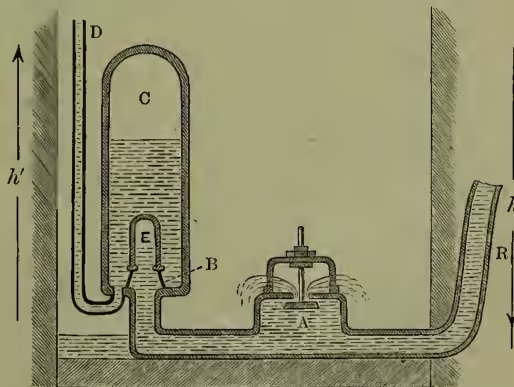
The small air-vessel, E, is for diminishing the shocks, and has a small relief valve in it to admit air when necessary; it is self-acting. The hydraulic ram was an invention of Montgolfier (1797), but has been greatly improved; its mechanical efficiency is good, and for raising small quantities of water, such as are necessary for the supply of single houses, farm- yards, &c.—where water at the lower level is plentiful and cheap, it is a most useful piece of mechanism. It can even be made to work a pump, and so to deliver a supply of pure water when the motive water is muddy or impure.