Hydrostatics treats of the equilibrium of liquids, and of their pressures on the walls of vessels containing them. It is a purely dynamic science, and concerns itself virtually with only two of the many physical properties of liquids. These are density and mobility. In virtue of the latter property, a liquid has no tendency to conserve its shape, so that if a distorting force acts on it it yields without any tendency to recover. It has no Elasticity (q.v.) of form. Viscosity (q.v.) may retard the rate at which the distorting force takes effect; but a liquid will continue to change form so long as there is a force acting on it which is not balanced by a perfect reaction. Thus, in hydrostatic problems, nothing of the nature of a distorting force is taken into consideration. All pressures acting on portions of the liquid must therefore be perpendicular to the surfaces on which they act; and equilibrium requires equality of pressure in all directions at any point.
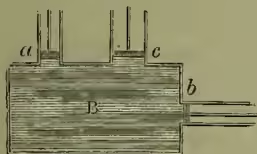
The fundamental property may be thus stated: When a pressure is exerted on any part of the boundary of a liquid at rest, that pressure is transmitted undiminished to all parts of the mass and in all directions. Most of the other propositions of hydrostatics are only different forms or direct consequences of this truth, which may be proved experimentally. Suppose a close box B to be filled with water, and to have inserted into the upper cover a tube a, with closely-fitting plug or piston, 1 square inch in area. If the piston a is now pressed down upon the water with a force equal to a pound weight, the water, being unable to escape, will react upon the piston with the same force; but it obviously will not press more against a than against any other part of the box, therefore every square inch of the interior surface of the box is pressed outward with the force of a pound. If, then, there is another tube inserted in any part of the box with a plug of the same area, as at b, it will require a force of a pound to keep this plug in its place. (We leave out of account at present the pressure upon b arising from the weight of the water in the box above it—i.e. we neglect gravity and consider only the pressure propagated by the forcing down of the plug a.) However many plugs of the same size there may be, each will be pressed out with the same force of a pound; and if there be a large plug of four times the area, as at c, it will be pressed out with a force of four pounds. We have only, then, to enlarge the area of the piston c to obtain any multiplication of the force exerted at a. If the area of c is 1000 square inches, that of a being 1 square inch, a pressure of one pound on a becomes a pressure of 1000 pounds on c; and if we make the pressure on a one ton, that on c will be 1000 tons. This seemingly wonderful multiplication of power has received the name of the hydrostatic paradox. It is, however, nothing more than what takes place in the lever, when one pound on the long arm is made to balance 100 pounds on the short arm.
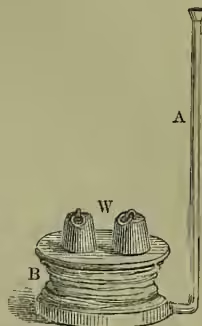
If the pressure supposed to be exerted on the piston a arise from a pound of water poured into the tube above it, it will continue the same though the piston be removed. The pound of water in the tube is then pressing with its whole weight on every square inch of the inner surface of the box—downwards, sideways, and upwards. The apparatus called the hydrostatic bellows acts on this principle (see fig. 2). It consists of two stout circular boards connected together by leather in the manner of a bellows, B. The tube A is connected with the interior; and a person standing on the upper board, and pouring water into the tube, may lift himself up. If the area of the upper board is 1000 times that of the tube, an ounce of water in the tube will support 1000 ounces at W. It is on the same principle that the Hydraulic Press (q.v.) depends.
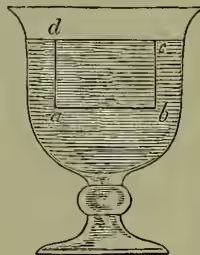
(1) Equilibrium of Liquids.—After this explanation of the fundamental properties of liquids it may be enough to state the two conditions of fluid equilibrium which directly flow from it. (1) Every particle of the liquid must be solicited by equal and contrary pressures in every direction; otherwise there would be a tendency to motion, and therefore motion because of the liquid property of mobility. (2) The upper particles at the free liquid surface must form a surface perpendicular to the impressed force. The truth of this is experimentally demonstrated by the horizontality of the surface of a liquid at rest under gravity. It can be shown to be a consequence of the primary property of 'pressing equally in all directions,' for let da and cb be vertical lines, or lines in the direction of gravity; and ab a plane at right angles to that direction, or horizontal. A particle of the liquid at a is pressed by the column of particles above it from a to d; and the like is the case at b. Now, since the liquid is at rest, these pressures must be equal; for if the pressure at b, for instance, were greater than at a, there would be a flow of the water from a towards b. It follows that the line ad is equal to bc, and hence that dc is parallel to ab, and therefore horizontal. The same might be proved of any two points in the surface; therefore the whole is in the same horizontal plane.
(2) Pressure of Liquids on Surfaces.—The general proposition on this point may be stated thus: The pressure of a liquid on any surface immersed in it is equal to the weight of a column of the liquid whose base is the surface pressed, and whose height is the perpendicular depth of the centre of gravity of the surface below the surface of the liquid (see CENTRE OF PRESSURE). The pressure thus exerted is independent of the shape or size of the vessel or cavity containing the liquid.
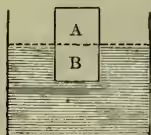
(3) Buoyancy and Flotation.—As a consequence of the proposition regarding the pressure of liquids on surfaces it can be shown that when a solid body is immersed in a liquid its loss of weight is equal to the weight of the displaced liquid—i.e. to the weight of an equal bulk of liquid. Thus, if a cubic foot of the liquid weighs the same as a cubic foot of the solid, the solid will appear to have lost all its weight, and will remain in the liquid wherever it is put; if a cubic foot of the liquid weighs less than a cubic foot of the solid, the solid will appear to lose part of its weight, and will sink; but if a cubic foot of the liquid weighs more than a cubic foot of the solid, the immersed solid will not only lose all its weight, but will appear to be dominated by a negative weight, being urged upwards to the surface of the liquid by a force equal to the difference of the weights of the displaced liquid and the solid. In this last case the solid will rise until it swims or floats on the surface of the liquid, the amount of solid immersed in this final state of equilibrium being determined by the obvious principle that a floating body must be buoyed up by a force equal to its own weight. Here again, then, the solid seems to lose all its weight, which loss must be simply the weight of the displaced water. Thus in fig. 4, where AB represents a floating solid, the water displaced by the immersed part B is equal in weight to the whole solid.
As the buoyancy of a body thus depends on the relation between its weight and the weight of an equal bulk of the liquid, the same body will be more or less buoyant, according to the density of the liquid in which it is immersed. A piece of wood that sinks a foot in water may sink barely an inch in mercury. Mercury buoys up even lead. Also a body which would sink of itself is buoyed up by attaching to it a lighter body; the bulk is thus increased without proportionally increasing the weight. This is the principle of life-preservers of all kinds. The heaviest substances may be made to float by shaping them so as to make them displace a volume of water greater than the bulk of their own solid substance immersed. A flat plate of iron sinks; the same plate, made concave like a cup or boat, floats. It may be noted that the buoyant property of liquids is independent of their depth or expanse, if there be only enough to surround the object. A few pounds of water might be made to bear up a body of a ton weight; a ship floats as high in a small dock as in the ocean.
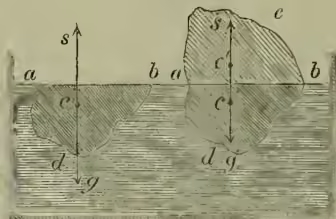
(4) Stability of Floating Bodies.—Conceive abd (fig. 5) to be a portion of a liquid turned solid, but unchanged in bulk; it will evidently remain at rest, as if it were still liquid. Its weight may be represented by the force eg, acting through its centre of gravity e; but that force is balanced by the upward pressure of the water on the different parts of the under surface; therefore, the resultant of all these elementary pressures must be a force, cs, exactly equal and opposite to eg, and acting through the same point c, otherwise the body would not be at rest. Now, whatever other body of the same size and shape we suppose substituted for the mass of solid water abd, the supporting pressure or buoyancy of the water around it must be the same; hence we conclude that when a body is immersed in a liquid the buoyant pressure is a force equal to the weight of the liquid displaced, and acting in the vertical line through the centre of gravity of the space from which the liquid is displaced. This point may be called the centre of buoyancy.
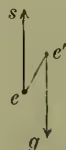
We may suppose that the space abd is occupied by the immersed part of a floating body acbd (fig. 5). The supporting force, cb, is still the same as in the former case, and acts through c, the centre of gravity of the displaced water; the weight of the body must also be the same; but its point of application is now e', the centre of gravity of the whole body. When the body is floating at rest or in a state of equilibrium, this point must evidently be in the same vertical line with c; for if the two forces were in the position of cs, e'g (fig. 6), they would tend to make the body roll over. The line passing through the centre of gravity of a floating body and the centre of gravity of the displaced water is called the axis of flotation.
A floating body is said to be in stable equilibrium when, on suffering a slight displacement, it tends to regain its original position. The conditions of stability will be understood from the accompanying figures. Fig. 7 represents a body
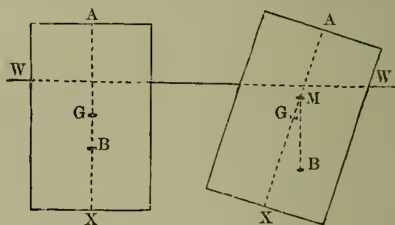
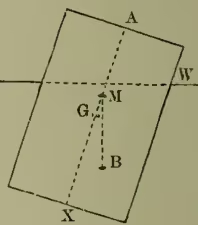
floating in equilibrium, G being its centre of gravity, B its centre of buoyancy, and AGB the axis of flotation, which is of course vertical. In fig. 8 the same body is represented as pushed or drawn slightly from the perpendicular. The shape of the immersed portion being now altered, the centre of buoyancy is no longer in the axis of figure, but to one side, as at B. Now, it is evident, that if the line of direction of the upward pressure—i.e. a vertical line through B—meets the axis above the centre of gravity, as at M, the tendency of the two forces is to bring the axis into its original position, and in that case the equilibrium of the body is stable. But if BM meet the axis below G, the tendency is to bring the axis further and further from the vertical, until the body get into some new position of equilibrium. There is still another case; the line of support or buoyancy may meet the axis in G, and then the two forces counteract one another, and the body remains in any position in which it is put; the body is then said to be in neutral equilibrium. In a floating cylinder of wood, for instance, B is always right under G, in whatever way the cylinder is turned. When the angles through which a floating body is made to roll are small the point M is nearly constant. It is called the metacentre; and its position may be calculated for a body of given weight and dimensions. In the construction and lading of ships it is an object to have the centre of gravity as low as possible, in order that it may be always below the metacentre. With this view, heavy materials, in the shape of ballast, are placed in the bottom, and the heaviest portions of the cargo are stowed low in the hold. See SPECIFIC GRAVITY.