Ice is water in the solid form. It is specifically lighter than water which is just about to freeze, and therefore swims in it. Water, in becoming solid, expands about th in volume or bulk, and thus acquires a density equal to 0.91674 (water at ). The formation of ice takes place generally at the surface of water. This is owing to the peculiarity that, when water has (at the ordinary atmospheric pressure) cooled down to within of freezing, it ceases to contract as it did before with increase of cold, and begins to expand until it freezes (see HEAT); this causes the coldest portions of the water to be floating always on the surface. In some circumstances, not very well explained, ice forms at the bottom of rivers, and is called ground-ice or Anchor-ice (q.v.).
Water in ordinary cases freezes at the degree of temperature marked on the Centigrade and Réaumur's thermometers and on Fahrenheit's; but if it is kept perfectly still it may be cooled to nearly below freezing () and still remain liquid. The least shake, however, or throwing in of a solid body, makes a portion of it freeze instantly, and its temperature rises immediately to Sea-water, and salt water in general, freezes at a lower temperature than pure water; in doing this part of the salt separates, and the ice, when melted, gives water that is fresher than that on which the ice was formed. The colour of pure ice is deep blue, which is only discernible, however, when it is in large masses; it is best seen in the clefts of a glacier or of an iceberg. In order to melt a pound of ice it is necessary to communicate to it as much heat as will raise 80.025 lb. of water This measures the 'latent heat' of ice; the temperature does not rise until the ice has been melted.
In the neighbourhood of the poles, and on mountains of a certain height in all latitudes, there exist immense masses of permanent ice; and even in some districts of Siberia, where a kind of culture is practicable in summer, there are found, at a certain depth below the surface of the earth, strata of ice mingled with sand. In sinking a well at Yakutsk, the soil was found permanently frozen hard to the depth of 382 feet, and consisting in some parts entirely of ice. In the lower regions of the torrid zone there is no ice, and in the temperate zones it is a passing phenomenon. From the polar ice-fields and glaciers which are always protruding themselves into the sea, great floating masses become detached and form ice-bergs, floes, and drift-ice (see GLACIER). These bergs or mountains of ice rise sometimes more than 250 feet above the sea-level. They present the appearance of dazzling white chalk-cliffs of the most fantastic shapes. Fresh fractures have a green or blue colour. From the specific gravity, it is calculated that the volume of an ice-
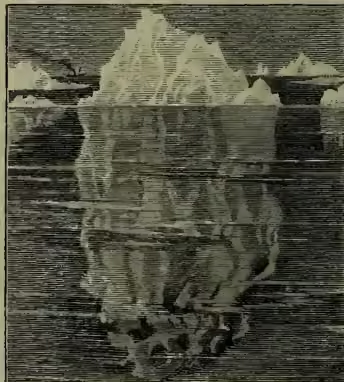
berg below the water is about nine times that of the protruding part. Icebergs, and floes or ice-fields, are often laden with pieces of rock and masses of stones and detritus, which they have brought with them from the coasts where they were formed, and which they often transport to a great distance towards the equator. These floating masses of ice are dangerous to navigation. The ice-foot is the belt or fringe of ice along the shores in arctic regions.
The hardness and strength of ice increases with the degree of cold. In the severe winter of 1740 a house was built of the ice of the Neva at St Petersburg, 50 feet long, 16 wide, and 20 high, and the walls supported the roof, which was also of ice, without the least injury. Before it stood two ice-mortars and six ice-cannon, made on the turning-lathe, with carriages and wheels also of ice. The cannon were of the calibre of 6-pounders; the thickness of the ice was only four inches, and yet it resisted the explosion.
Faraday first called attention to a remarkable property of ice, since called Regelation. Two slabs of ice, with flat surfaces, placed in contact, unite into one mass even though the temperature of the surrounding air be considerably above the freezing-point. Faraday endeavoured to account for this by assuming that a small quantity of water, surrounded on every side by ice, has a natural tendency to become ice; and the fact that two blocks of ice placed in contact do not unite unless they are moist seemed to bear out this idea. But J. Thomson gave a totally different explanation of this phenomenon. He showed that the capillary force in the film of water between the plates is sufficient to account for a very considerable pressure between them; so that from his point of view the phenomenon would be identical with the making of snowballs by pressure, or with the formation, by a hydraulic press, of clear blocks from a mass of pounded ice, an observed fact, the explanation of which is to be found in the property of ice mentioned below. Faraday, taking up the question again, showed that the (so-called) regelation takes place in water as readily as in air, a fact quite inconsistent with the action of capillary forces. To this J. Thomson replied, showing, very ingeniously, that the capillary forces he at first assumed are not necessary to a complete explanation of the observed phenomena. See Proceedings of the Royal Society, 1860-61.
Other views of the question are numerous: for instance, that of Persoz, adopted by Forbes, in which ice was considered as essentially colder than water, and as passing through a sort of viscous state before liquefying, as metals do during the process of melting. This idea, however, has not of late found much support; and it is possible that the true solution of the question is, as J. Thomson pointed out, to be found in the analogy of the crystallisation of salts from their aqueous solutions.
However that may be, there is no doubt about the following property of ice, theoretically predicted by J. Thomson from the experimental fact of its expanding in the act of freezing, and demonstrated by means of the Piezometer by Sir W. Thomson—viz. that the freezing-point of water, or the melting-point of ice, is lowered by pressure to the extent of C. for every atmosphere of pressure; and the brothers have, with singular ingenuity, applied this to the explanation of the motion of glaciers. That a mass of glacier-ice moves in its channel like a viscous fluid was first completely established by Forbes. Thomson's explanation of this motion is of the following nature: In the immense mass of the glacier (even if it were homogeneous, much more so when full of cracks and fissures, as it always is) there are portions subjected to a much greater stress than others. The pressure to which they are subjected is such as corresponds to a melting-point considerably below the temperature of the mass—and therefore, at such points, if the ice be not altogether too cold it melts, the stress is relieved, and the whole mass is free for an instant to move nearly as a fluid would move in its place. But, the stresses being thus for an instant removed, the temperature and pressure of the water are again consistent with freezing—the thin layer of water quickly solidifies, and then matters proceed as before. Thus, at every instant, the stresses at different parts of the mass melt it at those places where they are greatest, and so produce the extraordinary phenomenon of a mass which might in common language be termed solid, and even rigid, slowly creeping down its rocky bed like a stream of tar or treacle. This explanation would not meet the case of extremely cold ice; and it appears that even extremely cold ice can be made to flow slowly; whence ice must have some true viscosity.
Ice-trade and Manufacture.—The trade in ice is now one of great and increasing importance. Ice has always been esteemed as a luxury in warm weather; and this early led to the storing of it in winter and preserving it for summer use. The Greeks, and afterwards the Romans, at first preserved snow, closely packed in deep underground cellars. Nero, at a later period, established ice-houses in Rome, similar to those in use in most European countries up to the present time. But these means were not enough to supply the luxurious Romans with ice for cooling beverages, and they actually established a trade in snow, which was brought to Rome from the summits of distant mountains. The trade in ice in Great Britain was, until a recent period, a very limited one, having been chiefly confined to the supply required by a few of the first-class fishmongers and confectioners—the private residences of the more opulent families being furnished with ice-houses (generally solid built cellars, wholly or partially underground), in which a sufficiency is kept for private use. But ice has come to be more and more largely used in preserving provisions, both in refrigerating chambers and otherwise. It is also used by brewers. In surgical operations ice is used to produce partial anaesthesia; it serves in fevers to cool the mouth and reduce the internal temperature, while ice in bags, applied to the spine, is found helpful in many cases of sea-sickness, and in other applications. Much ice is required in America, during the hot weather, for preserving dead bodies between death and burial.
Ice was imported into England from Norway on a considerable scale as early as 1823; but it was left to the Americans to originate a trade in this article in their own cities, which has extended to Europe and Asia, and in an incredibly short space of time attained a surprising magnitude. The export of ice from America was commenced about 1805, by a merchant named Tudor, who sent ice from Boston to the West Indies. After persevering against many losses he succeeded in establishing a trade with Calcutta, Madras, and Bombay; and now not only is it sent in vast quantities to those places, but also to Hong-kong, Whampoa, and Batavia. About the year 1840 the Wenham Lake Ice Company commenced sending ice to Great Britain from Boston. The supply of ice for Great Britain, however, now comes almost wholly from Norway (mainly from Drobak, near Christiania, where a lake was christened 'Wenham Lake,' after the Boston one; in 1888, 283,605 tons (value £178,482) were imported thence, and only 145 tons from all other countries. In 1896 the export from Norway to Britain had a value of £262,298. In severe winters the Norfolk Broads supply a quantity.
Thirty years previously America had sent to Great Britain on an average 20,000 tons annually, costing £20,000.
In America the ice harvest is gathered in on an enormous scale and with an elaborate system of apparatus. The ice is cleared from snow by means of an implement called the snow-plane. An ice-plough, drawn by horses, and driven by a man riding upon it, is then made to cut deep parallel grooves in the ice, and these are again crossed by other grooves at right angles, so that the whole of the surface is deeply marked out into small squares, measuring a little more than three feet. A few of these square blocks being detached by hand-saws, the remainder are easily broken off with crowbars, and floated away to the ice-storehouses, which are usually built of wood, on the borders of the lake or river. Some of these are of vast dimensions, and contain vaults of great depth; the walls are double, sometimes treble, or even quadruple, being altogether as much as four feet in thickness, and having hollow spaces between to render them less heat-conducting. The blocks of ice are covered up with sawdust, a layer being placed between each tier of blocks. Many of these ice-houses are made large enough to hold from 40,000 to 80,000 tons of ice. The quantity of ice harvested in the United States may be guessed from the fact that Philadelphia requires an annual supply of 700,000 tons, New York and the adjoining cities, 1,200,000; while in some states the average consumption per head of the population is 1600 lb. yearly. New York is supplied from the Hudson; Philadelphia from the Schuylkill, Delaware, and Lehigh, as well as from the Kennebec; Boston from Weunham Lake, &c.; and the west from the great lakes. Throughout the States everywhere, except in the extreme north, the manufacture of artificial ice is now largely carried on—in 1890 by 222 factories with 3265 hands.
The building of ice-edifices is still a winter amusement in Russia; and, in the New World, Montreal set the example of an annual ice-carnival, one of the features of which is the building of a great ice-palace, and of ice-monuments of various kinds. Skating (q.v.) is the subject of a separate article. Ice-boating is an exhilarating recreation, pursued on frozen lakes and rivers, especially in America. The Canadian ice-boat or ice-yacht is not so much a boat as a triangular framework of wood, running by means of a sail—with the broad end foremost—on three skates or runners, 3 feet long by 8 inches deep. There is but one large sail, usually triangular, fastened to a boom and yard, which may be over 30 feet in length. Such an ice-boat may be steered by the rudder-skate in almost any direction not in the teeth of the wind, and may attain an average speed of thirty or forty miles an hour, and sometimes as much as sixty-five miles. Snow seriously reduces the speed. For means devised for artificial freezing, see FREEZING MIXTURES, and REFRIGERATORS.