Igneous Rocks are those which have been erupted from the heated interior of the earth: hence they are also termed eruptive rocks. Petrologically they may be grouped under two heads—crystalline and fragmental. The crystalline division includes many rocks which are rather vitreous or glassy than crystalline, while a large number are composed partly of crystalline and partly of non-crystalline materials. No quite satisfactory classification of the 'crystalline' igneous rocks has as yet been possible, perhaps the most convenient being that which is based on the nature of the principal rock-forming minerals. Thus, those in which orthoclase (see FELSPAR) is a dominant ingredient are grouped together as Orthoclase rocks. In another large class plagioclase-felspars play a principal part, and thus we have the Plagioclase rocks; and so in like manner Nepheline and Leucite rocks, and Olivine and Serpentine rocks.
(1) Orthoclase Rocks.—Some of these rocks contain much free silica (Quartz, q.v.), while others contain little or none. They are thus divided into two groups—Quartziferous and Quartzless. Under the first group come Granite, Quartz-porphyry, and Liparite, while under the second are ranged Syenite, Orthoclase-porphyry, and Trachyte. Some of these rocks are holocrystalline—i.e. composed entirely of crystalline ingredients, as granite and syenite; others, such as liparite and trachyte, are only semi-crystalline—they contain in addition to crystalline constituents a larger or smaller proportion of non-differentiated mineral matter. Obsidian and Pitchstone are vitreous species of orthoclase rocks which consist almost entirely of volcanic glass. Other kinds of orthoclase rocks have been recognised by petrologists, but those mentioned are the most important.
(2) Plagioclase Rocks.—Most of the rocks in this division are distinguished by their basic character—that is to say, they contain generally less silica than orthoclase rocks. The most important species are Diorite (a crystalline granular aggregate of plagioclase and hornblende), Andesite, Porphyrite, Basalt, and Gabbro. The holocrystalline character is seldom met with in this division; it occurs, however, in diorite and gabbro. The other species mentioned usually contain some admixture of non-differentiated mineral matter. Vitreous varieties also occur in this division. See BASALT.
(3) Nepheline and Leucite Rocks.—The rocks included under this head closely resemble the basalt rocks of the preceding division, plagioclase being substituted in whole or in part by nepheline or leucite or by both. See BASALT.
(4) Olivine and Serpentine Rocks.—These are generally rather basic rocks. The olivine rocks proper, or Peridotites, as they are called, contain olivine as their principal constituent. They often show more or less alteration, the olivine being replaced in whole or in part by Serpentine. Some olivine rocks, indeed, have been completely altered into serpentine.
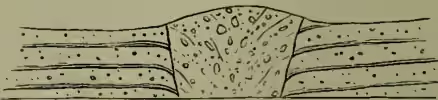
The fragmental igneous rocks consist of the loose ejectamenta which have been erupted from volcanic orifices. These rocks are frequently consolidated, and when fine-grained it is sometimes difficult without the help of the microscope to distinguish them from compact crystalline igneous rocks. Some account of these rocks will be found under AGGLOMERATE, TUFF, VOLCANO.
Igneous rocks, when looked at from the point of view of the student of structural geology, are classified in an altogether different way. It is not only necessary to know the petrological character of a rock—we must discover something of its history. Was it extruded at the surface like the ejecta of modern volcanoes, or did it cool and consolidate below ground? Thus two kinds of igneous or eruptive rocks are recognised by geologists: (1) Volcanic rocks, consisting of lavas, tuffs, &c., which have been ejected at the surface, either upon the land or under water; (2) Plutonic or Hypogene rocks, which, whether consisting of crystalline or fragmental materials, have not been so extruded, but are now exposed owing to the denudation of rock-masses underneath which they were formerly concealed. The volcanic rocks are often termed contemporaneous—i.e. they belong to the same geological age as the strata with which they are interbedded. On the other hand, the plutonic rocks are described as intrusive or subsequent, because they have been intruded amongst, and therefore must be subsequent in date to the rocks with which they are in contact.
(1) Contemporaneous Igneous Rocks.—These consist of crystalline (lava-flows) and fragmental rocks (tuffs, &c.), and are simply the products of former volcanic action. They are met with at all geological horizons from the oldest down to the most recent period. Sometimes they indicate the former existence of small isolated 'puys' (see VOLCANO), from which it may be only a single eruption took place; at other times they are obviously the products of much more powerful and long-continued volcanic action. Many of the hill-ranges of central Scotland (for example, Sidlaws, Ochils, &c.) are built up of successive lava-flows with associated tuffs, which have been ejected from vents in the manner of modern volcanic eruptions. In some regions, however, there occur vast successions of lava-flows, covering immense areas, which do not appear to have been erupted from isolated vents, but are believed to have welled up along the line of great fissures, and to have poured in wide floods over the surface, so as eventually to form extensive plains or plateaus. The rocks of such 'fissure-eruptions' consist usually of basalt, with basalt-tuff or Palagonite. The basalt plateaus of the western territories of North America, of Iceland and the Faroes, of the Deccan (India), and of Abyssinia are good examples; while in Antrim and in many of the western islands of Scotland fragments of similar plateaus may be studied.
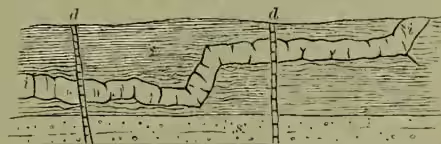
l, igneous intrusive sheet; d, d, dykes; s, s, sedimentary strata.
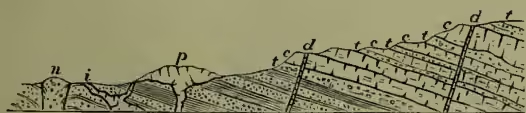
c, c, contemporaneous trap-rocks; t, t, contemporaneous fragmental igneous rocks; i, p, n, d, intrusive igneous rocks.
An interbedded or contemporaneous lava-form rock may often be distinguished from an intrusive vents. These latter, in countries where volcanic action has been long extinct, no longer exist as crateriform hollows. The upper parts of the cones have all been swept away, and only the stumps remain. These stumps are known as necks, by which is understood a more or less cylindrical funnel or volcanic vent filled up either with fragmental or crystalline rock or with both. Such necks vary in diameter from a few yards up to several hundred feet; sometimes they occur upon a line of Dislocation (q.v.) or fault; at other times they have no such connection. The necks now described are probably the relics of comparatively small volcanoes like the puys of Anvergne and the Eifel. Now and again, however, as in some of the hill-ranges of central Scotland, necks of a larger size are met with. These vary from 100 yards or so up to a mile or more in diameter, and are usually plugged up with crystalline igneous rock, although fragmental rock also is occasionally present. Such necks seem to be the stumps of great volcanic vents, from which the lava-form and fragmental igneous rocks of the surrounding neighbourhood were ejected. Good examples occur in the ranges of the Sidlaws, the Ochils, the Braids, &c. Bosses is the term applied to irregular-shaped masses of crystalline igneous rocks, which appear to be for the most part of deeper-seated origin than those of the necks just referred to. The rocks of these bosses are usually more or less coarsely crystalline, and often have a granitoid aspect, such as granite, syenite, gabbro, &c. Bosses usually cover a considerably wider area than necks, and it has been conjectured that they are merely the most deeply seated portions of ancient volcanoes—the reservoirs from which molten matter was pumped up to the surface. Intrusive Sheets are masses of crystalline igneous rock which have been erupted between the planes of bedding of pre-existing strata. They are never scoriaceous or slaggy, and are generally markedly crystalline in texture, especially when the sheet is thick. Their intrusive character is often betrayed by the baked appearance of the beds which overlie them; by the fact that they seldom keep quite to one and the same plane, but sometimes break across the overlying beds and continue their course along a somewhat higher horizon; and by the veins and protrusions which not infrequently proceed from them. Dykes are vertical wall-like sheets of igneous rock, which may vary in thickness from a foot or so up to 30 yards or more. They often run persistently in one direction for many miles. Occasionally they divide into two or more branches, and now and again they send out veins into the surrounding strata. The rock most frequently met with in such dykes is basalt. Sometimes dykes rise along the lines of faults, but this is by no means general. Veins is the term applied to the more irregular, winding, branching, and tortuous smaller intrusions of igneous rock. They may consist of any kind of crystalline rock. Dykes and veins are frequently found proceeding in all directions from bosses, as in the case of granitic masses. From the smaller puy-like necks also veins and dykes have occasionally been injected into the surrounding rocks, while these and sheet of crystalline igneous rock by noting that the beds which immediately overlie it show no trace of having been subjected to the action of heat. The upper part of the lava-form rock is not infrequently scoriaceous or amygdaloidal (see AMYGDALOID) in character, and fragments of this crust may occasionally be found in the overlying beds if these chance to be of aqueous origin.
(2) Intrusive Igneous Rocks.—These rocks are likewise met with under two forms—crystalline and fragmental. The fragmental intrusive rocks are found only in connection with old volcanic extensive sheets may often be traced proceeding from the larger kinds of necks. The rocks surrounding bosses, and traversed by veins, are often highly metamorphosed.