Iguana, a genus typical of the Iguanidae, a family of thick-tongued lizards representing in the New World the Agamidae of the Old. The family comprises fifty-six genera, most of which are found in tropical America. They are slender and lizard-like in form, have distinct eyelids, the tympanic membrane usually free, the tail long and compressed, the toes free, five on each limb, and ending in a sharp claw. They are arboreal in habit, and feed chiefly on leaves and fruits, but will also eat insects. The genus Iguana includes five species, found in the West Indies and South America, and all characterised by a pyramidal head, a pouch of skin under the throat, and an upright comb of pointed teeth extending along the back from the neck to the tip of the tail. The best known is the Common or Green Iguana (I. tuberculatus), which has a very large pouch, is predominantly of a beautiful green colour, and grows to a length of from 3 to 5 feet. This iguana lives usually in trees near a stream, climbing with great ease, and moving rapidly along the branches, but taking readily to the water, where it swims by means of its tail.
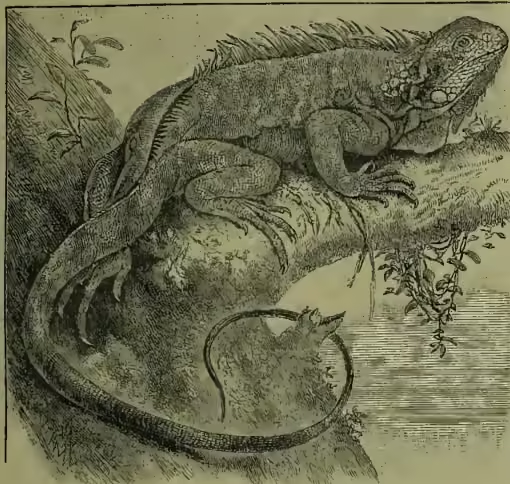
Its flesh is white and tender, and is much esteemed for food. It is sometimes caught by noosed cords, sometimes tracked to its burrow by dogs trained for the purpose. The eggs are about the size of those of a pigeon, but have no hard shell, and are laid in the sand. They also are used as food. Other species of iguana and their eggs are eaten by those, as Darwin says, 'whose stomachs soar above all prejudices.' Other important genera are Anolis; Cyclura, one species of which, C. lophoma, is called the 'great Iguana' of Jamaica; Amblyrhynchus, the marine lizard; Phrynosoma, the 'horned toads'; and the Basilisks (q.v.). See LIZARD; and Boulenger, Brit. Mus. Cat. of Lizards (2d ed. Lond. 1885-87).