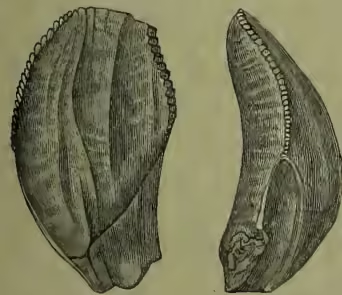
Iguanodon (Iguana, and Gr. odous, 'tooth'), a genus of remarkable gigantic dinosaurian reptiles, more abundant in the Wealden beds of Kent, Sussex, and the Isle of Wight than any other genus of associated saurians. Their singular structure, differing in many important particulars from any known reptile, long caused great diversity of opinion as to their true position. Dr Mantell, their original discoverer and learned expounder (1822), first knew of their existence from some enormous bones, which, notwithstanding their colossal size, he considered reptilian. A large tooth next turned up, whose smooth-worn crown attested its having belonged to a herbivorous animal. Numerous other specimens of teeth were in process of time discovered, and Dr Mantell found that they corresponded in a remarkable manner with the teeth of the small American lizard, the iguana, although they exhibited very striking and important differences. The first guesses as to the creature's size, founded on fragmentary materials, varied vastly; Mantell suggesting a length of 70 feet, Owen of 28. An extraordinary recent find of iguanodonts has simplified this and other questions as to the structure. In 1878 there were found at Bernissart, in Belgium, between Mons and Tournai, the remains of about twenty-three specimens, belonging to two well-marked species; only two other species having till then been proposed. In the complete skeleton set up at Brussels from these materials the height is 14 feet 2 inches; the horizontal length of the body in a half-standing attitude, 23 feet.
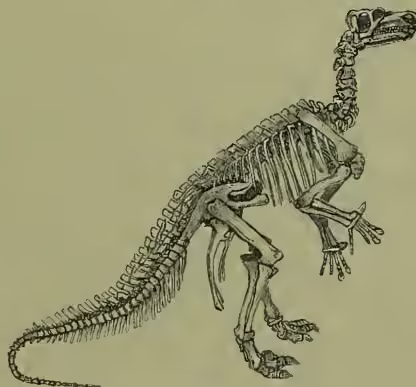
The structure of the skeleton is very remarkable. The front parts of both upper and lower jaws were without teeth, and suggest a hollow, beak-like arrangement; possibly the creature had a long prehensile tongue. In many respects there are striking resemblances between the structure of the ornithopod Dinosaurians (of which the Iguanodontidae are a family) and that of birds. The vertebral column had joints slightly concave on both surfaces, yet had lofty neural arches; and the sacrum was composed of five anchylosed joints, a structure found in no other reptile. The two fore-legs were small; the hinder limbs were long and strong, raising the body some distance from the ground. The leg terminated in a three-toed foot, which produced the enormous tridactyle impressions on the argillaceous Wealden beds that were for some time considered to be the footprints of huge birds. The teeth of the iguanodon, while bearing a general resemblance to those of the iguana, were much more complicated both in external form and internal structure than in any other known reptile. In all other known reptiles the vertically flat teeth are always sharp-edged, and fitted only to cut off the plants on which they feed; but the worn crowns in this animal show that the iguanodon thoroughly triturated its food before swallowing it.