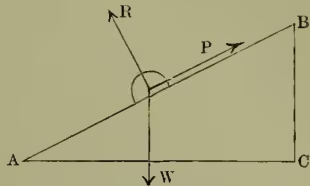
Inclined Plane, THE, is reckoned one of the mechanical powers, because, by rolling it up a plane, a man may raise a weight which he could not lift. Let us suppose a plane as in the figure: let its length, AB, its height, BC, and its base, CA, be respectively 13, 5, and 12 feet; and let a rolling load of 780 lb. be placed upon it and sustained in position by a pull or push acting up the plane. We have now three forces in equilibrium: (1) the weight, W, of the body; (2) the resistance, R, of the plane to bending or breaking; and (3) the pull, P, up the plane. These, W, R, and P, are respectively proportional to the length, AB, the base, CA, and the height, BC; and are thus, in the case supposed, respectively 780, 720, and 300 lb. A force which would, if applied vertically, just lift 300 lb., will thus keep a rolling mass of 780 lb. in position upon a smooth inclined plane, the gradient of which is 5 (height) in 13 (sloping length); and a force exceeding this would pull the mass up the slope. In every practical case, however, there is a certain force expended in overcoming Friction (q.v.), even on a dead level; in railway trains this is equivalent to vertically lifting about 50 lb. for every ton of dead weight; and when a train leaves a level run to go up a slope of, say, 1 in 80, the engine has then, for every ton of weight, to do work equivalent to vertically lifting 50 lb. + ton = 78 lb., instead of the former 50. The steeper the gradient, therefore, the heavier the pull; and engineers, in roadmaking, avoid as far as possible making steeper slopes than 1 in 20. The inclined plane presents various modifications, such as knives, chisels, axes, wedges, screws; the last two are generally reckoned as distinct mechanical powers, and will be treated each under its own head.