Indigo (Gr. Indikon, 'Indian drug'), a most important vegetable dyestuff, yielding a beautiful blue and very durable dye, the basis also of the best black dye in woollen cloths. It has been used in India from a very early period, and was imported thence by the ancient Greeks and Romans, but was lost to Europe during great part of the middle ages—although the cultivation of the plant and preparation of the dye were described by Marco Polo in the 13th century—until re-introduced by the Dutch about the middle of the 16th century.
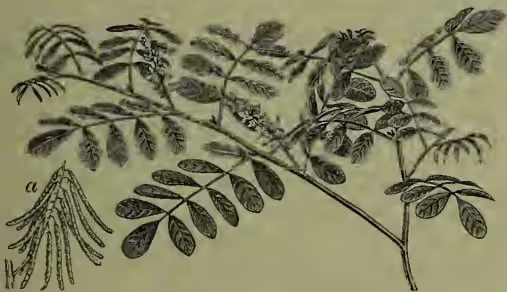
a, raceme of seed-pods. (From Bentley and Trimen.)
The plants that yield the best indigo belong to the genus Indigofera, of the natural order Leguminosæ, sub-order Papilionaceæ. Indigofera tinctoria is the species most generally cultivated in India. Central American and West Indian indigo is the produce of I. anil and I. guatimala.
Indigo is, however, obtained from plants of other genera, particularly from Wrightia tinctoria (natural order Apocynaceæ), East Indies; Baptisia tinctoria (natural order Leguminosæ), North America, which yields indigo of a pale colour and very inferior quality; Tephrosia tinctoria (natural order Leguminosæ), Malabar; T. Apollinea, Egypt and Nubia; Marsdenia tinctoria (natural order Asclepiadaceæ), in Sylhet; and Polygonum tinctorium and P. Chinense (natural order Polygonaceæ), China and Japan.—In times when East Indian indigo was not known, or was brought to Europe only in small quantity, the same dyestuff was obtained from Woad (q.v.).—A coarse kind of indigo, called Bastard Indigo, was also at one time made in North America from the young shoots of Amorpha cærulea and A. fruticosa (natural order Leguminosæ).
In cultivating the indigo plant the seed is sown in drills about one foot apart at the beginning of the rainy season. Hoeing and weeding require to be assiduously attended to to prevent the plants from being overpowered by weeds. The first crop is obtained in about three months after sowing. The stems are cut as the plants begin to flower, and quickly shoot up again, and in this way two and sometimes three crops are taken from the same plants in one season. Immediately the crop is cut it is tied in bundles and carried to the steeping vats to undergo the process of extracting the indigo; for an account of which see DYEING.
Commercially speaking, indigo may be said to be the produce of India and Central America, as these are the only localities which supply the recognised form of the article. Bengal is the chief seat of indigo produce; and Bengal indigo is the most esteemed. From 1740 till the civil war indigo was much grown in Georgia and South Carolina, but thereafter the United States depended on imported indigo. British imports fluctuated from above 1,000,000 cwt. (value £2,500,000) to under 60,000 cwt. (value £950,000) in the last years of the 19th century, when the trade was menaced by German artificial indigo. The essential constituent of natural indigo is Indigotin or Indigo Blue (), but it likewise contains Indigo Brown, Indigo Red, and other ingredients. In 1878 Baeyer of Munich announced the successful synthesis of an artificial indigo from phenylacetic acid, a coal-tar product; and Neumann of Zurich made the synthesis commercially practicable. By 1897 Germany supplied its own wants from this source; by 1901 one company at Ludwigshafen produced as much as could be grown on 250,000 acres of Indian land, and it was a question whether the growers of natural indigo in Behar and other parts of Bengal would be able to compete with the German aniline companies (see ANILINE, DYEING, SYNTHESIS). The costly so-called green indigo of China, used by Chinese artists and for silk-dyeing, is obtained from a tree called hom-bi.