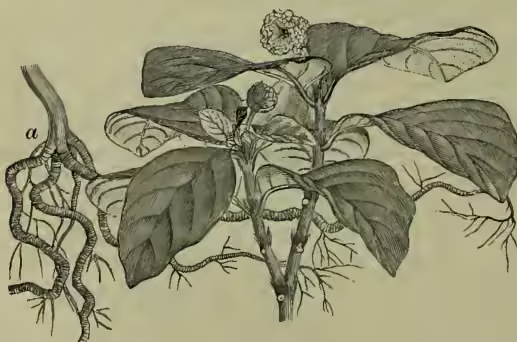
a, the root.
Ipecacuanha, the name both of a very valuable medicine and of the plant producing it. The plant (Cephaelis Ipecacuanha) belongs to the natural order Cinchonaceæ, and is a native of the damp shady woods in Brazil and some other parts of South America. More recently it has been cultivated in India and Ceylon, although there is a tendency under cultivation for the plant to run into varieties. It is somewhat shrubby, with a few oblongo-lanceolate leaves near the ends of the branches, long-stalked heads of small white flowers, and soft dark-purple berries. The part of ipecacuanha used in medicine is the root, which is simple or divided into a few branches, flexuous, about as thick as a goose-quill, and is composed of rings of various size, somewhat fleshy when fresh, and appearing as if closely strung on a central woody cord. Ipecacuanha root is prepared for the market by mere drying. It is collected at all seasons, although chiefly from January to March. The plant is never cultivated in Brazil. It has now become scarce in the neighbourhood of towns, but, owing to the readiness with which it is propagated from portions of the root, it is not likely to be exterminated.
It is in the bark of the root that the active principle, the emetine, almost entirely lies; the other ingredients, such as fatty matters, starch, lignine, &c., being almost inert. Emetine is represented by the formula . It is a white, inodorous, and bitter powder, moderately soluble in alcohol, and having all the characters of the vegetable alkaloids. It acts as a violent emetic in doses of th of a grain or less, and is a powerful poison. In good specimens of root it is present to the extent of nearly 1 per cent. In small and repeated doses—as, for instance, of a grain or less—ipecacuanha increases the activity of the secreting organs, especially of the bronchial mucous membrane, and of the skin. In larger doses of from 1 to 5 grains it excites nausea and depression; while in doses of from 15 to 30 grains it acts as an emetic, without producing such violent action or so much nausea and depression as tartar emetic. Ipecacuanha is useful as an emetic when it is necessary to unload the stomach in cases where there is great debility, or in childhood. As a nauseant, expectorant, and diaphoretic it is prescribed in affections of the respiratory organs, as catarrh, looping-cough, asthma, &c.; in affections of the alimentary canal, as indigestion and dysentery; and in disorders in which it is desired to increase the action of the skin, as in diabetes and in febrile affections.
Besides the Powder, the most useful preparations are the Wine of Ipecacuanha—of which the dose to an adult as a diaphoretic and expectorant ranges from 10 to 40 minims, and as an emetic from 2 to 4 drachms—and the Compound Ipecacuanha Powder, commonly known as Dover's Powder (q.v.). To produce the full effect as a sudorific a dose of 10 grains of Dover's Powder should be followed by copious draughts of white-wine whey, treacle-posset, or some other warm and harmless drink.