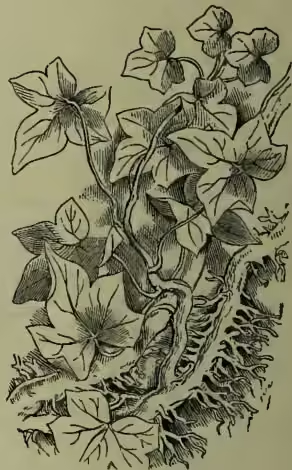
Ivy (Hedera), a genus of plants of the natural order Araliaceæ, consisting of shrubs and trees, mostly natives of tropical countries. The flowers have five or ten petals, and five or ten converging or consolidated styles. The fruit is a berry with five or ten cells.—The Common Ivy (H. helix) is a well-known native of Britain, and of most parts of Europe, although it is more rare in the northern countries. Its long, creeping, branched stem, climbing on trees and walls to a great height, and closely adhering even to very hard substances by means of aerial rootlets, which it throws out in great abundance along its whole length, acquires in very aged plants almost the thickness of a small tree. Its 5-lobed, shining, stalked, evergreen leaves, clothing bare walls with green luxuriance, serve to throw off rain, and thus render damp walls dry, contrary to a common prejudice, that ivy tends to produce dampness in walls. In order to accomplish this, however, it requires to be pruned annually, for if allowed to run wild it admits rain to the walls by its projecting branches, and so renders even dry walls damp by preventing evaporation. It injures living trees by constriction when permitted to grow upon them. The flowering branches of ivy have ovate, entire leaves, very different from the others, and do not climb, but project from the climbing branches. Its small greenish flowers are produced in the beginning of winter, and the small black berries swell during winter and ripen in the following April. The berries are eagerly eaten by many birds, although they have a pungent taste, and contain a peculiar bitter principle called hederine, and an acid called hederic acid; which are also found in a gummy exudation obtained by incisions from the stem, and occasionally used in medicine as a depilatory and a stimulant, and in varnish-making. An ointment made from the leaves is used for curing burns; the application of bruised leaves is serviceable for removing corns. In Egypt the ivy was sacred to Osiris, in Greece to Bacchus (Dionysos), whose thyrus was represented as surrounded with ivy; the Romans mingled it in the laurel crowns of their poets.
There are numerous varieties of common ivy often planted for ornamental purposes, of which that generally known in Britain as Irish Ivy, and on the Continent as English Ivy, is particularly esteemed for its large leaves and luxuriant growth. They are distinguished from each other by the form of their leaves, and also by their colour, there being many shades of green and bronze, and not a few with gold and silver blotched leaves. Ivy grows readily from cuttings.—H. umbellifera, a native of Amboyna, is said to produce a finely aromatic wood; and H. terebinthacea, a Ceylonese species, yields a resinous substance which smells like turpentine.