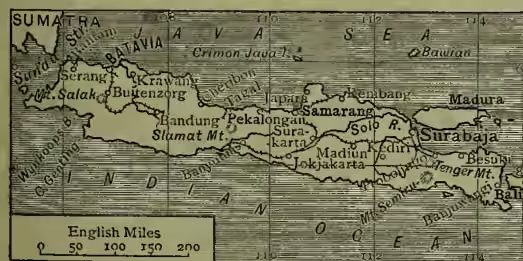
Java (Djâwâ), an island of the Dutch East Indies, the seat of the colonial government. It is situated between 5° 52' (St Nicholas Point) and 8° 50' (South Cape) S. lat., and 105° 13' and 114° 39' E. long. The island is washed on the N. by the Sea of Java, on the E. by the Strait of Bali, on the S. by the Indian Ocean, and on the W. by Sunda Strait. It extends almost due west and east, declining about 15° to the south. The extreme length is about 600 miles, the breadth 40 to 125 miles, the superficial area about 49,000 sq. m. (excluding Madura, q.v.). The coast-line is not much developed; a few large bays, protected by islands, furnish safe anchorage for vessels. From end to end of the island (most probably corresponding to a volcanic line of fissure) there is a mountain-chain, named Gunung Kendang, and, especially in the western part of the island, several parallel shorter chains. To the north there are a few isolated mountains in the alluvial plain. Towards the south the island falls in general steeply towards the sea. There are forty-three volcanoes, several of which are still active. The rivers are generally small, but become torrents when swollen by rain; only a few of them are navigable. The climate depends on the altitude; it is rather hot and unhealthy on the coast, but pleasant in the hills. The thermometer seldom indicates more than 95° F. In Batavia the average temperature is 78.5°, the extremes being 92.7° and 66.9°. The mountains rise to about 12,000 feet, and are clothed up to 9000 or 10,000 feet with luxuriant foliage; on the loftiest eminences the thermometer sometimes sinks to 32°. Generally, even in the hills, the days are hot, but moderated by land and sea breezes, which blow regularly across the island; the nights, especially in the highlands, are cool. The rainy season lasts from November to March.
The population of Java has rapidly increased; in 1850 it was 9,570,000, and in 1894, 24,643,000. At the beginning of 1888 (excluding Madura) it amounted to a total of 20,898,122. These figures included 20,614,222 natives, 228,340 Chinese, 11,665 Arabs, and 2736 other Orientals (natives of India, of Further India, &c.). The Europeans (half-castes included) amounted to 41,159. The natives belong to the Malay (q.v.) race. The Madurese, in the eastern part of the island, the Sundanese, living in the western part, and the Javanese proper differ in physique and in language. Most of them are Mohammedans, at least in name, for much of the belief of their ancestors survives in the Islam that is now practised. A few tribes, however, profess the old religion (viz. the Baduwis in Bantam and the 'Heathen' of the Tengger Mountains). The native Christians number about 12,000, and the Chinese Christians a few hundreds. How many half-castes are counted among the Europeans it is impossible to say. The inhabitants are more civilised than those of the other islands of the archipelago. One of the chief vices is opium-smoking, which is a source of income to government, and yields for Java alone about £1,000,000 a year for licenses and profit on the import. There are thirty-nine Dutch Protestant and twenty-one Roman Catholic clergymen for the whole of the Dutch East Indies, besides those who are working among the natives. Every form of religious belief is free, but proselytising is strictly prohibited.
The chief wealth of Java consists in its luxuriant vegetation, though the producing power seems to be now a little exhausted, at least to judge from the many diseases by which the plantations have been visited of late. The character of the vegetation varies with the soil and the elevation. The division (of Junghuhn) into four botanical zones, up to 2000, 4500, 7500, and above 7500 feet altitude, has been commonly adopted. The fauna differs from that of the other islands of the archipelago. The animal kingdom is not very rich: tigers (which are a scourge to some parts of the island), rhinoceros, deer, and wild swine are the chief representatives of the quadrupeds; there are only a few birds that are conspicuous for their plumage, and hardly any that are distinguished by their song. Several species of serpents (some venomous) and crocodiles are found on the island. The geology of Java is still largely undetermined. For the greater part, the island belongs to the Tertiary formation, altered by many eruptions of more recent date. Some parts of Java seem to belong to the Pleistocene period; sedimentary formations of recent date are especially considerable along the north-west part of the island. Though in old times Java was called the 'land of gold,' little of that metal has been found of late; silver is scarce; and there are no other metals at all. Salt, the manufacture of which is a govern- ment monopoly, is prepared from sea-water; and coal is worked in the Preanger, and marble in the Madiun residency.
Formerly Java used to be considered as affording almost a perfect answer to the question, How can a colony best be governed? The material prosperity which resulted to the mother-country from this possession was owing, for the greater part, to the system of General Van den Bosch (introduced in 1830). Under that system the natives were compelled to cultivate part of the ground and plant staple articles on it, whilst the produce was delivered at a fixed price to the magazines of the government, and from them shipped to Europe and sold by the Netherlands Trading Company. Although this system brought large sums into the treasury of the Netherlands, a vigorous opposition against it existed almost from the beginning, since it pressed very hard on the natives. As time went on the opposition gained ground, and in name the system was given up and private planters admitted. But in point of fact, at least so far as the coffee-plantations were concerned, the system was still continued, because the income derived from this item could not be dispensed with. A commission was appointed in 1889 to consider in what way the system of coffee-planting might be altered. At that time the natives received fifteen florins (£1, 5s.) for one picul (133½ lb. avoird.), which they had to deliver at the magazines. Though private planters had been admitted before 1870, the 'Agrarian Law,' which then was promulgated, greatly facilitated the establishment of plantations by private individuals; but still the competition of the government prevented an unrestrained development. In some parts of the island (especially in the western part) where private persons are owners of the ground, or hire it from the native princes, private industry was in better circumstances; but of late diseases in the crops and a falling-off in prices have done much damage. Sugar, coffee, indigo, tea, and tobacco are planted for export. Rice is grown extensively for native consumption (and a little for export); but it is not sufficient, and other food-crops (maize, &c.) have to be cultivated. The teak-forests belong exclusively to the government, but they are managed by private persons, working under contract. The live-stock includes about two and a half million buffaloes, two million cattle, half a million horses.
Java may be considered the centre of the commerce and trade of a great part of the Dutch East Indies. In 1888, 2995 vessels entered and 3126 cleared from Java. Of the chief staple articles there were exported, in 1888, 13,529 cwt. of indigo, 576,957 cwt. of coffee, 7,381,040 cwt. of sugar, 239,657 cwt. of tobacco, 66,791 cwt. of tea, 198,073 cwt. of tin (all these by private persons or by companies), and 426,331 cwt. of coffee and 117,420 cwt. of tin by the government. The general exports and imports were valued in 1886 at £308,266 and £2,090,709 respectively on account of the government, and at £10,079,683 and £10,140,717 respectively on account of private persons. The countries which trade most extensively with Java are Holland, the Straits Settlements, and Great Britain. The leading articles of import are cotton and linen goods, wine and spirits, provisions, machinery, railway-plant, &c. Java has frequent intercourse with Europe, via Singapore or directly by Dutch steamers, and is connected by cable with Europe and with Australia. The telegraph system of the island is very extensive. There are good roads and railways, partly belonging to the government, partly to private companies; 566 miles of the former and 194 miles of the latter were open in 1889.
The island is (excluding Madura) divided into twenty-one residencies: Bantam, Batavia, Krawang, Preanger Regencies, Cheribon, Tagal, Pekalongan, Samarang, Japara, Rembang, Surabaya, Pasuruan, Probolinggo, Besuki (including Banyuwangi), Banyumas, Bagelen, Kadu, Jokjakarta, Surakarta, Madiun, Kediri—two of which (Surakarta and Jokjakarta) are under native princes. Over each residency a Dutch resident exercises a general control. The residencies are divided into afdeelingen, under assistant-residents, to whom are subject the controllers (100). Subject to the supervision of these European officers the administration is carried on by native functionaries—regents at the head of the regencies (generally corresponding to the afdeelingen), to whom are subject the wedono or demang; the regents have substitutes called pattih.
The languages are Javanese, a Malayan tongue, divided into an aristocratic dialect and a popular dialect, Sundanese, and Madurese. Besides there is another language used in old inscriptions and manuscripts, called Kawi (better, Old Javanese). The Javanese alphabet is derived from the Devanagari. Many antiquities were left by the early Hindu conquerors, especially in middle and eastern Java (Boro Budor (q.v.), Brambanan, Dieng). The literature of modern Java is rather insignificant. Babads ('chronicles') and the wayang ('puppet-plays') stories should be mentioned.
The history of Java can only be given in outline. The earliest historical references date back to the beginning of the 5th century. In 412 A.D. Fa-Hien visited Hindu colonies in Java. About the year 800 the intercourse of the Hindus with the island appears to have become more important. Already by that time the Javanese had attained to a considerable degree of civilisation. To judge from the antiquities, there were three periods of Hindu ascendancy—a period of Buddhism, a period of Sivaism, and a period of compromise. Several powerful Hindu states were established, among which Madjapahit must be mentioned. At the beginning of the 15th century Mohammedanism reached the island and quickly got a firm footing. At the end of the 16th century European merchant-adventurers established themselves in Java; whilst the Dutch rule in the island began in 1610 (the first governor-general, Pieter Both). Then began a long, tough struggle with the natives, but with the lapse of time the Dutch gained ground. The most important native state then was Mataram. In 1705 the company obtained possession of the Preanger Regencies, and in 1745 its authority was extended over all the north-east coast of the island. In 1755 the empire of Mataram was divided into two states, Surakarta and Jokjakarta. In 1808 the kingdom of Bantam was incorporated with the Dutch possessions; but these in 1811 became part of the French empire. In the same year Java was occupied by the English, and remained in their hands up to 1817. A short time after the Dutch had resumed possession of Java an insurrection burst out in Jokjakarta in 1825 under Dipā Negārā, and the struggle lasted until 1830, when the chief of the rebels submitted to the Dutch authorities. By that time the greater part of the states of the native provinces had been incorporated in the Dutch possessions, which then assumed the extension they have to-day.
See Sir Stamford Raffles's History of Java (Lond. 1817); De Jonge, Nederlandsch Oost-Indie (1862-88); Junghuhn, Java (1849-53); Worsfold, A Visit to Java (1893); P. J. Veth, Java, Geographisch, Ethnologisch, Historisch (3 vols. 1875-78). This last is the most important work on Java, though, in some respects, a little out of date. See also R. Schuiling, Nederland in Oost en West (1889; a general description of the East Indian colonies, not always to be trusted); De Louter Handleiding tot de Kennis van het Staats- en Administratief-Recht van Nederl. Indie (3d ed. 1884); Worsfold's Visit to Java (1893); Eliza Scidmore's Java, the Garden of the East (1898); and Douwes Dekker's romance, Max Havelaar (Eng. trans. 1868). The best maps are in Atlas der Nederlandsche Bezittingen in Oost-Indie, by Stemfoort and Ten Siethoff.