Jerusalem. Its Site.—Jerusalem—31° 46' 50" N. lat. and 35° 13' 25" E. long.; height, 2364 to 2582 feet above the sea-level—stands on the spurs of two hills surrounded and divided by two valleys, once deep, now partly or wholly filled up with rubbish. The exact form of the hills has recently been ascertained by taking, whenever practicable, a series of rock levels, of which 250 have been (1890) correctly laid down over the whole area of the city. More are being added from day to day, and the contours have been settled by Major Conder, the surveyor of western Palestine, with a general accuracy which can only be questioned at a few points. The dividing valley had two shallow branches within the city, a fact of considerable importance in considering the course of the second wall. The Eastern Hill was originally a rounded top crowned with the 'threshing-floor of Araunah,' and the rock and cave, probably a sacred site from time immemorial. It sloped steeply to the west and gradually to the east: its southern extremity was a tongue of land between the central valley, the Tyropæon, and the eastern valley of the Kedron.
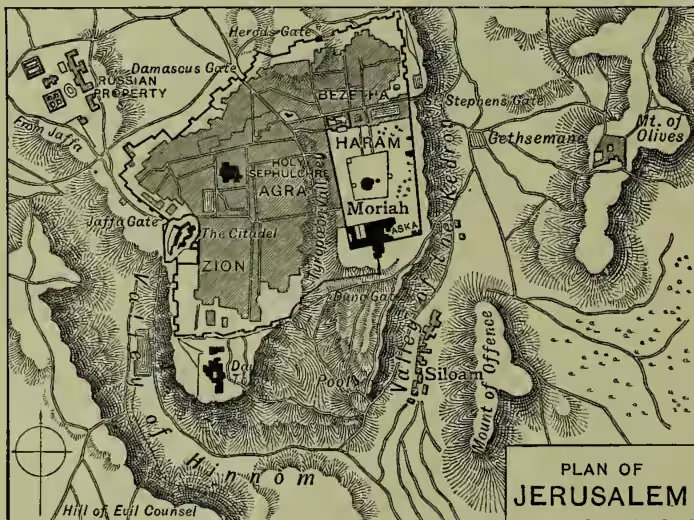
The Western Hill, higher than the other by more than a hundred feet, presented similar characteristics of a steep valley on either side and a tongue of land running southwards. Either hill was therefore a strong natural fortress, a hill-fortress, such as are found in great numbers in England—e.g. the ancient stronghold called Castle Neroche, in Somersetshire, seems to be exactly the kind of fortress which David stormed. The weakness of the place for purposes of defence lay in its insufficient supply of water. One spring, that now called the 'Virgin Fount,' lies just without the old city wall of Ophel. The rock-cut passage, which runs from this spring to the Pool of Siloam below, enters within the course of the old Ophel wall. There is also a well called Hammâm es-Shafa in the very centre of the city, close to the Bâb al-Kattanîn ('Gate of the Cotton Merchants') in the Haram area.
Jerusalem is known to the Moslems as Beit el-Mukaddas or Beit el-Mukdis, the 'Holy House,' or El-Kuds, 'The Holy.' Yakût, the great Moslem geographer, who knew the Jewish name Yeru- shalaim, mentions other forms—Urishallum, Urî-shalum, and Shallam, as formerly used in the days of the Jews. It is first mentioned in Joshua, x. 1—'Adoni-zedek, king of Jerusalem.' Afterwards, in the same book, it is spoken of as Jebus, or Jebusi, 'which is Jerusalem.' It has therefore been inferred that the name of Jerusalem was given to the city by David. But the name was found in 1890 on the cuneiform tablets from Tel-el-Amarna; it there appears as Urusalem, the 'City of Peace.' It was therefore known under that name at least 500 years before the conquest by David. The northern boundary of Judah is drawn 'south of the Jebusite;' therefore it is reckoned among the cities of Benjamin. In some passages, however (e.g. Psalms, lxxviii. 68), it is held to belong to Judah. The conquest of the city by the Israelites proved at first incomplete: before the time of the Judges it was again 'the city of the stranger.' Finally conquered by David, the Lower City was united to the Fortress of the Upper Hill and the whole surrounded by a wall.
Its History.—The history of Jerusalem covers a period of about 3500 years. Of these, 500 at least are prehistoric, though glimpses of this long period may hereafter be arrived at from the treasures of the cuneiform inscriptions. Of the 3000 years which remain, less than 500 show us Jerusalem independent, the capital of a free country, and the centre of a national religion. For 600 years longer the city was in the hands of the Israelites, it is true, but never wholly independent, always a prey to internal factions, and alternately the possession of Egypt or some other powerful neighbour. Loss of independence, banishment from the city, persecution and exile, have only made the Jew look with more passionate eyes of longing upon the city which, when it was his own, he could not hold without idolatry, contempt of his own laws, and internal dissensions. Only 500 years of independent tenure! That period removed by more than 2000 years: yet the passionate love of the Jew for Jerusalem is no whit diminished.
Here are the landmarks of its history. Its name is found on an inscription 500 years at least before David (see also Gen. xiv. 18); it was besieged almost immediately after the death of Joshua, circa 1400 B.C.; it was again taken by David about 1046 B.C.; it was surrendered by Jehoiachin 597 B.C.; it was taken from Zedekiah 586 B.C., and wholly destroyed. Fifty years later (536 B.C.) the edict of Cyrus enabled the people to return; the temple was rebuilt; for a hundred years parties of the Jews straggled back—Ezra arrived 457 B.C., Nehemiah 445 B.C. For 500 years after this Jerusalem knew not a single generation of peace. Internal factions tore it to pieces; the city was the possession in turn of Persian, Macedonian, Syrian, Egyptian, and Roman. It was never wholly independent; there was never any real independence for Jerusalem after its destruction by Nebuzaradan. It is a great pity that those who study the history of Jerusalem generally pass over the period from Nehemiah to Herod as of little interest. It is, on the other hand, a time of the greatest interest, and full of instruction for those who study the development of the fiery Judean race. We hear no more about Baal-worship and the groves of Asherah; the pagan cult was growing obsolete; the gods of Hellas had invaded Syria; those of Phœnicia were forgotten. Under Antiochus the temple was consecrated to Zeus Olympios; pigs were sacrificed on the altars; the Jewish rites and ceremonies—the observance of the Sabbath, the sacrifices enjoined by the law, the rite of circumcision—were forbidden. Had it not been for one family—the most illustrious rebels on record—the religion of the Jews would have been abandoned and their nationality lost. How both were saved belongs to the history of this period (see MACCABEES).
It is not, however, a time on which the historian dwells with pleasure. The character of the people, always fiery and full of zeal, turned to fanaticism; their respect for the law, forced upon them by persecution and disaster, turned to a worship of the letter; they divided into sects which hated each other more bitterly than they hated the Gentile. The picture of Jerusalem and its people during the fifty years which preceded the destruction of the city by Titus is nowhere surpassed in all the dark annals of religious zeal. The city was besieged, taken, and totally destroyed by Titus, 70 A.D.
During the long history of Jerusalem—the City of Peace—it sustained seventeen sieges; twice it was utterly destroyed and razed to the ground. There is no city in the world whose soil has been more repeatedly drenched with the blood of its people—the thousands who have perished by the sword within these gray walls from the time when the 'children of Judah smote it with the edge of the sword and set it on fire' to the day when Godfrey de Bouillon and his knights rode in a stream of blood reaching to their saddle girths to recover the Holy Sepulchre.
The history of the city to the destruction by Titus is the history as contained in the Bible; that which follows is a second volume divided into four chapters. The first chapter contains the early centuries of Christianity, for the most part a peaceful time when the land was covered with monasteries, churches, and hermitages; when the voice of psalm and prayer never ceased day or night. The city contained the great group of churches of which the most splendid was Constantine's Basilica of the Anastasis, built not over the sepulchre, but to the east of it, the sepulchre itself being ornamented with columns and open to the sky. Pilgrimages began at first to the site of the Ascension, afterwards, as other sites were miraculously recovered, to that of every scene in the gospel history. The Persians came 614 A.D., sacked the city, and destroyed all the churches. Then the Moslems appeared, and the gates were thrown open without a blow.
The second chapter contains the Moslem rule (637–1099). Then the Mosque el-Aksa was built, Justinian's great church of St Mary furnishing the principal edifice; the Dome of the Rock was built; and, by order of the mad calif Hakem Bi Asur Illah, the church of the Holy Sepulchre was again destroyed.
The third chapter is that of the Latin kingdom (1099–1244). The constitution of this kingdom, as contained in the Assises de Jérusalem, is the most valuable document extant on the principles of feudalism. The kingdom, after continuous war for eighty-seven years, lost Jerusalem, nor did the crusaders ever succeed in retaking it. It was, however, ceded by treaty to Frederick II., who in 1229 crowned himself in the church with his own hands, being then under papal excommunication.
The last chapter is that of Jerusalem again under the Moslems (since 1244). It was in 1517 that the Turkish sultan Selim took Jerusalem. The seven hundred years covered by this chapter have been for the most part years of peace. The chronicles of later years are barren and devoid of incident.
Its Monuments.—The principal buildings and monuments for which the explorer of the modern city has to look are the first, second, and third walls of the great temple itself; the royal towers of Phasaelus, Hippicus, Psephinus and Mariamme; the Tyropeon Bridge; Baris or Antonia; Ophel; the Tombs of the Kings; and certain pools. It would be strange indeed if, after so many sieges and so many generations, much should survive of the city of Herod, to say nothing of the city of Solomon. There is, however, more than might have been expected, more in proportion than remains of ancient Rome of the former date; far more than remains of Tyre, Carthage, or Corinth. The town was so carefully examined by the ordnance survey of Sir Charles Wilson in 1865 that it seemed as if everything above ground must have been found. Yet we must not forget that Clermont Ganneau found above ground the inscribed stone of the temple, and that there may still be most important remains built up in walls. Excavations on a very extensive scale have also been conducted by Sir Charles Warren in 1867–70, Major Conder in 1871–76, Clermont Ganneau in 1874–75, the Russians, the French, and the Germans; so that since 1870 the whole of the previous literature in Jerusalem topography has become completely antiquated. In the 'Jerusalem' volume of the Survey of Western Palestine the authors, Warren and Conder, have enumerated most of the monuments that now exist above ground or have been discovered under ground. They are briefly as follows:
- (1) The rock scarps on the south of Zion, which were almost certainly those of the first wall, and therefore belong to the time of David.
- (2) The tomb, west of the rotunda of the Holy Sepulchre Church, known as that of Nicodemus. Its form is that of the oldest class of Jewish tombs. If the site was formerly within the second wall this must have been the Tombs of the Kings.
- (3) The great rock-cut passage from the Virgin's Fount to the Pool of Siloam. This can hardly be more recent than the 8th century B.C. The inscription discovered there in August 1880 is believed from the form of the letters and the character of the language to belong to that period.
- (4) The wall of Ophel, discovered by Sir C. Warren (1868–69).
- (5) The rock scarp of the Tower of Baris. This is most probably that scarp now existing at the N.W. angle of the Haram.
- (6) The rock-cut monuments in the Kedron valley. Many belong apparently to the Hasmonean period (2d c. B.C.).
- (7) The Haram area itself, the site of the temple, with its stupendous walls, its ancient gates, its wailing-place, and the buildings within it; the Mosque el-Aksa, the Dome of the Rock, the Dome of the Chain, the Golden Gate, its vast vaults, hitherto but little explored.
- (8) The Pool Amygdalon, now called Hezekiah's Pool. This is probably as old as Herod.
- (9) The Pool of Bethesda, recovered in 1888.
- (10) The Twin Pool, half of which was found by Wilson in 1866, and the other half by Warren in 1868.
- (11) The 'Tower of David,' which is certainly on the site of one of the old royal towers, probably Phasaelus.
- (12) The Tyropeon Bridge, marked by the spring of the first arch. The remains of that arch and the opposite pier were discovered sixty feet under ground by Warren in 1868.
- (13) The wall erected by Hadrian to fortify his Elia Capitolina. This probably followed the line of the present city wall. He also probably made the great reservoir, Birket Isrâil.
- (14) The Basilica of the Anastasis, completed by Constantine in the year 335 A.D., certainly stood on the site of the present church of the Holy Sepulchre. It was entirely destroyed by Chosroes II. in 614 A.D. There are, however, still existing certain remains and fragments which have been fitted by Conder into their places in Constantine's work. After the destruction of this building a more humble group of churches was erected on the site.
- (15) In the year 532 A.D. Justinian built the great Basilica of St Mary's within the temple area. This church is probably the present Mosque el-Aksa. It is suggested by Conder that the later ornamentation of the Double Gate, the structure of the Golden Gate, and the roofing of the Haram cisterns also belong to the time of Justinian.
- (16) The existing church of the Holy Sepulchre was commenced in 1103 A.D., and stood until 1808, when it was partly destroyed by fire. Some parts of it are, however, believed to be older than the crusaders' time.
- (17) The great Hospice of the Knights of St John, south of the Holy Sepulchre, was erected during the Latin kingdom.
Recent excavations (1875-85) have laid bare a great part of these buildings.
(18) Of crusading remains there are still many in the city. The Tower of David on the site of Phasaelus (?) is mainly the work of the Pisans, and a great deal of the city wall is of crusading times.
These are the principal monuments now existing. We may add the discovery in 1887 of a fragment of what was certainly part of the second wall, certain rock scarps which are supposed to belong to the same wall, and a wall with a gate discovered in the building of the Protestant church, which has been conjectured to belong to this wall. But this is uncertain, as the course of the wall has never been clearly ascertained.
The Restoration of the City.—The restoration of the ancient city, whether under Herod or Solomon, has been the subject of keen controversy for many years. It is, of course, perfectly well known that to the ordinary pilgrim every spot in the city connected with the Sacred Narrative is exactly ascertained. He has no doubt. The first who ventured to dissent from the authority of tradition and the priests was one Korte, a German printer, who travelled in Palestine about the year 1728. There, however, a hundred years later, he was followed by Dr Robinson, who argued that the church of the Holy Sepulchre could not possibly cover the site of our Lord's tomb. In the year 1847 Mr James Fergusson, a well-known student of Indian architecture, produced an essay on the topography of Jerusalem, in which he advanced the proposition that the Dome of the Rock was not built by Melek at all, but by Constantine, that it covered the Holy Sepulchre, that the site had been transferred at some time or other—during some period of disturbance—that the temple was not built over the 'Rock,' but in the south-west corner of the Haram. These revolutionary views were adopted by a small party, and even advanced in Smith's Dictionary of the Bible. Since that time the opinion has also been advanced further that Mount Zion and the city of David were not the upper but the lower hill, and that the latter was situated on the northern slope of Ophel. These views, of course, necessitated a complete re-casting of the topography, with results that have been, with various modifications, before the world for forty years. As regards the general acceptance of these theories it is enough to say that Warren, the explorer of Jerusalem, and Conder, the surveyor of western Palestine; that Palmer and Le Strange among linguists; that De Vogüé, George Williams, Willis, Clermont Ganneau, among antiquaries and scholars; with many other scholars, all alike refuse to accept them; and that not a single architect of eminence has followed Fergusson's views as to the date of the Dome of the Rock.
The sites adopted in this article are those advocated by Warren and Conder, who agree in the main points. The reasons will be briefly indicated.
(1) The Site of the Temple.—It was within the Haram area, which is defined by the ruins of its gigantic walls: Josephus says that the cloisters reached from 'valley to valley;' that the wall of Ophel joined the east cloister; that the temple was on the top of the hill; that the Tower of Antonia stood on a lofty rock north of the hill. Not one of these conditions can be satisfied by Fergusson's view, which places the temple in the south-west corner of the Haram and makes the east wall start northwards 600 feet from the south-west corner and on the level part of the ridge. This theory was put forward before any excavations had been attempted and when the nature of the ground was utterly unknown. The hill has now been contoured, and it seems certain that if Josephus was right the temple stood over the sacred rock, which, according to De Vogüé, was just south, and according to Warren, was just north, of the altar. The latter also makes it the foundation of the gate Nitzotz. Conder, on the other hand, identifies the rock, which is the highest point of the hill, with the foundation-stone of the Holy House. He therefore follows Josephus exactly. Not only this: he follows a tradition accepted universally by Jew, Christian, and Moslem. Now it is a maxim based on the experience of this officer, who has given far more time and attention to this subject than any other traveller or scholar, that when a tradition is accepted by all alike it is generally true. From every other consideration, indeed, Conder's views seem impregnable. If Solomon built his temple where Fergusson put it, he either built it half-way down the hill and on a steep slope, or he had to make enormous sub-structures to begin with: he chose for his site a hill with a slope of 1 in 5; he neglected the obvious advantages of the summit; and he departed from the universal custom of choosing the highest part of the hill for temple, fortress, or city. As regards the position of Antonia, that agrees perfectly with the rock scarps now known to exist at the north-east of the Haram area and with Josephus. Further, if the temple had been built at the south-west corner there would have been a break in the continuity of the wall at a point 600 feet east of the south-west angle—that is, at the Double Gate. No such break occurs, and no trace of foundations remains where the east wall of the temple would have stood. The whole of the walls about the Haram have been examined at different points; they all belong to the same period, and were built by the same builder. But, it is argued, Josephus says that the temple enclosure was a stadium in length on each side. Fergusson began, therefore, by measuring out a space of 600 feet. Why Josephus should in one place be considered as accurate as a modern engineer and in all other places should be acknowledged as a loose and inaccurate writer is not apparent. Conder, however, and those who agree with him meet the difficulty by supposing (as the Mishnah also does) that the sacred enclosure, estimated, not measured, by Josephus, meant the sacred court within which no Gentile could enter. (See Warren and Conder's Jerusalem.)
(2) The Site of the Holy Sepulchre.—This site is even more important on topographical grounds than the exact position of the temple. For on it depends the course of the second wall. On other grounds it is important, because the whole question of tradition and its value depends upon it. If we can prove that the second wall runs without the church, then Christ could never have been buried here, and the whole mass of medieval traditions comes toppling to the ground, dragging with them a thousand superstitions and traditions attached to other places. Fergusson says that the Dome of the Rock is the actual church built by Constantine. Now this church was certainly destroyed by Hakém. Further, if our view of the temple be correct, the church could not have stood on this site. But against Fergusson's view every single writer, every pilgrim and traveller, and every architect is arrayed. There exists a long catena of evidence from the Bordeaux pilgrim of the 4th century to the present day, which, when it is arranged in chronological order, makes it impossible to doubt that the basilica erected by Constantine was on the site of the present church.
Was, however, the true site of the Holy Sepulchre known to the Christians of that time? The present writer agrees with those who believe that in the 4th century the site of the Holy Sepulchre was utterly lost and forgotten. There is not a hint anywhere to show that it was known or cared about. No tradition of it survived. When pilgrims first began to visit the city they were shown the site of the Ascension; it was the living Lord they worshipped, not the dead Christ. As for the tomb itself, they never so much as inquired after it. When sites began to be manufactured this would doubtless be one of the first, and Eusebius with naïveté records the surprise of everybody when they dug up the ground covering what they called the site of the Lord's tomb, and actually did find a tomb there! The difficulty of a transference of sites—though sites are sometimes transferred—is enormously increased in this case, because there never ceased, during the time, when the transference was possible, a continuous stream, first, of Christian pilgrims, including clerics as well as ignorant people, and next, of Moslem pilgrims; and in order to gain evidence for their story, the Christians who changed the site would have to get the Moslems to join in the fraud. And how was the memory of the old site to be obliterated from the minds of the people?
There are many other questions connected with the topography of the city, such as the apparent confusion of Mount Zion, sometimes with the city of David, and sometimes with the temple; the description of the city given in the Book of Nehemiah; the date and purpose of the Golden Gate; the position of the gates of the city; the course of the first, second, and third walls; the royal towers; the Tombs of the Kings, with many others which must be left for a more detailed investigation. Meantime, to fix the site of the temple, Antonia, the first and second walls, and the Basilica of the Anastasis is to go far towards clearing up the whole of this difficult question connected with the recovery of Jerusalem.
Modern Jerusalem.—The present city contains about 48,000 inhabitants, of whom half are Jews, a quarter Moslems, and the rest Christians of various sects. There are three sects of Jews, the Sephardim, of Spanish origin; the Ashkenazim, of German or Polish origin, themselves divided into several sects; and the Karaïtes. The Christians consist of Greeks, Armenians, Georgians, Copts, Syrians, Abyssinians, Latins, and Protestants. Lying among not very fertile mountains, the city has but little commerce, and practically no manufactures; of late years it has grown a considerable way outside its walls, the dull, uniform, windowless one-storied houses stretching on every side. The climate has been compared to that of the south of France. Snow sometimes falls in January and February; rains begin in October and continue to fall at intervals till April, when a cloudless sky begins and lasts until October. There are now banks and hotels, and a railway from Jaffa was opened in August 1892.
The best books on Jerusalem are De Vogüé's Temple de Jérusalem; Warren and Conder's Jerusalem (Palestine Exploration Fund), with its great portfolio of plates (1884); Wilson's Ordinance Survey of Jerusalem (1868). The student should also consult the Quarterly Statement of the Palestine Exploration Fund, for which a very good index has been made. Palestine under the Moslems (1890), by Guy le Strange (Palestine Exploration Fund), is invaluable because it is the only book which gives the evidence of Arabic writers. Major Conder's Tent Work in Palestine (1878) also contains an excellent chapter on Jerusalem. And for architecture there is the work (1888) of Professor Hayter Lewis on the Dome of the Rock. See also Besant and Palmer, Jerusalem, the City of Herod and Saladin (1872; 4th ed. 1899); and the articles CALVARY, JEWS, MACCABEES, CRUSADES, GODFREY, BALDWIN, HOSPITALLERS, OMAR.
JERUSALEM BISHOPRIC.—In 1841, at the instance of Frederick-William IV. of Prussia and by the mediation of Count Bunsen, an arrangement was made to institute a bishopric at Jerusalem in connection with the united Church of England and
Ireland, and under the joint protection of England and Prussia. The right of appointment was to lie alternately with each of the protecting governments. The agreement met with strenuous opposition on the part of the Tractarian section of the Church of England, as excluding sympathy with the Roman Catholic Church, and courting intercommunion with Protestant, non-episcopal Prussia; and Newman regarded it as 'the third blow, which finally shattered his faith in the Anglican Church.' The first bishop, Alexander, was a converted German Jew who had taken orders in the English Church. On his death (1845), Bishop Gobat, a German Swiss who had been in the service of the London Missionary Society, was appointed by Prussia. He died in 1879; and on the death of the third bishop, Barclay (named by England), in 1883, no successor was appointed. Prussia withdrew from the agreement in 1886; and since 1887 the bishopric is a missionary bishopric of the Church of England exclusively. See Hechler, The Jerusalem Bishopric (1883).