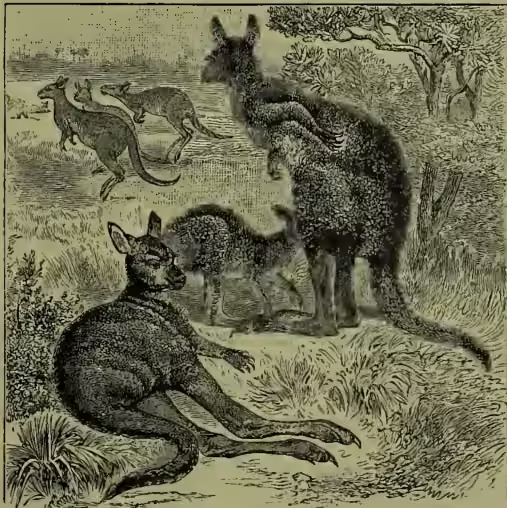
Kangaroo (Macropus), a genus of marsupial quadrupeds, of which there are many species, almost all Australian, although a few are found in New Guinea and neighbouring islands. The genus, as now restricted, contains, according to the most reliable estimate, twenty-three species. The kangaroos are of different sizes; some of the Wallabies, which really belong to the same genus, being comparatively small, while the Great Kangaroo (M. giganteus) attains a length of 8 feet, counting the long tail.
They are entirely herbivorous—mainly grass feeders—and the two lower incisors, which are elongated, play upon each other like the blades of scissors and crop the grass. The tail is very thick and strong, and the animal uses it as a third leg when moving slowly. The hind-legs are very strong, while the fore-limbs are short. They are very powerful animals, and the hind-limb forms a very effectual weapon for ripping open the bodies of dogs, with the aid of which they are sometimes hunted. They make enormous bounds, and get over the ground very swiftly and gracefully. Some kangaroos can jump a fence 11 feet high; most can jump one of 9 feet. In the districts where they are still numerous, they are formidable consumers of pasture; two kangaroos eat as much grass as three sheep. They are treated as vermin, being hunted, shot, poisoned, or killed by means of extensive battues—'yarding' or 'driving'—when parties of horsemen chase them into enclosures and kill them there, many hundreds at a time. The skin is valuable for leather, both for shoes and gloves. The flesh is good eating, the tail being a delicacy, and producing excellent soup. The great kangaroo was discovered in 1770 on the coast of New South Wales during Cook's first voyage. One of the most remarkable types of kangaroo is the Tree Kangaroo (Dendrolagus), in which the hind-limbs have become proportionately shorter in accordance with its arboreal life. The kangaroos and Wallabies breed freely in the Zoological Gardens at London, and the young, as in all Marsupials (q.v.), are born in a very imperfect condition. They remain within the pouch of the mother, or retreat there in case of danger, long after they have ceased to be nourished by the maternal milk.