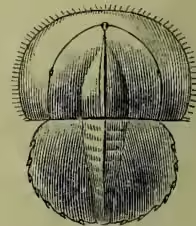
King-crab (Limulus), a curious animal, the last of its race, usually referred to a special group, Xiphosura, within the spider and scorpion class
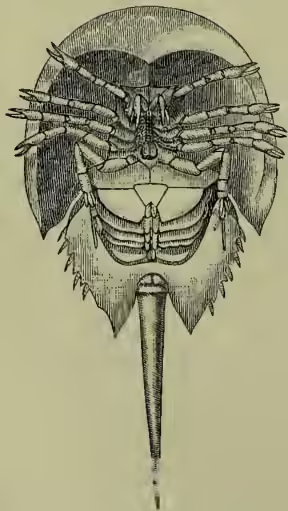
Arachnida. A large convex chitinous buckler covers the head and thorax, a flatter hexagonal shield protects the abdomen, while a long spear runs out from the hind end. There are twelve pairs of appendages on the ventral surface, a pair in front of the mouth, five pairs of legs, the bases of which surround the mouth and are masticatory, and a cover or operculum which overlaps five pairs of flattened abdominal appendages, used in swimming, and bearing peculiar respiratory organs known as gill-books. On the top of the large buckler there are two large compound eyes and near the middle line two simple eyes. The internal structures are no less peculiar. The sexes are separate, and the spineless larvæ present a curious resemblance to Trilobites.
The king-crabs attain a length of over two feet. They live on muddy bottoms at a depth of 2 to 6 fathoms, where they sometimes swim slowly about or more frequently burrow their way in the mud by alternately bending and straightening their shields and spine. The food consists for the most part of marine worms, which are sucked into the mouth and there crushed. Limulus is restricted to the warm coasts of the Indian Archipelago (L. moluccanus) and the east of North America (L. polyphemus). The genus first appears in Jurassic strata, but the allied Bellinuridæ, represented by Neolimulus in the Upper Silurian and by other genera of later date, seem to link the king-crabs to the ancient Trilobites. In some of the Indian islands the spine is used for pointing arrows, and in tropical America the shell sometimes serves as a ladle. See E. Ray Lankester, 'Limulus an Arachnid,' Quart. Jour. Micr. Sci., vol. xxi. 1881; also vols. xxiii. xxiv.