Kingfisher (Alcedo ispidia), a well-known British and European bird, in the order of pies or Picariæ, famous for its brilliant plumage and fish-bone nest. Though it measures only about 7 inches in length from the tip of the beak to the end of the tail, it is rendered conspicuous by the flashing feathers, which are predominantly blue and green. To watch the kingfisher is difficult, for it is shy and wary, and the powerful wings are used in singularly rapid fitful flight. The fish-catching bill is large and strong; the legs are short and weak, but the toes are strengthened by being joined for the greater part of their length. The bird frequents the banks of rivers and lakes throughout Europe; and in Britain is most at home in the south of England. The cry is faint but shrill, like ti-ti often repeated. The kingfisher feeds chiefly on small fishes, which are caught by a dexterous dive, carried to the perch, killed by a few blows on a branch, and swallowed whole. The bones are afterwards disgorged, and used in part to form the nest. This is hidden at the end of a hole bored in the bank, and is often anything but clean. The birds generally live in pairs away from their fellows, whose intrusion on the appropriated preserves is jealously resented.
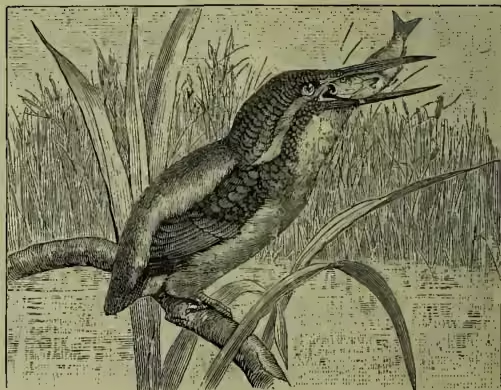
The seven or eight eggs, which are laid in April, are almost spherical in form and very white, as is often the case in hidden nests. Within the family Alcedinidæ, of which the common kingfisher is type, there are numerous genera with representatives in most parts of the world. The pied kingfisher of India and Africa (Ceryle rudis) and the belted kingfisher of North America (Ceryle halcyon) are common forms. A sub-family (Daceloninae) includes numerous more omnivorous kingfishers with stouter, flatter bills. Of these the great laughing jacksasses of Australia (Dacelo) are notable representatives.
The kingfisher is the old halcyon, 'whose dead body carefully hung by a single thread always turns its beak towards the wind,' a popular and still surviving notion to which Shakespeare makes more than one reference. With the halcyon the imagination of the ancients played lovingly, for to them the bird was Alcione the daughter of Æolus and wife of the king of Trachis, the son of the morning star, 'who, mourning in her youth for her lost husband, was winged by divine power, and now flies over the sea, seeking him whom she could not find, sought throughout the earth.' 'The bird is not great,' as Socrates continues in Lucian's dialogue 'The Halcyon,' 'but it has received great honour from the gods because of its lovingness; for while it is making its nest, all the world has the happy days which it calls halcyonidæ, excelling all others in their calmness.' So Aristotle, quoting Simonides, says that the halcyon has its young about the turn of the year in winter, 'when Zeus gives the wisdom of calm to fourteen days. Then the people of the land call it the hour of wind-hiding, the sacred nurse of the spotted halcyon.' See R. Bowdler Sharpe's Monograph of the Alcedinidæ or Kingfishers; Ruskin's Eagle's Nest; and HALCYON DAYS.