La Crosse, a Canadian field game played with a ball and a long stick (5 or 6 feet) of light hickory, bent at the top like a bishop's crozier (Fr. crosse). Strings of deer-skin are stretched diagonally across the hooked portion of the crosse in different directions, forming a network—not so tightly as in a battledore or tennis racquet, nor so loosely as to form a bag. Only one ball is employed, made of india-rubber, and 8 or 9 inches in circumference.
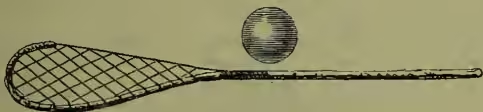
Posts or poles about 6 feet high, with a small flag at the top of each, complete the equipment. The players are usually twelve on each side, but their number, as well as the distance of the goals apart, is nearly optional. The object of the game is for one side to drive the ball through their opponents' goal. The ball must not be touched with the hand or foot, but is scooped up from the ground with the bent end of the crosse, on which it is carried horizontally, while the player runs towards one of the goals, trying to dodge his antagonists. If it seems prudent, he pitches the ball off his crosse towards one of his own side who may be in a better position to carry it towards the goal. The players must not strike, trip up, or grasp one another, nor must any one lay hold of the crosse of another; a player may strike the ball off an opponent's crosse with his own crosse, and not by any other means.
The National La Crosse Association of Canada was founded in 1867, and in the same year an Indian team visited Great Britain. Afterwards other Canadian teams played in England and Scotland, and several local clubs were formed; in a few places the game is very popular.