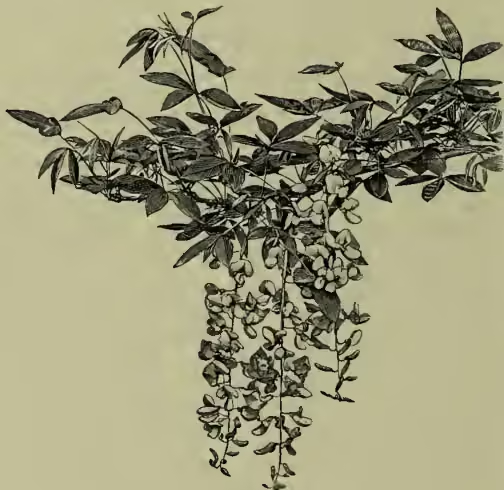
Laburnum (Cytisus Laburnum), a small tree, a native of the Alps and other mountains of the south of Europe, much planted in shrubberies and pleasure-grounds in Britain, on account of its glossy foliage and its large pendulous racemes of yellow flowers, which are produced in great abundance in May and June. It is often mixed with lilac, and when the latter preponderates the combination has a fine effect. In favourable circumstances laburnum sometimes attains a height of twenty or even forty feet. It is very hardy, and nowhere flourishes better than in the north of Scotland. It is of rapid growth, yet its wood is hard, fine grained, and very heavy, of a dark-brown or dark-green colour, and much valued for cabinet-work, inlaying, and turnery, and for making knife-handles, musical instruments, &c. The leaves, bark, and particularly the seeds, are nauseous and poisonous, containing Cytisine, an emetic, purgative, and narcotic principle. Accidents to children from eating laburnum seeds are not unfrequent; but to hares and rabbits laburnum is wholesome food. A fine variety of laburnum, called Scotch Laburnum, by some botanists regarded as a distinct species (C. alpinus), is distinguished by broader leaves and darker yellow flowers, which are produced later in the season than those of the common or English laburnum. The form known as Adam's Laburnum (C. L. adamii), now occasionally seen in British gardens, originated in the Jardin des Plantes at Paris, about 1840, and is peculiar in producing the ordinary flowers of the common laburnum and those of another species (C. purpureus) in an irregular and indiscriminate way over its branches. The peculiarity is considered to be the result of grafting or budding the one species on the other.