Labyrinth, the name of some celebrated buildings of antiquity, consisting of a series of intricate chambers or passages. Of these the most celebrated were the Egyptian, the Cretan, and the Samian. The Egyptian was visited by Herodotus and Strabo, and was reckoned one of the wonders of the world, containing 3000 chambers. It was built on the shore of Lake Mœris, and its foundations were discovered by Lepsius (see FAYYÛM). The Cretan labyrinth was supposed to have been built by Dædalus for King Minos, to contain the Minotaur. The only mode of finding the way out of it was by means of a hank or skein of linen thread, which gave the clue to the dwelling of the Minotaur. The Samian labyrinth was constructed in the age of Polyerates (540 B.C.). Other inferior labyrinths existed at Nauplia, at Sipontum in Italy, at Val d'Ispica in Sicily, and elsewhere; and the name of labyrinth was applied to the subterranean chambers of the tomb of Porsena, supposed to be that now existing as the Poggio Gazella, near Chiusi. Labyrinths called mazes were at one time fashionable in gardening, being imitations, by hedges or borders, of the Cretan; the best known in modern times is the Maze at Hampton Court.
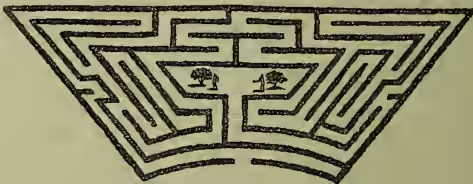
An ancient story told in Fabyan's Chronicle, also in Higden and other early historians, and blindly followed by their successors, makes a maze at Woodstock the scene of Queen Eleanor's apocryphal vengeance upon Fair Rosamond.