Lace is an ornamental fabric of linen, cotton, silk, or gold and silver threads, made by looping, knotting, plaiting, or twisting the thread into definite patterns, of contrasted open and close structure. Three distinct varieties of lace are made, two by handwork, known respectively as needle or point lace and pillow-lace, and one by machinery. To hand-made lace the term real lace is sometimes applied, and, although it may be made in all or any of the varieties of thread above enumerated, in general it is composed of white linen thread of exceedingly great delicacy and tenuity. Machine-made lace on the other hand usually consists of cotton thread of high counts, but it cannot be used of such fineness as linen; while with machines it is quite impossible to rival the combined grace, delicacy, and strength of ornamental structure obtainable by the skill and patience of the hand-worker. Nevertheless machine-made lace is a marvellous triumph of mechanical ingenuity, and more inventive genius has been devoted to its production than has been bestowed on any other branch of textile industry.
Lace on one side, as needle or point lace, is closely allied to embroidery; pillow-lace is derived from and merely an elaboration of plaited fringe-work; and machine-lace is a development of fancy weaving. Although we have these three distinct methods of lace-making, combinations of the whole may be found in one piece of modern lace, and frequently the products are so similar that it requires both experience and close observation to distinguish what is made by the needle from the plaited product of the pillow, or even the twisted lace of the machine. Technically, lace consists of two elements, the pattern, flower, or gimpe which forms the closer-worked and more solid portion of the fabric, and the ground or filling which serves to hold the pattern together and in its proper place. In some varieties of lace, however, the ground is almost entirely wanting, and the pattern holds together by joining at the edges where two portions of the design meet and touch. In other cases the ground consists of ties or brides, thin loops or plaits passing from the edge of one portion of the pattern to another contiguous, and thus tying them together. More frequently the ground consists of a delicate filmy honeycomb called a réseau, of which the simplest form is the bobbin-net, now made by machinery. On the réseau the pattern is sometimes stitched down after being separately made, such lace being known as appliqué or applied; in other cases pattern and réseau are formed together by needle or bobbin or by both. Other technical terms are met with in the description of lace—as cordonnet, a stout thread or several threads together employed to outline the pattern; picot, a minute loop worked on the edge of ties or flowers for their enrichment; and modes, which are ornamental fillings, variations of the réseau, which is always a plain honeycomb mesh.
Point-lace is a fabric which appears to have been arrived at through the efforts to produce light, graceful, and airy effects in embroidery. It is not known to have been made earlier than the first half of the 16th century; and its original production, as well as its most varied triumphs, are associated with Venice. The stages by which it developed from embroidery-work can be traced from the illus-
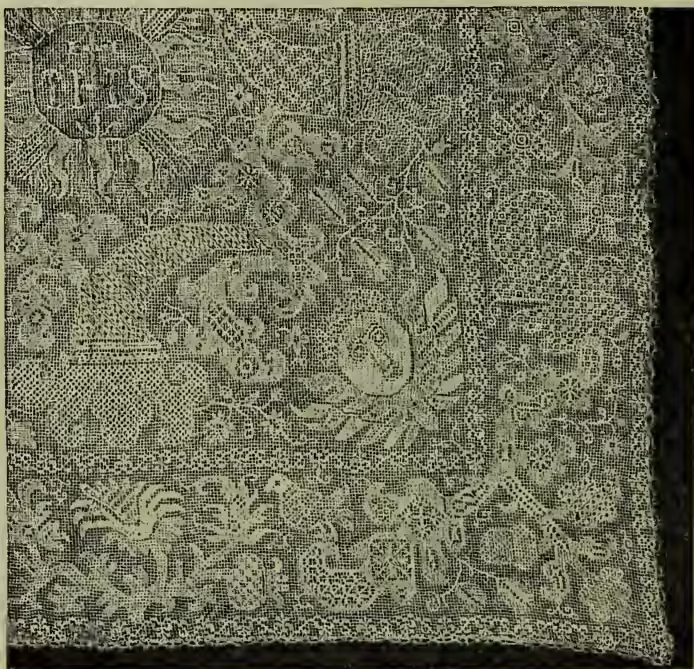
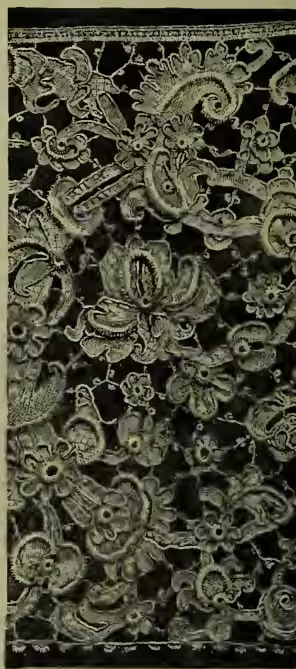
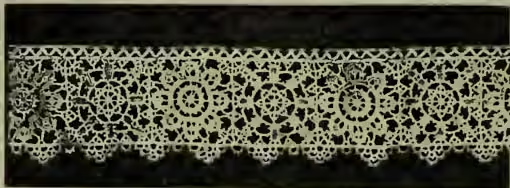
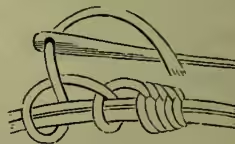
trated pattern-books for embroiderers which were issued early in the 16th century. In these books we find two styles of work intermediate between embroidery and lace-making, one of which consists of patterns cut out of stuff, and having the cut edges sewn over with a button-hole stitch, such work being known to the Venetians as punto tagliato. The second method of producing a lace-like effect was by cutting the individual threads in any texture in accordance with a definite pattern, and drawing out the cut portions, the resulting design, partly open work and partly close, being known as punto tirato. The converse of this consisted in darning in patterns on a gauze or other open woven texture, a class of work termed by the Italians punto a maglia (see fig. 1), and by the French lacis or lassis—whence our ‘lace,’ which has taken the place of the earlier name passement or pascent. The earliest true needle-lace of Venice, known as punto in aria or reticella, was in its design similar to the cut work of the pattern-books, showing only rectilinear and geometrical forms, as in fig. 2. A gradual development can be traced from such simple forms into rich floral ornaments and scrolls, till early in the 18th century, in the very delicate needle-point with meshed ground known as point de Venise à réseau, we come to the richest and most elaborate products of the north Italian needlewomen. The most characteristic and valuable of the laces of Venice is that known in Britain as rose-point (French gros-point) (fig. 3), which consists of patterns worked in relief like sculptured work, forming strong and solid flowers and scrolls, held in position by ties or brides enriched with picots. With such lace the robes of great ecclesiastics and wealthy nobles were adorned, and it was also employed for the ornamentation of altar covers and other church textures. In the making of point-lace the design is first drawn on a piece of parchment, which is then stitched down to a backing of stout linen. Over the lines of the design one or more threads of linen are stitched lightly down, and the slow work of filling up the pattern with button-hole stitches proceeds on the thread outline so obtained. The methods of working are numerous, and some of the stitches indeed have been lost, but commonly the pattern or cloth is obtained by laying down a series of threads parallel to each other, as in fig. 4, and overstitching them as shown. For the brides or réseau a single thread may form the foundation, it also being closely stitched over, as seen in fig. 5. When pattern and fillings are finished, it remains only to cut the
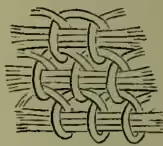
stitches which hold the outlining threads to the parchment and the linen backing, thus liberating the lace. From Venice the art of making point-lace travelled out to other Italian towns, and westward to France and Flanders. Principally owing to the efforts of the minister Colbert, who in 1665 chartered a company with exclusive privileges for ten years and a subsidy of 36,000 livres, the art was firmly established in France, ateliers being established in several of the principal towns. Among these places was Alençon, where Venice lace of very fine quality was being made by a lady named Laperrière prior to the establishment of Colbert's company. Alençon lace and the closely-allied fabric made at the neighbouring town of Argentan attained great perfection during the 18th century. The designs employed were distinctively French in character, and the réseau and modes which formed the filling showed a minute and filmy delicacy unapproached by the products of any other district (fig. 6). Point-lace also formed one portion of the manufacture carried on at Brussels. The ground of the old Brussels lace is sometimes, though rarely, of needle-point, but the flower, which is made separately and sewed on, or applied to the ground, is, in fine specimens, frequently needle-made.
Pillow-lace.—It is an undecided question whether pillow-lace originated in Italy or in Flanders. simplest ground in the pillow-lace consists of the twisted net or bobbin-net, originally made on the pillow, but now entirely made by machinery (see fig. 7). More commonly the net is partly twisted and partly plaited; and the variations in the mesh so formed are characteristic of the different classes of pillow-lace.
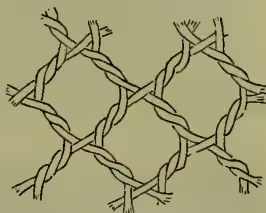
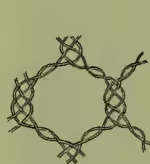
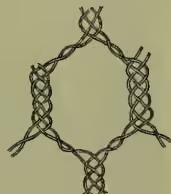
Thus, the mesh of Mechlin lace consists of four twisted and two plaited sides, as seen in fig. 8. The mesh of Brussels pillow-lace is similar to that of Mechlin, but the plaited sides are longer (fig. 9), while the Valenciennes mesh is plaited throughout. These differences in the form of the ground of pillow-laces give a different appearance to the reticulations.
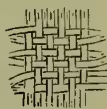
The flower or pattern of the lace is worked so as to give it the appearance of plain woven cloth (see fig. 10). The Valenciennes mesh renders that variety more solid and durable than any of the others. Much of the modern Brussels lace has now a machine-made ground instead of the ancient pillow-meshes, on which the separately-made flowers are applied or sewed by the imperceptible fine joining-stitch. The making of pillow-lace in Honiton and other localities in the south-west of England was begun towards the end of the 16th century by refugees from the Low Countries. In 1662 parliament, desirous of encouraging native lace-making,
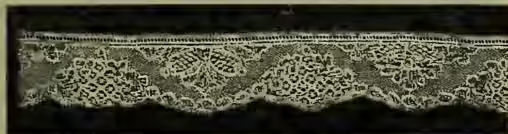
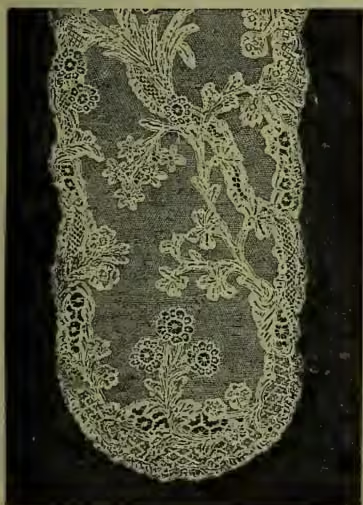
Border of Mechlin Pillow-lace, early 18th century.
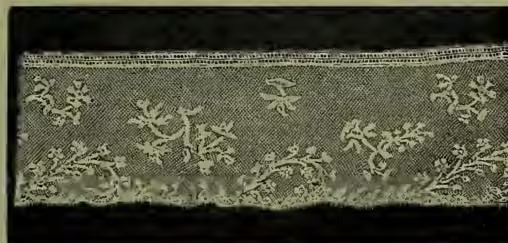
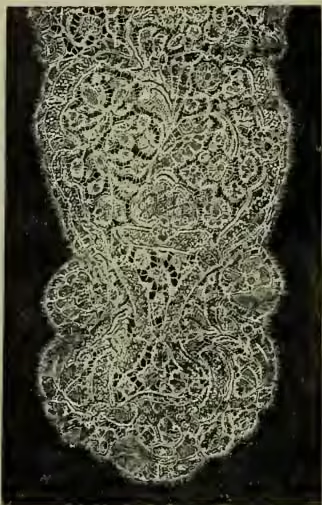
prohibited the importation of all laces of foreign manufacture. Lace-workers were thereupon encouraged to settle in England; but as the fine thread necessary for their work was not forthcoming they were forced to return to their native land. A vigorous smuggling trade between Brussels and England ensued, and the lace so introduced was freely sold as English point, whence Brussels lace came to be generally known as Point d'Angleterre. Honiton lace from the 17th century downwards has continued to be made in the same style as the Flemish laces, but at no time has it attained the celebrity acquired by the products of the great centres of the pillow-lace making in Belgium and the north of France. Fig. 13 is a fine example of Honiton lace-work.
Venice. Similarly, efforts have been made to revive the industry in Honiton, and at the present time much is being done to encourage the development of the art in various directions in conventional and other establishments in Ireland. The stimulus in all these cases is, however, obviously artificial, and it cannot be said that there is at present any really healthy indication of revived demand for these supreme products of patience and ingenuity.
Machine-lace.—The ground and simplest element of pillow-lace being a network of meshes, the earliest efforts of inventors were directed towards the producing of machinery for fabricating similar netting. The hosiery-frame, which had been invented by William Lee towards the end of the 16th century, was the first apparatus with which it was attempted to make a lace-net, and about 1764 a modification of the frame was devised by which an open loop-net was produced. By the various devices familiar to hand-knitters fancy patterns could be produced on this machine. The loop fabric, however, had the great disadvantage of unravelling freely at any point where it was broken, as it was constructed of a continuous single thread. At a subsequent period what was known as the warp-lace machine was introduced, in the use of which a separate thread is supplied to each hooked needle employed in the production of the web. On these warp-threads loops are formed by mechanical means, and as they can be moved by the machine either to the right or to the left, neighbouring warps and loops are joined together, and in this way a solid web, which can be cut without unravelling, is obtained. Towards the end of the 18th century a great variety of figured lace began to be made on the warp-machine, and in a greatly improved form it still continues in use.
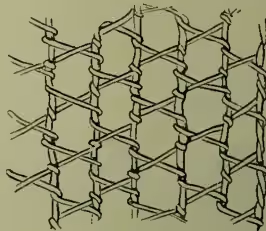
A new era, however, in machine lace-making was inaugurated when, in 1809, John Heathcoat patented his second bobbin-net machine, by which it was made possible to twist or wrap round each other an indefinite number of threads, and to cause any one thread to traverse, mesh by mesh, every other thread in the width of the fabric being netted. The bobbin-net machine of Heathcoat became the foundation of an enormous industry, and the inventor reaped both honour and ample pecuniary reward for his remarkable ingenuity. His frame has been modified by many inventors, but the most important improvements were effected by John Levers in 1813. The lace-making machine now principally used is known as the Levers machine, but of its complicated structure it would be quite impossible to convey any clear conception within moderate limits. The structure of the simplest fabric produced by it is shown as it appears on the frame in fig. 14; and when dressed and finished this fabric has the appearance indicated in fig. 7, which is common bobbin-net. It will be seen that the texture is formed of a series of vertical parallel threads which may be taken to represent the warp of a common web, these being diagonally crossed and intertwined with others which may be looked on as weft-threads. The frame or loom holds the warp-threads vertically, a space being left between each sufficiently wide to admit of a shilling being passed edgewise between them. Behind these threads, and corresponding to the interspaces, is a row of ingeniously constructed flat bobbins or reels resting in an arrangement called a comb-bar or bolt-bar. These are so placed that with the first movement of the machine each bobbin, which carries its thread with it, passes through two of the parallel and perpendicular threads of the warp, and is lodged in another and similar bolt-bar in front of the warp. But this front bolt-bar, besides an advancing and receding motion, has another movement, called shogging—from right to left. When it receives a bobbin by its forward motion it draws back, bringing the bobbin and thread through two of the upright threads; then it shogs or moves to one side, and goes forward again, taking the thread through the next two warp-threads, and lodging the bobbin on the back bolt-bar again, one distance beyond its last space; this it recovers by the next movement, and it again passes through the first space, to be again received by the front bolt-bar. By these movements the bobbin-thread is twisted quite round one upright thread of the warp; another movement then shifts the bobbin, so that it will pass through the next pair of upright threads, and so carry on its work, the warp-threads moving at the same time, unwinding from the lower beam, and being rolled on the upper one. There being twice as many bobbins as there are threads in the warp, each bolt-bar having a set which it exchanges with the other, and all being regulated with great nicety, a width of lace is made in far less time than has been required to write this short description. The additions to and variations upon these operations (which only apply to bobbin-net), for the production of patterns, are numerous and complicated—each pattern requiring new combinations; but they all depend upon the variations which can be given to the movements of the flat disc-like bobbins.
Gold Lace and Silver Lace.—The so-called gold thread which is used in textiles consists of silver-gilt wire, or for commoner purposes copper-gilt wire, either round or flattened into a fine ribbon.
These wires may be so used for weaving and embroidery purposes, but generally what is called gold thread consists of a yellow thread of cotton or linen round which the flattened gold wire is spirally wound so as to completely encase it. Silver wire is similarly prepared and used, being wound on a white instead of a yellow basis. Gold and silver threads may be used in ordinary lace-making, but what is generally termed gold and silver lace consists of braids, ribbons, and bands of these materials employed for embroidery and braiding, and for the ornamentation of uniforms and official robes, badges, &c. The use of gold and silver wire in textiles is of great antiquity, and sumptuous garments enriched with precious metals must have been used in Egypt for royal and priestly personages in the time of Moses; for we find (Exod. xxxix. 2, 3) directions for making gold-embroidered robes for Aaron in the wilderness. The making of gold and silver lace is associated with the ribbon industry, and it is usually prosecuted in districts where that trade is located. Lefèvre, Embroidery and Lace, their Manufacture and History (Eng. trans. 1888).
See Felkin, Machine-wrought Hosiery and Lace Manufacture (1867); Palliser, History of Lace (1875); The Art of Lace Making (1881); Seguin, La Dentelle (1874); Despières, Histoire du Point d'Alençon (1888); Doumert, La Dentelle (1889); Lefèvre, Embroidery and Lace (Eng. trans. 1888); and the catalogue of Mr Chick's Collection of Antique Lace, to which this article is indebted for illustrations.