Lamprey (Petromyzon), a genus of round-mouths (Cyclostomata, q.v.), nearly allied to the Hag (q.v.), and like it differing markedly from true fishes in the absence of jaws, paired fins, and scales, and in the presence of peculiar gill-pouches. An eel-like form, a slimy skin, a gristly skeleton, a primitive brain imperfectly roofed in, a single median nostril, a suctorial mouth with numerous horny teeth on the lips and on the large piston-like tongue, seven pairs of gill-pouches (whence the German name neun-auge, 'nine-eyes') opening by as many apertures to the exterior, and connected internally with a tube lying beneath and communicating with the adult gullet, and the striking differences between young and mature forms are among the less technical characteristics. They differ from hag in the development of a dorsal fin, in the fact that the nasal passage ends blindly without opening into the pharynx, and in several peculiarities of the respiratory and other systems. Along with Petromyzon, there are several genera—e.g. Mordacia and Geotria from the coasts of Chili and Australia—differing only in detail. Lampreys occur both in the rivers and seas of the north and south temperate regions, and at least some of the marine forms spawn and pass part of their long larval life far up rivers. They seem to represent an ancient race, more primitive than fishes, and, though their gristly skeletons are unknown as fossils, certain structures called 'conodonts' from very early strata are identified by some as lamprey teeth.
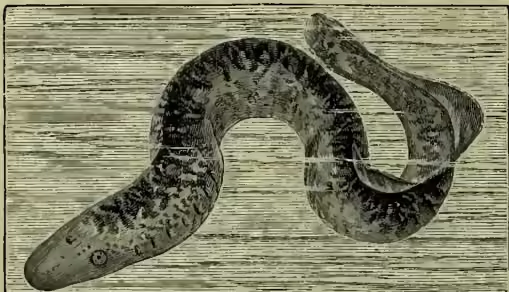
The habits of lampreys are in many ways curious. Thus, though they will eat worms, larvae, small crustaceans, and dead animals, they have also learned the audaciously aggressive habit of fixing themselves to fishes, and scraping holes in the skin. The mouth sticks like a vacuum sucker, the toothed tongue works like a piston, and both flesh and blood are thus obtained by a sort of parasitism which reminds one at once of leech and hagfish. 'When engaged in sucking they are carried about by their victims, and salmon have been captured in the middle course of the Rhine with the marine lamprey attached to them' (Günther). As the name Petromyzon suggests, they also attach themselves, as if to rest, to stones in the bed of the stream, or it may be even to the bottom of boats. Some species are able to move stoues of considerable size to form nests, and their grip is so firm that it is occasionally difficult to detach them from their hold. When the mouth is occupied in its suctorial work, water passes in as well as out by the respiratory apertures. The spawning occurs in spring, usually far up rivers, and according to some the mature forms die after reproduction. From the small eggs young develop which live wallowing in the sand or mud of the streams, and feed on minute animals. They are so different from the parents that in the case of the small lampern (P. branchialis) they were for long referred to a distinct genus Ammocetes. The head is small, the upper lip semi-circular, the lower lip small and separate, the mouth toothless and not suctorial, the eyes rudimentary and hidden, the future gullet (as distinguished from the above-mentioned respiratory tube) not yet developed, and so on. There is in fact a metamorphosis in the history of the lamprey, as was discovered 200 years ago by a Strasburg fisherman Baldner, but overlooked till August Müller worked out the curious story in 1856. In the small river lamprey—and analogous facts are probably true for the others—the change to the adult form is frequently postponed until the August of the fourth or fifth year, when it completes itself rapidly.
There are three British species—the sea-lamprey (P. marinus), over 3 feet in length, mottled greenish brown; the river-lamprey (P. fluviatilis), nearly 2 feet, dark bluish with silvery sides; the sandpiper, pride, stone-grig, or small lamprey (P. branchialis or planeri), hardly one foot in length, like the preceding species in colour. The marine and river lampreys, though despised in Scotland, have been esteemed as good eating since Roman times, being especially palatable in pies and potted preserves. They are caught in baited baskets or traps, and their eel-like tenacity of life makes them useful bait stores.